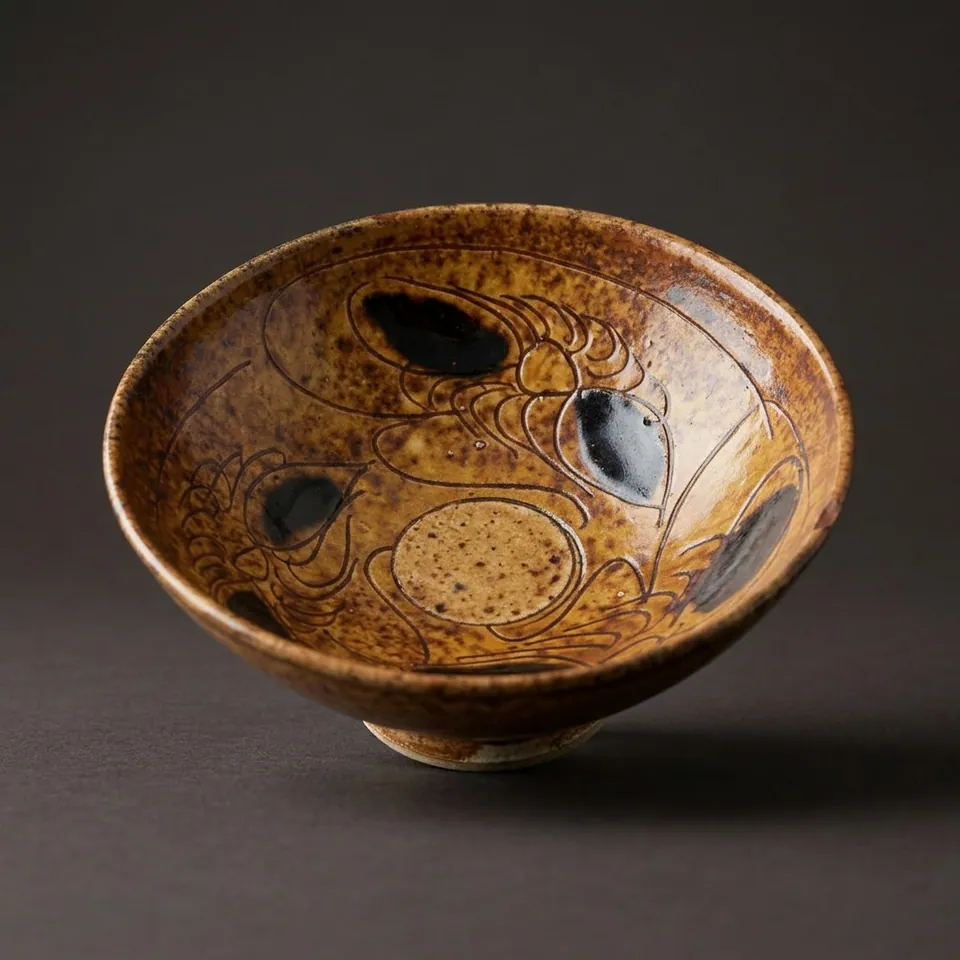
Nº 0473 · Bol
Tenmoku bowl
Un bol en grès à émail tenmoku, réalisé vers 1923 à la Leach Pottery.
Pourquoi c’est important
Shoji Hamada a fait ce bol à la Leach Pottery de St Ives vers 1923. La glaçure est un tenmoku aux éclaboussures noires.
Le CIRC.992-1924 du V&A est un bol en grès de Shoji Hamada, daté d'environ 1923, réalisé à la Leach Pottery de St Ives, en Cornouailles. Son émail est un tenmoku aux éclaboussures noires. Le musée décrit Hamada (1894-1978) comme l'un des grands potiers du mouvement japonais Mingei.
2 min de lecture
Toute l’histoire
Un potier japonais en Cornouailles
Shōji Hamada naquit à Kawasaki en 1894 et étudia la céramique à l’École industrielle de Tokyo, aujourd’hui l’Institut de technologie de Tokyo. À Kyoto, il expérimenta des glaçures aux côtés de son ami Kawai Kanjirō. Il rencontra le potier anglais Bernard Leach, qui était revenu à Tokyo en 1909 et y avait appris la poterie, en 1916 selon un récit. Après une exposition de l’œuvre de Leach, il partit avec lui pour l’Angleterre en 1920 et passa environ trois ans à St Ives, en Cornouailles.
Dans cette histoire
- Un potier japonais en Cornouailles
- Un bol à la marque imprimée
- Le retour à Mashiko

L’histoire continue dans l’app
- Auteur
- Shoji Hamada, 1894-1978
- Date
- Vers 1923
- Émail
- Tenmoku aux éclaboussures noires, sur grès
- Lieu
- Leach Pottery, St Ives
Liens
Pour aller plus loin
- Bowl, CIRC.992-1924, Victoria and Albert MuseumLa fiche du V&A.
Sources
- Bowl, CIRC.992-1924, Victoria and Albert Museum
- Tea bowl, C.33-1966, Victoria and Albert Museum
- Bowl, C.407-1934, Victoria and Albert Museum
- Bowl, Shoji Hamada, CIRC.992-1924, Victoria and Albert Museum
- Bottle, Shoji Hamada, Circ.348-1939, Victoria and Albert Museum
- Mingei: Bernard Leach and Shoji Hamada, The Spaces
- Shōji Hamada, Wikipedia

