Nº 0136 · Propaganda poster
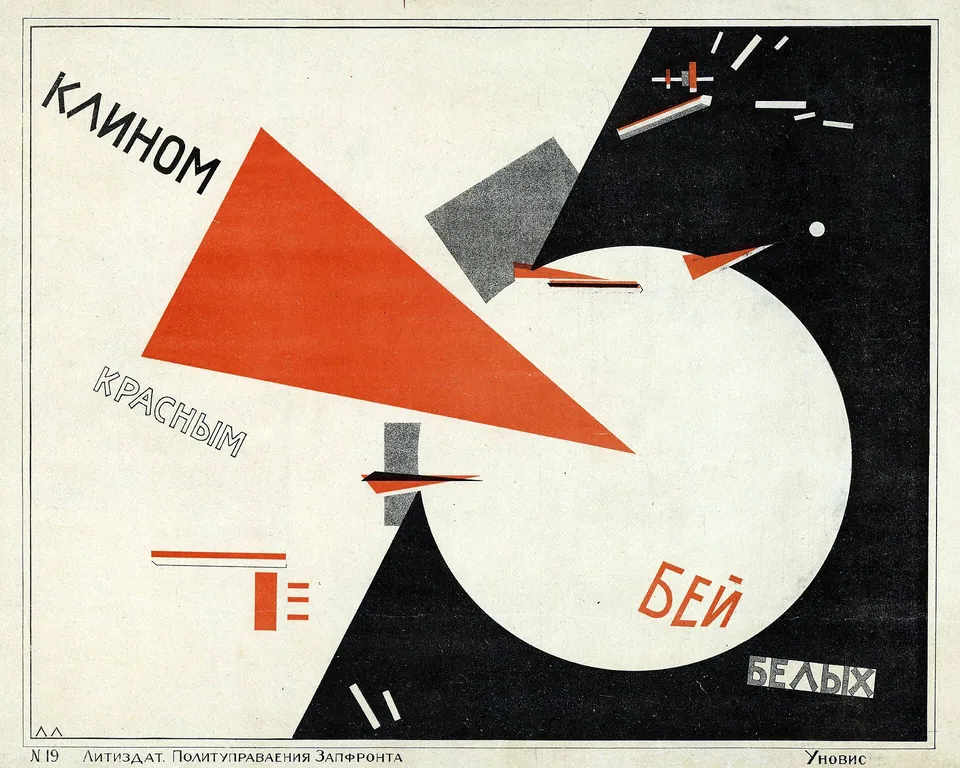
Beat the Whites with the Red Wedge
A red triangle splits a white circle.
Why it matters
Lissitzky made a Civil War propaganda poster out of flat geometric shapes and a few words, with no figures at all. Tate describes it as his first propaganda work and its forms as typical of Suprematism, the geometric art Malevich was teaching alongside him in Vitebsk.
The red wedge stands for the Bolsheviks and the white circle for the White forces they fought in the Russian Civil War. Lissitzky designed it in Vitebsk, where he taught from 1919, and it is often dated 1919; Tate, the Library of Congress and the MFA Boston date the printed poster 1920. The foot of the sheet names Litizdat of the Political Directorate of the Western Front and UNOVIS, the art group of the Vitebsk school. The copy in this image is in the Russian State Library, Moscow.
What to notice
- The point of the wedgeThe red wedge drives its point into the white circle.
- The first wordKlinom, by the wedge, set on a slant like the shapes around it.
- The imprintThe foot of the sheet: number 19, Litizdat of the Western Front, and at right UNOVIS.
3 min read
The full story
A school at the front
In 1918 Marc Chagall founded the People’s Art School in his home town of Vitebsk. He brought in Lazar Lissitzky, who had been illustrating Yiddish children’s books, to direct the workshops for printing, graphic design and architecture. Late in 1919 Lissitzky went to Moscow and came back with a new teacher, Kazimir Malevich, the founder of Suprematism.
In this story
- A school at the front
- Two inks, four words
- Number 19, Litizdat
- A wedge without its war

The story continues in the app
- Materials
- Lithograph, red and black on off-white paper
- Dimensions
- About 49 × 69 cm
- Publisher
- Litizdat, Political Directorate of the Western Front
- In collection
- Tate · MFA Boston · Russian State Library · Library of Congress
- Status
- Real · several printed copies survive
Connections
- El Lissitzky
- Litizdat, Political Directorate of the Western Front
- Suprematism
- Era of the World Wars
- Graphic design
- Paper
- Vitebsk
Nearby in the archive
In collections
Go further
- El Lissitzky: Life, Letters, Texts, Sophie Lissitzky-Küppers (1968)His widow’s account of his life, published with his letters, his own writings and a large body of plates.
- Situating El Lissitzky: Vitebsk, Berlin, Moscow, Nancy Perloff and Brian Reed (eds), Getty Research Institute (2003)Scholarly essays that follow his work through the three cities, starting with the Vitebsk years of the poster.
- Beat the Whites with the Red Wedge, Aleš Erjavec, Filozofski vestnik (2014)An open-access essay that traces the poster’s sources and its reuse by later artists from Moscow to Beijing.
- Klinom krasnym bei belykh (Beat the Whites with the Red Wedge), 2000.1069, Museum of Fine Arts, BostonThe museum record for its impression, with medium, sheet size and the provenance through Solomon Telingater.
- Chagall, Lissitzky, Malevich: The Russian Avant-Garde in Vitebsk, 1918-1922, The Jewish Museum, New York (2018)The page for the 2018 exhibition on the Vitebsk school where the poster was designed.
Sources
- Beat the Whites with the Red Wedge, 1920, The David King Collection at Tate, Tate
- Klinom krasnym bei belykh (Beat the Whites with the Red Wedge), 2000.1069, Museum of Fine Arts, Boston
- Klinom krasnym bei belykh, Library of Congress
- Klinom krasnym bei belykh, digitised copy, Russian State Library
- Wikipedia (English), Wikimedia Foundation

