Nº 0491 · Jōmon vessel
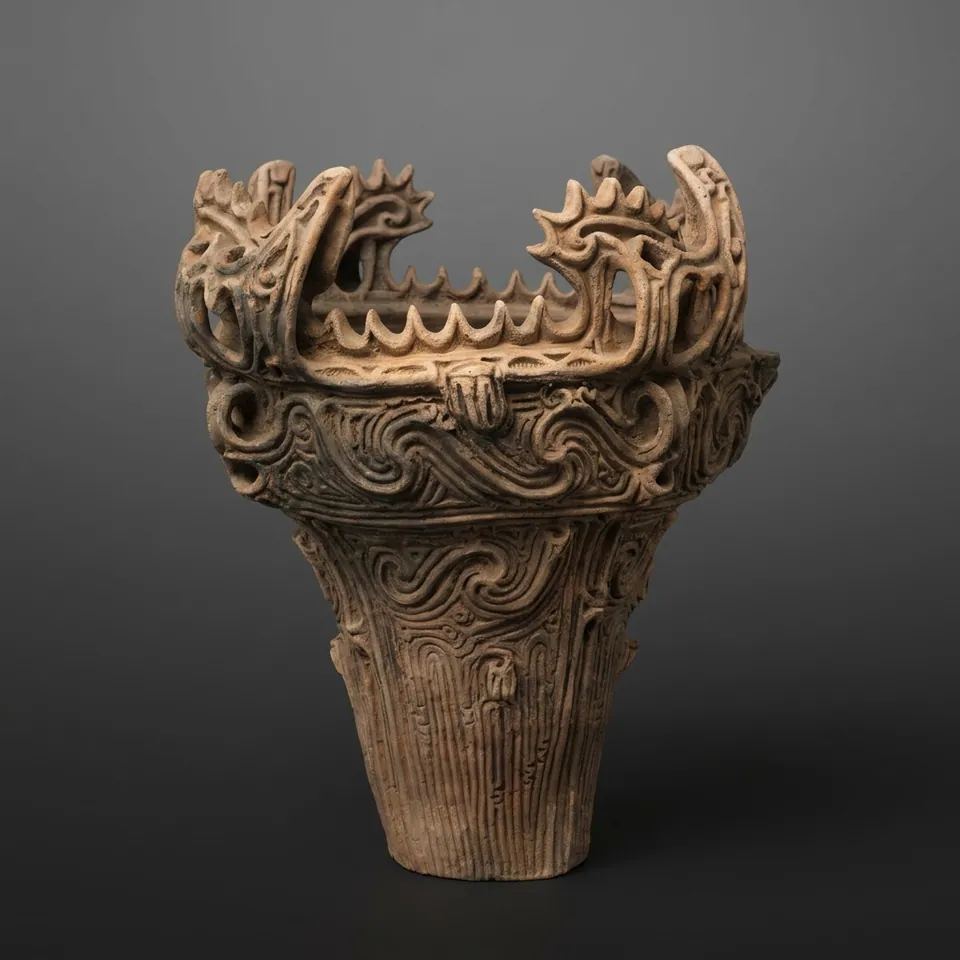
Fire-flame cooking vessel (Kaen doki)
A Jōmon earthenware vessel whose rim looks like flames, about 2500 BCE.
Why it matters
Archaeologists call this type fire flame because its rim resembles flames, and its purpose is unknown, the Cleveland Museum of Art says. Much of the vessel is original, but a base from another pot was used in its reconstruction.
The Cleveland Museum of Art’s 1984.68 is a Jōmon earthenware vessel with carved and applied decoration, dated about 2500 BCE (a range of 2750 to 2250 BCE), 61 cm high and 55.8 cm across. The museum bought it in 1984 from Gallery Kapitan of Tokyo with the John L. Severance Fund.
2 min read
The full story
Pots from the Shinano valley
Flame-style pottery comes from the Jōmon period of Japan, from the Middle Jōmon, some five thousand years ago, in the valley of the Shinano River in Niigata Prefecture. Pots of this kind have been found along the river from Niigata City to Tsunan Town. The first was found at the Umataka site in Nagaoka by an amateur archaeologist, about ninety years ago. Archaeologists call the style kaen, or fire-flame, because the crown of the vessel suggests flames. Such pots were made for roughly five hundred years.
In this story
- Pots from the Shinano valley
- Clay, coils and cockscombs
- The Cleveland vessel

The story continues in the app
- Date
- About 2500 BCE (2750–2250 BCE)
- Material
- Earthenware with carved and applied decoration
- Size
- 61 cm high, 55.8 cm across
- Cleveland
- 1984.68, John L. Severance Fund
Connections
- Prehistory
- Ceramics
- Ceramic
- Japan
In collections
Go further
- Fire-flame Cooking Vessel (Ka’en Doki), 1984.68, Cleveland Museum of ArtThe museum record.
Sources
- Fire-flame Cooking Vessel (Ka’en Doki), 1984.68, Cleveland Museum of Art
- Fire-flame Cooking Vessel (Ka’en Doki), 1984.68, Cleveland Museum of Art (Open Access API)
- Niigata’s Ancient Flame-shaped Pots, Japan Travel
- Flame-style pottery of the Jōmon period (Sasayama site, Tokamachi), Into Japan Waraku