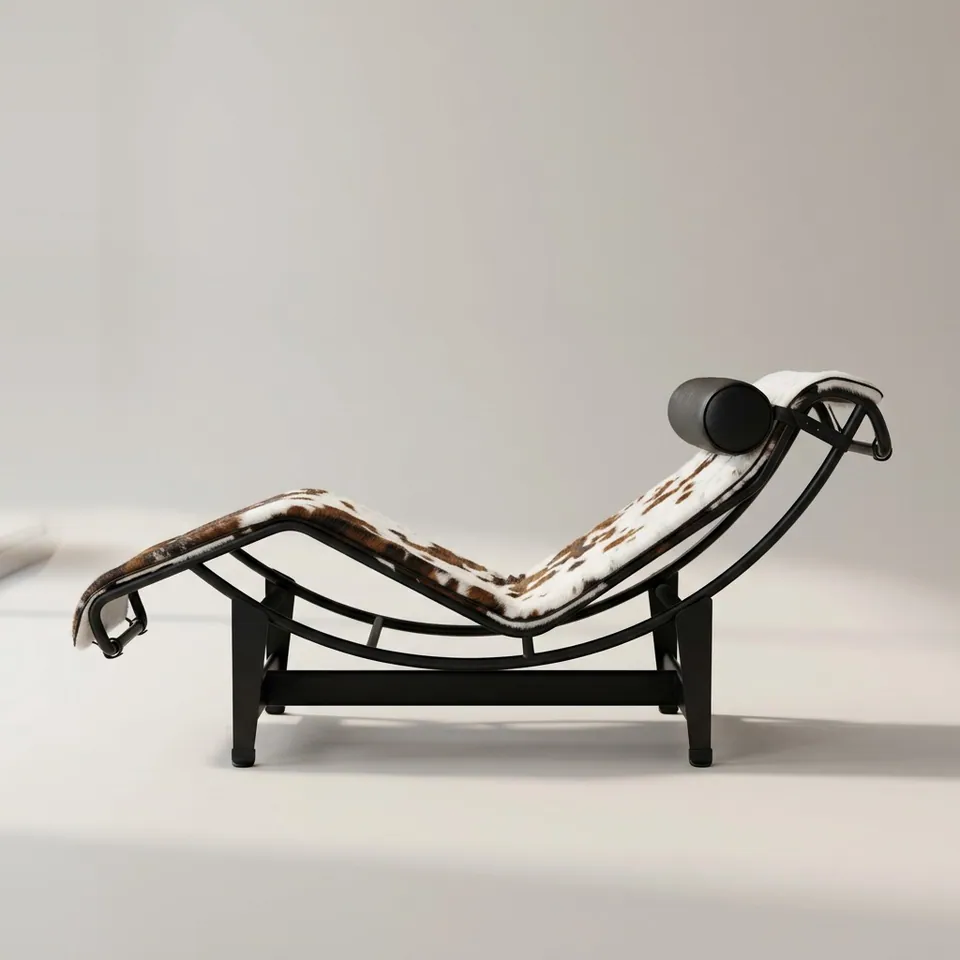
Nº 0090 · Chaise longue
LC4 Chaise Longue
A steel cradle that slides to any angle.
Why it matters
It is a machine for rest, in the Fondation Le Corbusier's words: a curved cradle, loose on a separate base, slides to any angle between sitting and lying. It belongs to the tubular steel furniture that Le Corbusier, Pierre Jeanneret and Charlotte Perriand showed in Paris in 1929, and sources still differ on which of the three led its design.
It was designed in 1928 in Le Corbusier’s studio in Paris, first shown at the Salon d’Automne in 1929, and made by Thonet as model B 306 from 1930. The V&A notes that it needs three kinds of metal and many welded joints, which kept it from being made in large numbers; the Fondation Le Corbusier records 172 sold between 1930 and 1935. Heidi Weber reissued it from 1959, and Cassina has held the rights since 1965. The example in this photograph, with a black frame and a hide cover, is in the Musée des Années 30, Boulogne-Billancourt.
What to notice
- The cradleThe curved frame rests on the crossbars of the base and is not fixed to it, so it can slide.
- The baseA separate black steel base on four splayed legs.
- The head rollA separate leather head roll sits at the raised end.
3 min read
The full story
Hired after the cushions remark
In 1927 Charlotte Perriand, a furniture designer of 24, applied to work in Le Corbusier’s studio in Paris and was told, in the reply that is always quoted, “We don’t embroider cushions here.” A month later he saw her Bar sous le Toit at the Salon d’Automne, an attic bar in aluminium and nickel-plated metal, and took her on. Furniture became her job in the office he ran with his cousin Pierre Jeanneret.
In this story
- Hired after the cushions remark
- A cradle with no mechanism
- Ninety square metres in 1929
- Whose chair it is

The story continues in the app
- Materials
- Tubular steel, painted steel base, hide or canvas, rubber
- Dimensions
- About 160 cm long, 57 cm wide, 67 cm high
- Maker
- Thonet (B 306) from 1930; Cassina since 1965
- In collection
- V&A · The Met · MoMA
- Status
- Real · still in production
Connections
- Le Corbusier
- Pierre Jeanneret
- Charlotte Perriand
- Gebrüder Thonet
- Cassina
- Modernism
- Era of the World Wars
- Furniture design
- Steel
- Leather
- Paris
Nearby in the archive
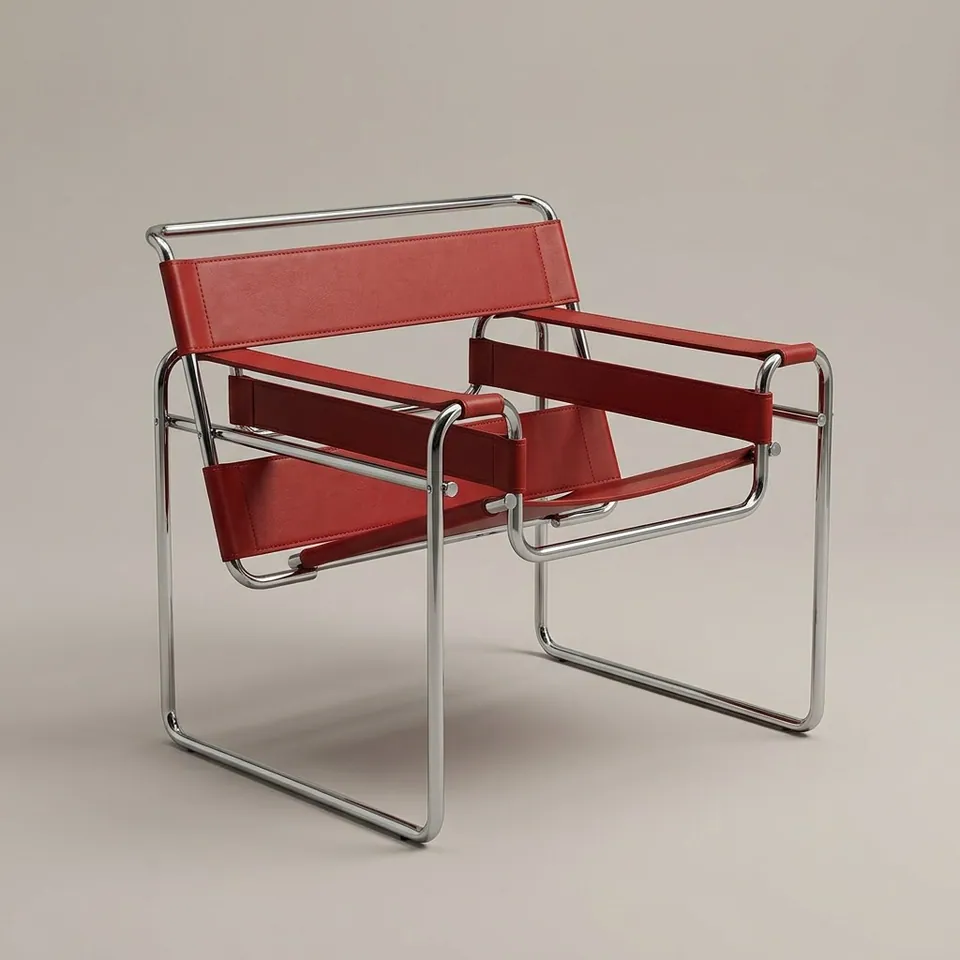 Wassily ChairBreuer · 1925 · tubular steel, three years earlier
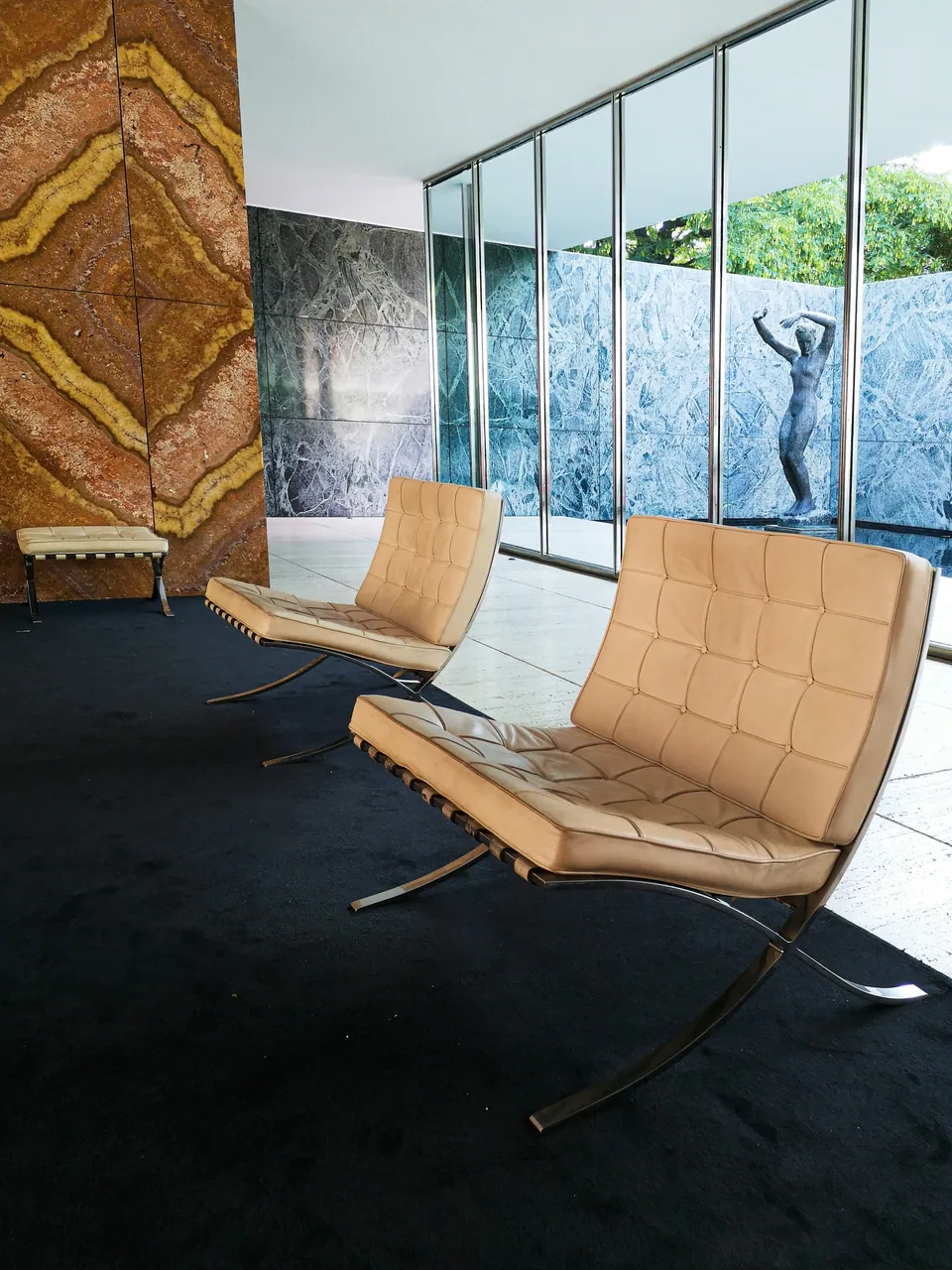 Barcelona ChairMies and Reich · 1929 · a steel chair of the same year
In collections
Go further
- Charlotte Perriand: An Art of Living, Mary McLeod (editor) (2003)A collection of scholarly essays on Perriand’s career, including her years in Le Corbusier’s studio.
- A Life of Creation: An Autobiography, Charlotte Perriand (2003)Perriand’s own account of her life and work, in the English edition published by Monacelli Press.
- Charlotte Perriand: the design visionary who survived Le Corbusier's putdowns, Oliver Wainwright, The Guardian (2019)A review of the Fondation Louis Vuitton exhibition that argues for Perriand as the author of the studio’s furniture.
- Chaise longue, W.11:1 to 3-1989, Victoria and Albert MuseumThe museum record for a Thonet example of 1928 to 1929, with photographs, measurements and notes on its construction.
- Chaise longue, 1928, Fondation Le CorbusierThe Fondation’s own entry, in French, with the production history from Thonet to Cassina.
Sources
- Chaise longue, Le Corbusier, Pierre Jeanneret, Charlotte Perriand, 1928, Fondation Le Corbusier
- Chaise longue, W.11:1 to 3-1989, Victoria and Albert Museum
- Chaise longue, CIRC.426:4-1970, Victoria and Albert Museum
- Armchair, W.31-1987 (tubular steel furniture of 1928 to 1929), Victoria and Albert Museum
- Chaise Longue, 2000.327a-c, The Metropolitan Museum of Art
- Chaise Longue (LC/4), 1928, The Museum of Modern Art

