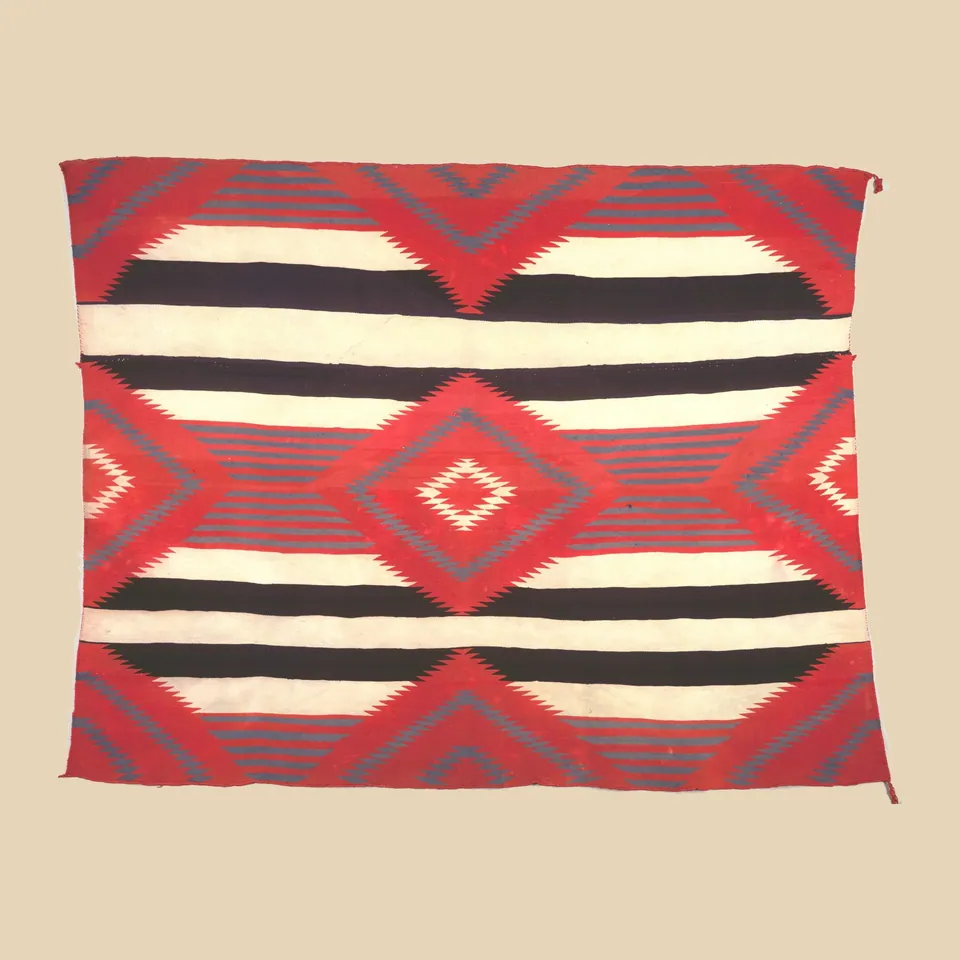
Nº 0493 · Rug
Rug in the third-phase Chief Blanket style
A Germantown-yarn rug in the Chief Blanket pattern, about 1890–1910.
Why it matters
This rug is in the third-phase Chief Blanket style, Germantown weaving, attributed to Navajo (Diné) culture. It is cotton and wool in tapestry weave, and the Cleveland Museum of Art holds it as accession 1921.565.
The Cleveland Museum of Art dates the piece to about 1890–1910. It measures 162 by 211 cm and was a gift of J. H. Wade in 1921. The museum files it in its Textiles department.
3 min read
The full story
A blanket to be worn
Before it was catalogued as a rug, this kind of weaving was clothing. According to the University of Colorado’s museum, Navajo (Diné) wearing blankets were worn over the shoulders, as ceremonial dress, as a warm jacket and as a cover for sleeping. They were woven so tightly that they were nearly waterproof, and they were expensive, so only wealthy, high-status people could afford them.
In this story
- A blanket to be worn
- Yarn from Pennsylvania
- Railway, traders and tourists
- The Cleveland rug

The story continues in the app
- Date
- About 1890–1910
- Culture
- Navajo (Diné)
- Material
- Cotton and wool, tapestry weave
- Size
- 162 × 211 cm
Connections
- Age of Industry
- Textile design
- Wool
- Textile
Go further
- Rug (Third-phase Chief Blanket Style, Germantown Weaving), Cleveland Museum of ArtThe museum record.
Sources
- Rug (Third-phase Chief Blanket Style, Germantown Weaving), 1921.565, Cleveland Museum of Art
- Chief blanket, University of Colorado Museum
- Weaving Cultures (Sky Kalfus, Distillations), Science History Institute
- Navajo weaving, Wikipedia

