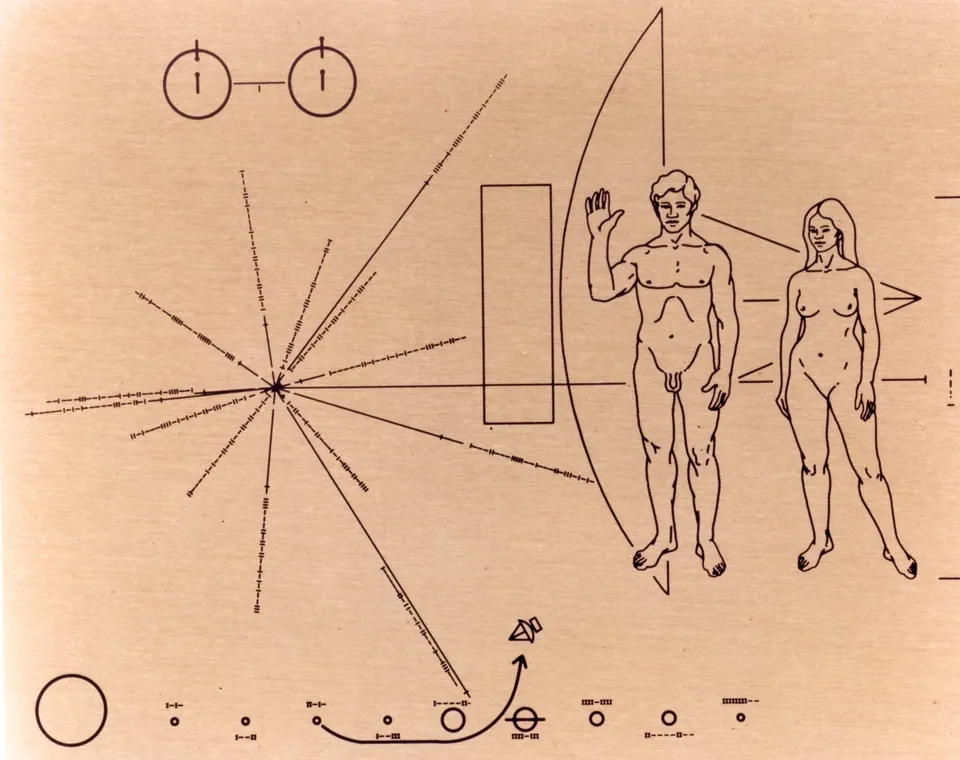
Nº 0427 · Engraved plaque
Pioneer plaque
A gold-coloured plaque addressed to whoever finds the probe.
Why it matters
The plaque is a message with no shared language, so drawings stand in for words. It was fixed to the antenna struts of Pioneer 10 and Pioneer 11.
Carl Sagan and Frank Drake designed the plaque, and Linda Salzman Sagan prepared the artwork. It is a plate of gold-anodised aluminium, 9 by 6 inches and 0.05 inches thick. Pioneer 10 was launched on 2 March 1972 and Pioneer 11 on 5 April 1973.
3 min read
The full story
A message with three weeks to write
Eric Burgess, a science writer, first suggested that the Pioneer spacecraft should carry a message from humanity. Accounts of where the idea came from differ: one says it came during a visit to the Jet Propulsion Laboratory at the time of Mariner 9, another that Burgess had it on seeing Pioneer 10 under test at TRW Systems. He went to Carl Sagan, who had lectured on communicating with extraterrestrials at a conference in Crimea. NASA agreed and gave Sagan three weeks to prepare the design.
In this story
- A message with three weeks to write
- A map and a ruler
- Anodised aluminium
- Nudity and arrows

The story continues in the app
- Designers
- Carl Sagan and Frank Drake; artwork by Linda Salzman Sagan
- Size
- 9 by 6 inches, 0.05 inches thick
- Material
- Gold-anodised aluminium
- Launches
- Pioneer 10, 2 March 1972; Pioneer 11, 5 April 1973
Connections
Go further
- Pioneers 10 and 11: the plaque, University of IowaA description of the plaque and its design.
- Pioneer 10, NASA ScienceNASA’s page for the first probe to carry the plaque.
Sources
- Pioneers 10 and 11: the plaque, University of Iowa
- Pioneer 10, NASA Science
- Pioneer plaque, Wikipedia
- Pioneer 10, NASA Science
- Pioneer 10, Wikipedia