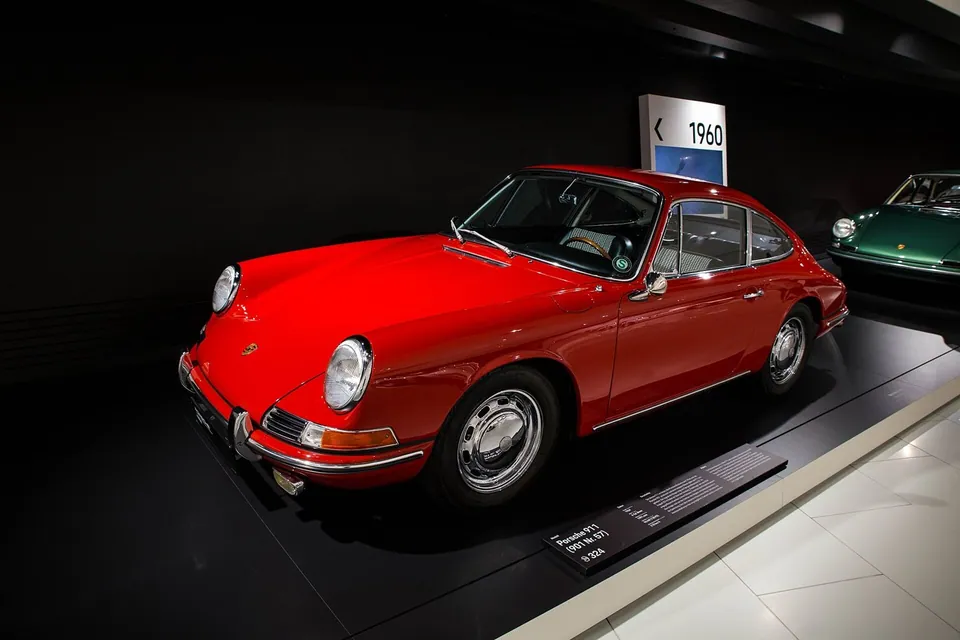
Nº 0032 · Sports car
Porsche 911
One silhouette, eight generations.
Why it matters
A roofline that has survived sixty years largely intact. Proof that a form can evolve without being replaced.
Shown at the 1963 Frankfurt motor show as the 901 and renamed 911 before sales began, the car kept its rear-mounted flat-six and sloping fastback while everything underneath changed, from air to water cooling in 1997.
What to notice
- The fastbackThe fastback falls in one curve from roof to tail.
- HeadlampsUpright round headlamps sit higher than the bonnet.
- Side windowEach generation widens the hips; the side window shape stays.
3 min read
The full story
After fifteen years of the 356
By 1963 Porsche had been building one road car, the 356, for fifteen years. It was a small coupé with a four-cylinder boxer engine behind the rear axle. The company wanted a successor with more power that kept the same layout and the two small rear seats.
In this story
- After fifteen years of the 356
- Two litres, six cylinders
- Rallies, roll bars and a ducktail
- From air to water

The story continues in the app
- Layout
- Rear engine, flat-six
- First shown
- IAA Frankfurt, 1963
- Manufacturer
- Porsche, Stuttgart
- Status
- Real · in production
Connections
In collections
Go further
- Porsche 911 Story, Paul Frère (1976)A model-by-model technical history written by a racing driver and engineer, revised through many later editions.
- Porsche: Excellence Was Expected, Karl Ludvigsen (1977)The standard history of the company, including the development of the 901 and the models that followed.
- 1. Generation Porsche 911 (Ur-Elfer), 1963-1973, Porsche NewsroomThe maker's own summary of the first generation, with dates, prices, power outputs and production totals.
- A brief history of the Porsche 911, PorscheAn overview of all eight generations with the production figure for each.
- Porsche Museum, PorscheThe company museum in Stuttgart, where early cars and racing versions are on display.
Sources
- Porsche corporate archive, Porsche

