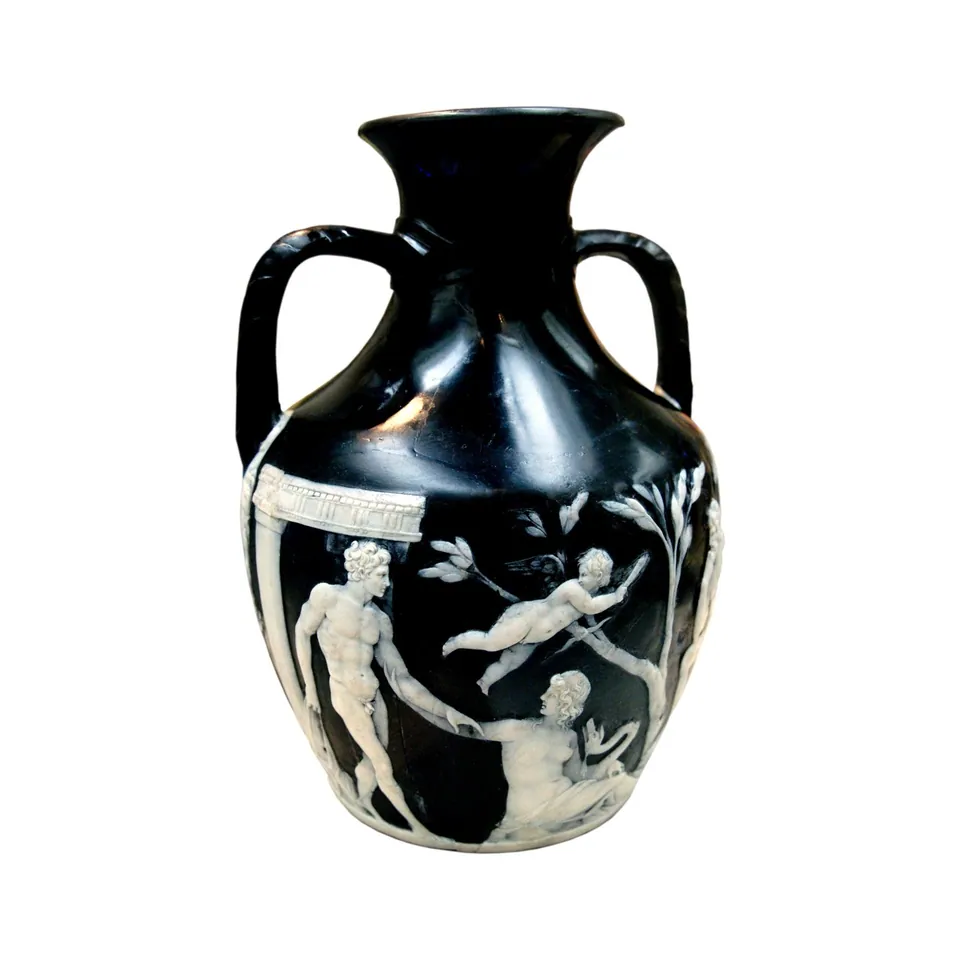
Nº 0128 · Cameo glass vase
Portland Vase
Roman cameo glass, smashed in 1845, mended three times.
Why it matters
It is the best known piece of Roman cameo glass, in which a white layer of glass is cut away to leave figures standing on a dark blue ground. Since the 18th century it has served as a model for makers in glass and ceramics, most famously for Josiah Wedgwood's jasperware copy.
The vase was made in the Roman Empire around the turn of the era and is most often dated AD 5 to 25; where exactly is not known. It is first recorded in 1601, was in the Barberini collection in Rome by 1626 and later passed to the Dukes of Portland, who lent it to the British Museum from 1810. A visitor smashed it on 7 February 1845, and it has been restored in 1845, in 1948 to 49 and in 1988 to 89. The museum bought it in 1945; the two scenes around its body have never been securely identified.
What to notice
- A winged figureA small winged figure flies across the dark ground, cut in low relief from the white layer.
- A handleTwo handles run from the shoulder up to the neck, in the same dark blue glass as the body.
- The second sceneOn the other side a woman reclines under a tree; what both scenes show is still debated.
3 min read
The full story
From Rome to Whitehall
Roman glassworkers made cameo vessels for only a short time, probably about two generations, while blowing glass was still a new skill. The British Museum dates this one to around AD 1 to 25. It was long believed to have come from a marble sarcophagus in the Monte del Grano, a burial mound south-east of Rome; the museum cites a review of the evidence that rates this as probable but not certain.
In this story
- From Rome to Whitehall
- Blue dipped in white
- Copied, then smashed
- Taken apart twice more

The story continues in the app
- Materials
- Two layers of glass, opaque white over dark cobalt blue, cut as a cameo
- Dimensions
- About 24 cm high, about 18 cm across
- Maker
- Unknown Roman workshop
- In collection
- British Museum, London, GR 1945,0927.1
- Status
- Real · broken in 1845, restored three times
Connections
In collections
Go further
- The Portland Vase, Susan Walker (2004)A short British Museum Press guide to the vase, its history and the readings of its scenes.
- The Breaking and Remaking of the Portland Vase, Nigel Williams (1989)The conservator’s own 32-page account of taking the vase apart and rebuilding it in 1988 to 89.
- The Vase in Italy, Kenneth Painter and David Whitehouse, Journal of Glass Studies 32 (1990)The opening chapter of ‘The History of the Portland Vase’, the standard scholarly survey, published by the Corning Museum of Glass; later chapters follow the vase to England.
- The Portland Vase, museum number 1945,0927.1, British MuseumThe museum record, with a full description, measurements and a long curator’s note on Hamilton and the Portland sale.
- Portland Vase, WE.4014-2014, Victoria and Albert MuseumThe record for a Wedgwood first-edition copy, which sets out how the jasper version was made from 1786 to 1789.
Sources
- Amphora; vessel (closed); cameo (the Portland Vase), GR 1945,0927.1, The British Museum
- Portland Vase, first edition copy, Josiah Wedgwood and Sons, 1790, WE.4014-2014, Victoria and Albert Museum
- Portland Vase, first edition owned by Thomas Hope, WE.8000-2014, Victoria and Albert Museum
- Wikipedia (English), Wikimedia Foundation
- Portland Vase, Wikipedia

