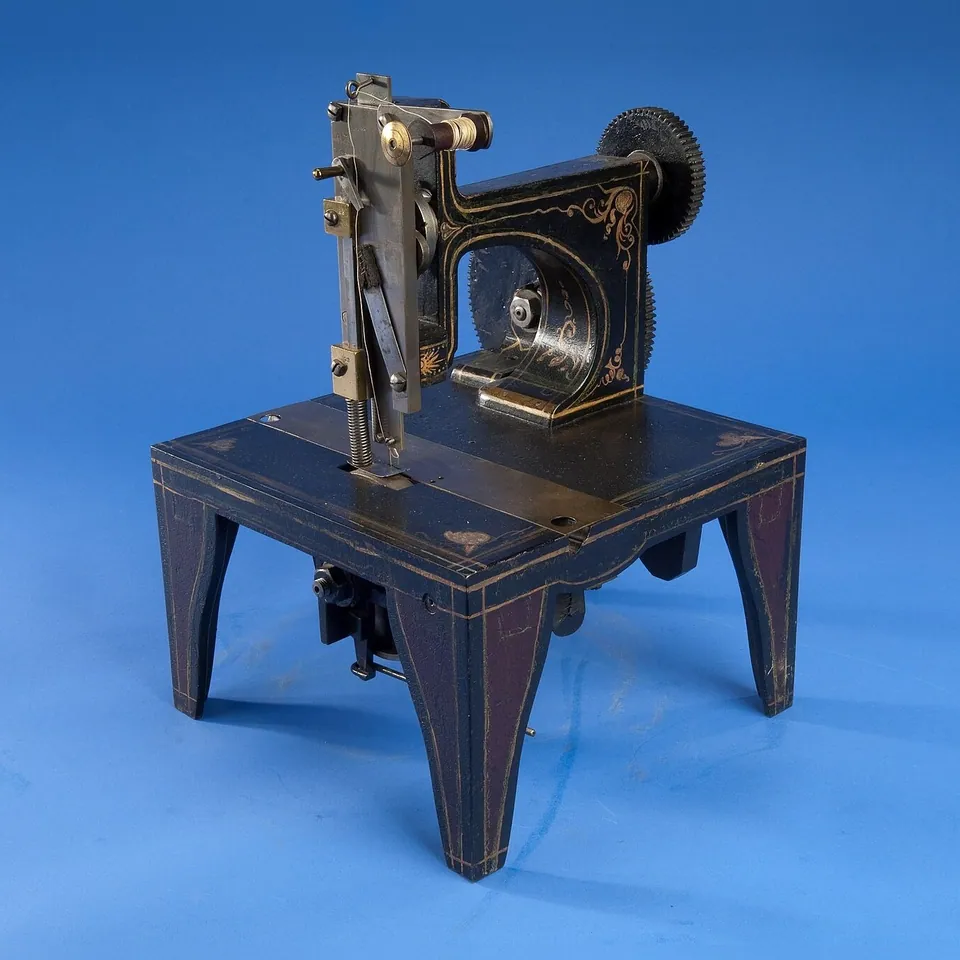
Nº 0195 · Sewing machine
Singer sewing machine
Improvements to another man’s machine, patented in 1851.
Why it matters
Singer did not invent the sewing machine: his patent covered improvements to another design, and he paid Elias Howe for the eye-pointed needle. Hagley describes the result as the first commercially viable sewing machine for home use, and the firm went on to sell it on installment plans.
Isaac Merritt Singer worked on the machine in Orson C. Phelps’s shop in Boston in 1850 and 1851, improving a machine designed by John A. Lerow and Sherburne C. Blodgett, and received US patent 8,294 on 12 August 1851. In his design the needle is straight and moves up and down, and the shuttle moves in a straight line rather than a circle. The object photographed is the patent model made for the Patent Office, now in the National Museum of American History. The Science Museum Group holds a full-size machine of the 1851 pattern in cast and wrought iron, made in Boston.
What to notice
- The needle barA straight needle bar at the front of the arm moves the needle up and down.
- The armThe cast iron arm reaches over the table, painted black with gold lines.
- The toothed wheelA large toothed wheel stands at the back end of the arm, part of the drive.
3 min read
The full story
Eleven days, forty dollars
Isaac Singer came to Boston in 1850 to promote a machine he had invented for carving printers’ wooden type. He showed it in Orson Phelps’s shop, where sewing machines of the Lerow and Blodgett pattern were being built. The carving machine drew little interest, so Singer turned to the sewing machine instead. Phelps and George Zieber, the publisher backing the carving venture, agreed to support him.
In this story
- Eleven days, forty dollars
- A table, a foot, a wheel
- Sold from its packing case
- Showrooms, instalments, a patent pool

The story continues in the app
- Patent
- US patent 8,294, granted 12 August 1851
- Dimensions
- Patent model 41 × 43 × 30 cm (NMAH)
- Materials
- Cast iron and wrought iron (Science Museum Group machine)
- Maker
- I. M. Singer and Company, Boston
- In collection
- National Museum of American History (patent model) · Science Museum Group
Connections
Nearby in the archive
In collections
Go further
- The Invention of the Sewing Machine, Grace Rogers Cooper (1968)The Smithsonian’s history of the early machines and their patents, with Singer’s own account of building the first model.
- A Capitalist Romance, Ruth Brandon (1977)A biography of Isaac Singer that follows the man and the company together.
- Example of original pattern Singer sewing machine of 1851, made c. 1853, Science Museum GroupThe museum record for a full-size machine of the 1851 pattern, with photographs and a short description.
- On this date, August 12, in 1851, Hagley Museum and LibraryA short note on the patent, illustrated with a 1934 photograph of a Singer display from Hagley’s collections.
- US Patent 8,294, Improvement in sewing-machines, Isaac M. Singer (1851)Singer’s patent text and drawings as granted on 12 August 1851.
Sources
- On this date, August 12, in 1851, Hagley Museum and Library
- 1851 Isaac Singer’s Sewing Machine Patent Model, TE*T06054, National Museum of American History
- Singer Lockstitch sewing machine model of 1851, 1892-135, Science Museum Group
- Example of original pattern Singer sewing machine of 1851, made c. 1853, 1892-135/1, Science Museum Group
- Wikipedia (English), Wikimedia Foundation

