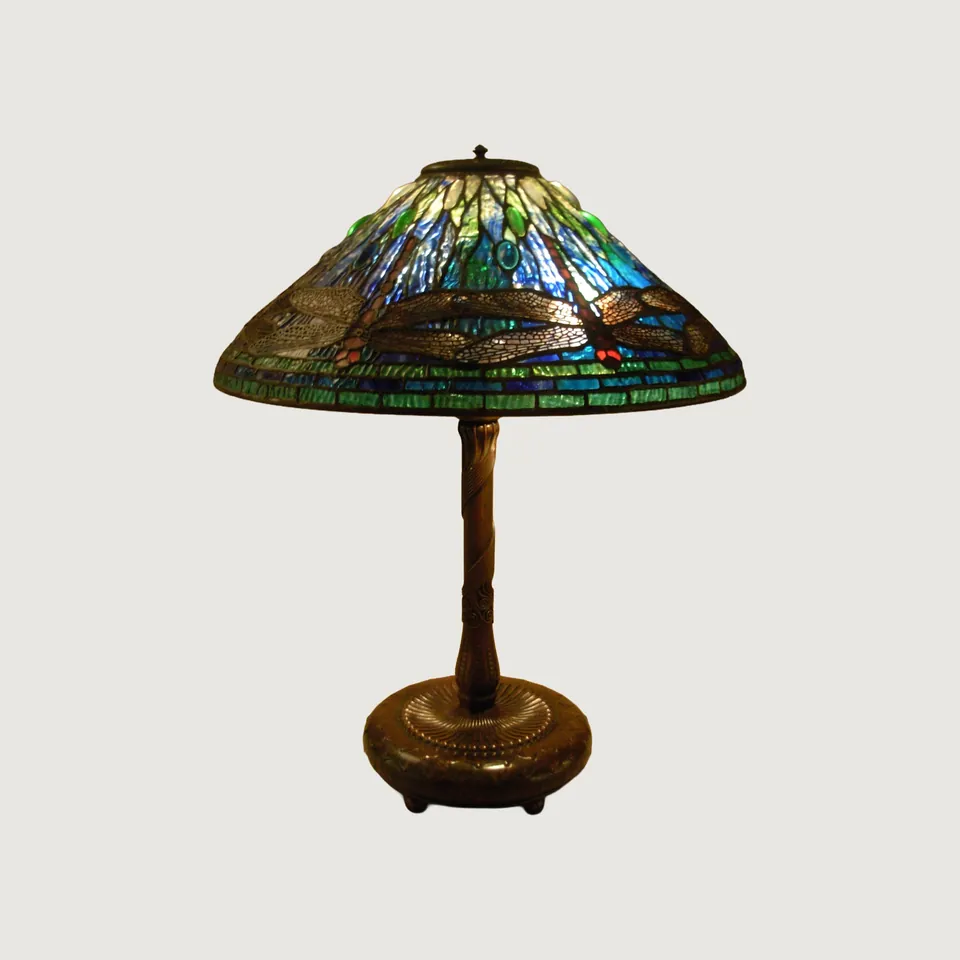
Nº 0130 · Table lamp
Dragonfly lamp
Long credited to Tiffany; now attributed to Clara Driscoll.
Why it matters
The Dragonfly shade became one of the firm's most popular designs and was made in several variants through 1924. For a century the lamps carried Louis Comfort Tiffany's name; a 2007 study of Clara Driscoll's letters led museums to attribute the design to her, the head of the women's glass-cutting department.
Driscoll had the idea in the summer of 1898 and designed the first Dragonfly shade early in 1899. A lamp of this design was shown at the Grafton Galleries in London that year. This example at the Corning Museum of Glass, made in 1899, sets six large dragonflies with iridescent wings among water flowers, on a green blown-glass base with a cast bronze foot of lily leaves. The lamps were made at the firm's works in Corona, Queens, and shades and bases varied from lamp to lamp.
What to notice
- A dragonfly wingEach wing is a mesh of fine lead lines over iridescent glass, lit from inside.
- A dragonfly headThe dragonflies' heads sit at the lower edge of the shade, marked by red glass eyes.
- The footA cast bronze foot shaped as water lily leaves holds the green glass base.
3 min read
The full story
An idea from last summer
Clara Pierce Wolcott was born in Tallmadge, Ohio, in 1861, studied design in Cleveland and came to New York for the Metropolitan Museum Art School. By 1888 she was working for Louis Comfort Tiffany. When the men of the glass cutters’ union struck in 1892, Tiffany hired women in numbers to cut glass, and an 1894 article names her, by then Clara Driscoll, as head of the Women’s Glass Cutting Department.
In this story
- An idea from last summer
- Glass, lead and lamp oil
- Two hundred and fifty dollars
- Her name on the label

The story continues in the app
- Materials
- Leaded glass shade, blown glass base, cast bronze foot
- Designer
- Clara Driscoll (attributed), under Louis Comfort Tiffany
- Maker
- Tiffany Glass and Decorating Company, Corona, New York (Tiffany Studios from 1902)
- In collection
- Corning Museum of Glass · Art Institute of Chicago
- Status
- Real · made in variants until 1924
Connections
- Clara Driscoll
- Louis Comfort Tiffany
- Tiffany Studios
- Art Nouveau
- Age of Industry
- Glass
- Glass
- Copper, brass and bronze
- Corona, Queens
Nearby in the archive
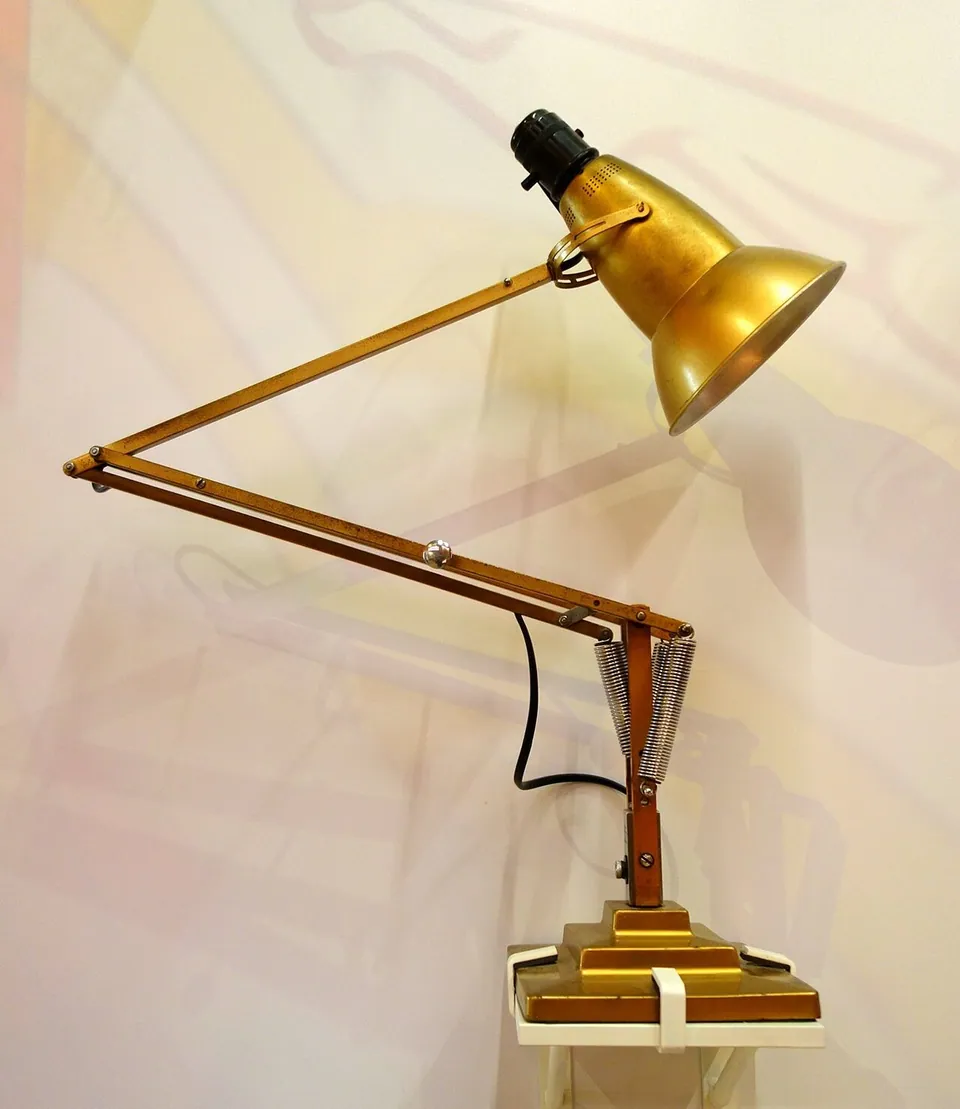 Anglepoise 1227Carwardine · 1935 · a lamp built from engineering, not glass
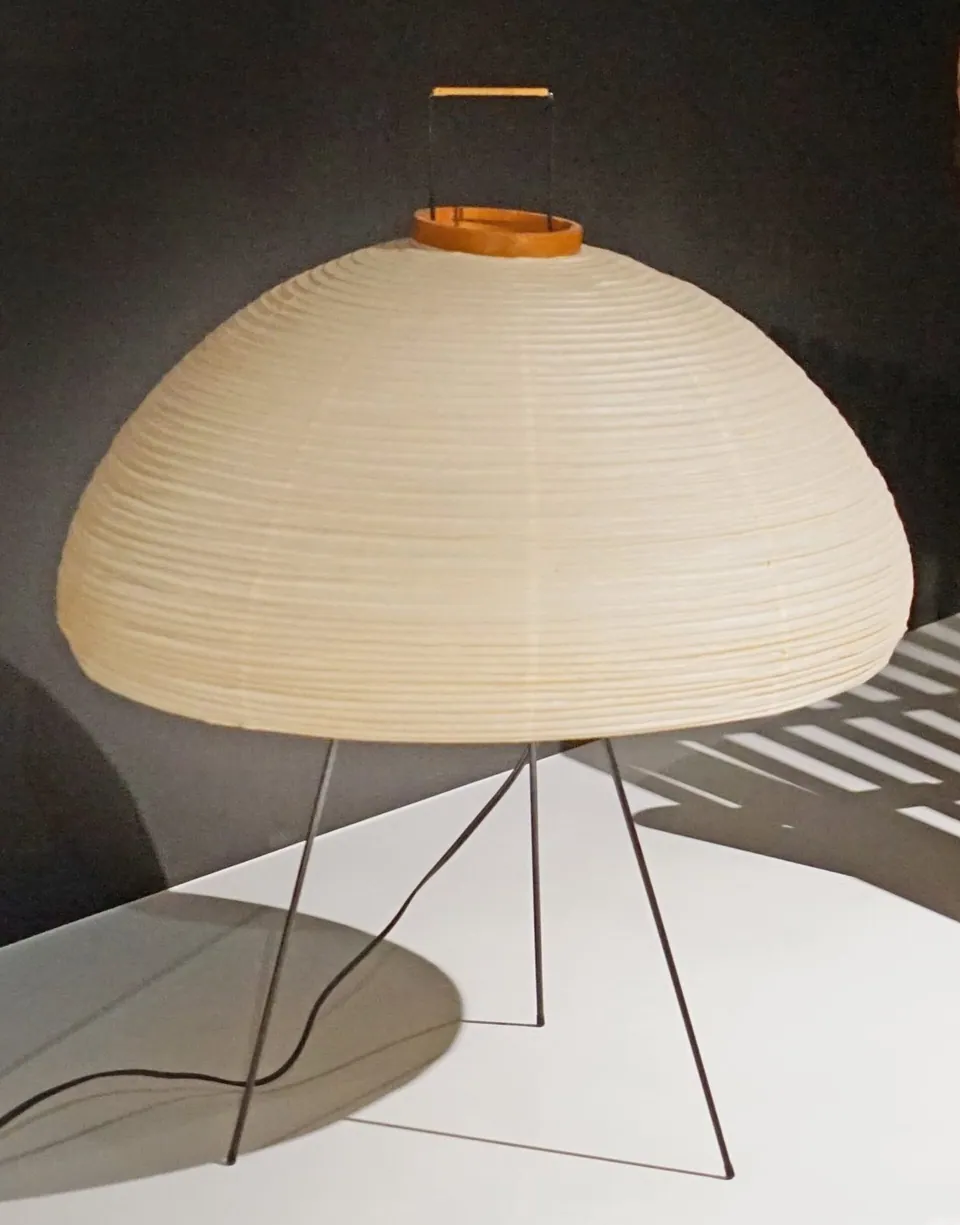 AkariNoguchi · 1951 · light through a handmade shade
In collections
Go further
- A New Light on Tiffany: Clara Driscoll and the Tiffany Girls, Martin Eidelberg, Nina Gray and Margaret K. Hofer (2007)The exhibition catalogue that set out Driscoll’s role from her letters and identified many of the women who worked under her.
- Out of Tiffany’s Shadow, a Woman of Light, Jeffrey Kastner, The New York Times (2007)A report on how two scholars found Driscoll’s letters and what the 2007 exhibition changed.
- Dragonflies and Water Flowers, reading lamp, 2013.4.4, Corning Museum of GlassThe museum record for the 1899 lamp, with Driscoll’s letter about it, measurements and the lamp’s history of ownership.
- Making a Tiffany Lamp, The Neustadt Collection of Tiffany GlassA step-by-step account of how a leaded shade was designed, cut, foiled and soldered.
- Lamp with Hanging Head Dragonfly Shade and Mosaic and Turtleback Base, Art Institute of ChicagoA later and larger Dragonfly lamp, with the museum’s note on Driscoll’s part in the design.
Sources
- Lamp with Hanging Head Dragonfly Shade and Mosaic and Turtleback Base, 2006.2, Art Institute of Chicago
- Dragonflies and Water Flowers reading lamp, 1899, Corning Museum of Glass
- The First Tiffany Lamps, Lillian Nassau LLC
- Wikipedia (English), Wikimedia Foundation

