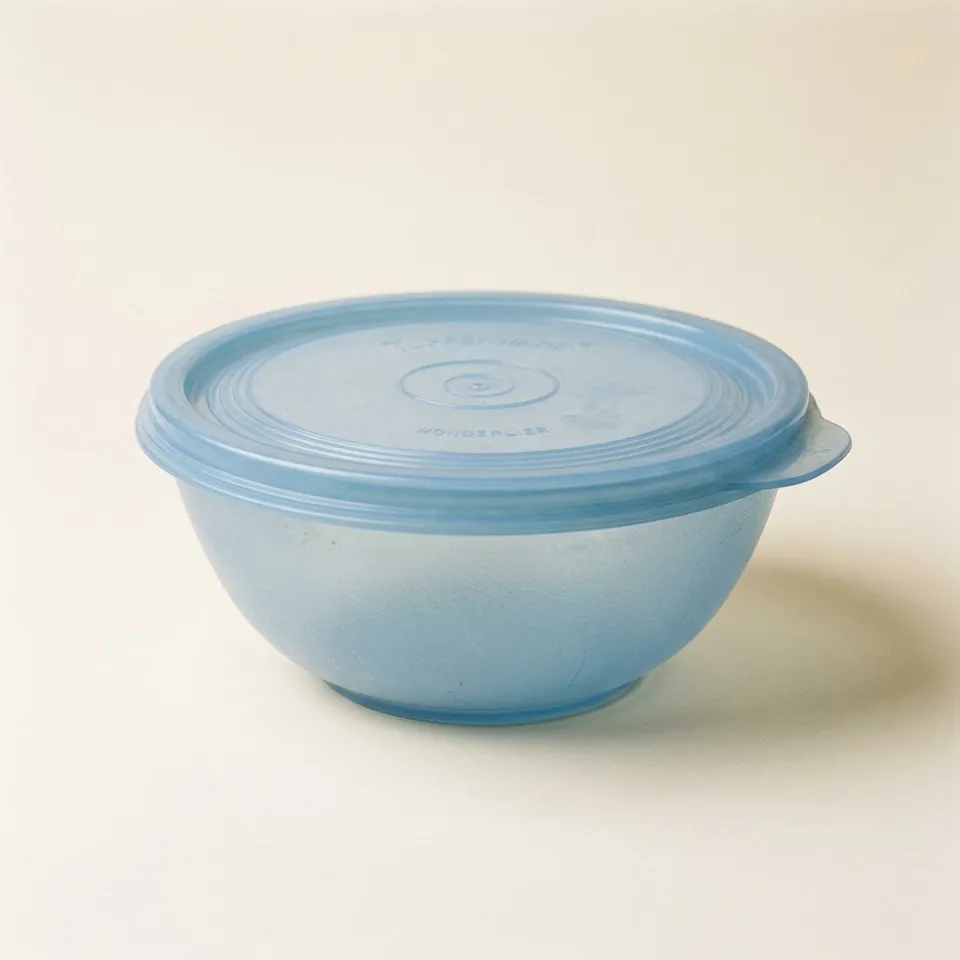
Nº 0196 · Food storage bowl
Wonderlier bowl
A flexible lid that seals by its rim.
Why it matters
The Wonderlier bowl made a sealed plastic container an ordinary household object, and a Smithsonian curator calls it the linchpin of Tupperware. It sold poorly in shops until the home party plan, led by Brownie Wise from 1951, carried it into homes.
Earl Tupper made his first household products in 1946 from polyethylene, refined from black refinery slag he was given at DuPont. He filed a patent for the airtight lid in 1947; the lid, inspired by the lids of paint cans, is flexible and grips the rim of the bowl. MoMA acquired a Tupper polyethylene bowl in 1948 and dates it 1945, and the National Museum of American History holds Wonderlier bowls from about 1954 onward. The bowls photographed are a nested set of four with tab lids in the Huis van Alijn in Ghent, filed under the 1960s; the museum record does not name the model.
What to notice
- The lidA soft lid fits over the rim and holds by its own edge; a small tab helps lift it.
- Nested sizesThe bowls came in several sizes that stack inside one another.
- The wallPlain walls in one solid colour, with no handles and no ornament.
3 min read
The full story
Black slag from DuPont
Earl Tupper was born in New Hampshire in 1907 and grew up on farms in central Massachusetts. His tree surgery business went bankrupt in 1936. He then found work in Leominster, a Massachusetts town of small plastics factories, at a plant that belonged to DuPont. After a year there he bought a few used moulding machines and set up on his own as Tupper Plastics, making beads and containers for cigarettes and soap.
In this story
- Black slag from DuPont
- A lid that peels off
- Thirty-nine cents, unsold
- After the parties

The story continues in the app
- Materials
- Polyethylene
- Dimensions
- 7.6 × 14.6 cm with cover (NMAH example, about 1954); sizes varied
- Patent
- Lid patent filed 1947, US 2,487,400, granted 1949
- Maker
- Tupperware, Farnumsville, Grafton, Massachusetts (NMAH example)
- In collection
- National Museum of American History · MoMA (Tupper bowls)
Connections
- Earl Tupper
- Tupperware
- Postwar era
- Industrial design
- Plastic
- Grafton
Nearby in the archive
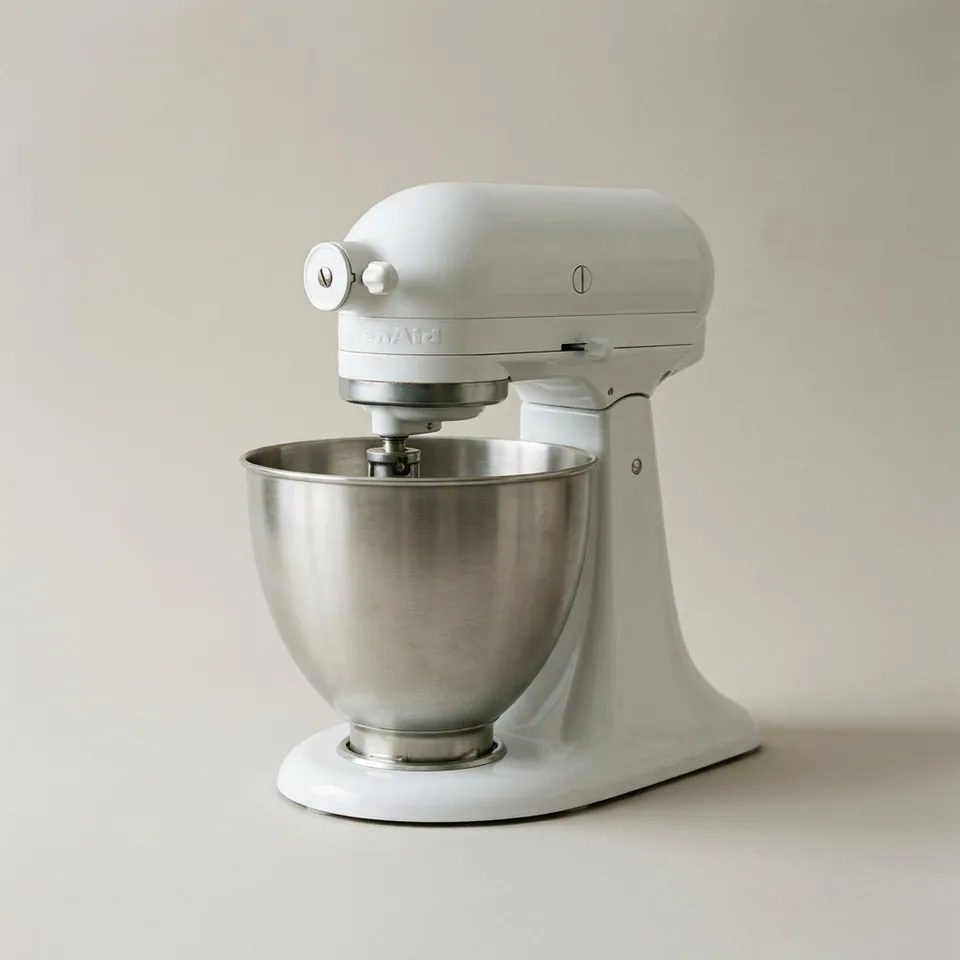 KitchenAid Model KArens · 1937 · American kitchenware of the decade before
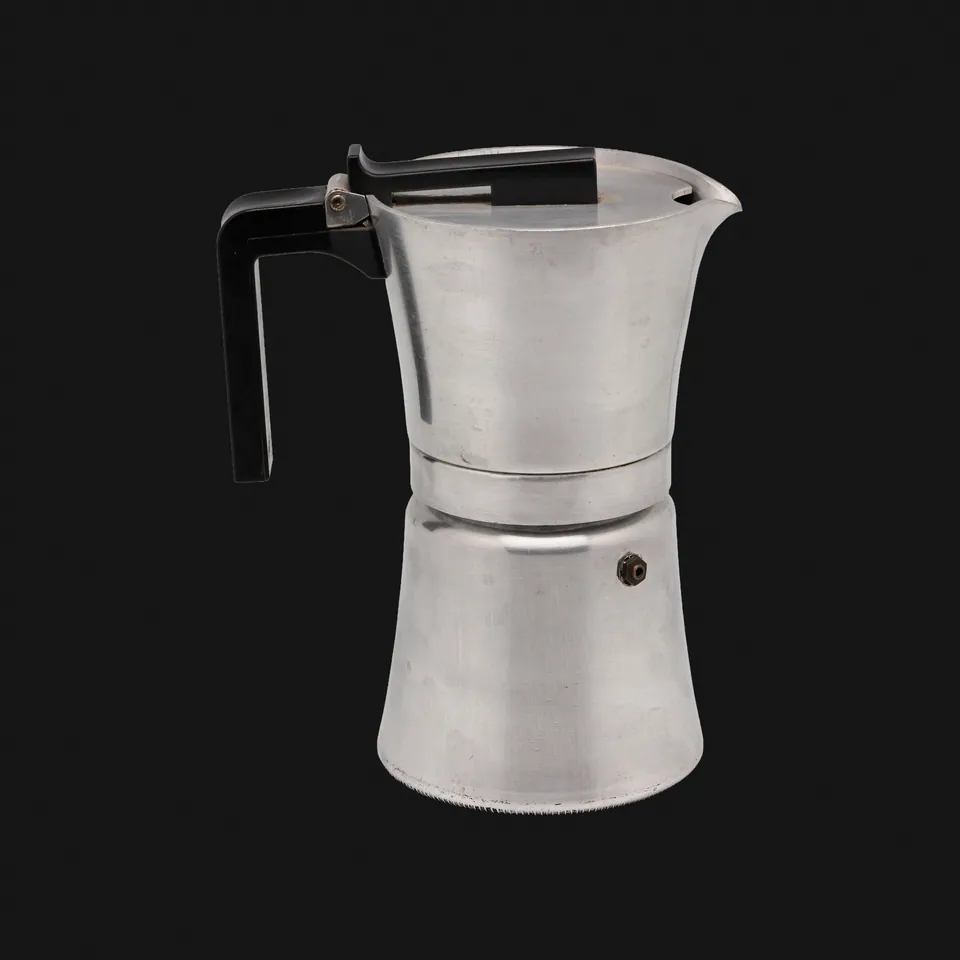 Moka ExpressBialetti · 1933 · a kitchen object in one cheap material
In collections
Go further
- Tupperware: The Promise of Plastic in 1950s America, Alison J. Clarke (1999)The standard history, from Tupper's workshop to the party plan, based on the Tupper and Wise papers at the Smithsonian.
- Tupperware, Unsealed: The Inside Story of Brownie Wise, Earl Tupper, and the Home Party Pioneers, Bob Kealing (2008)A journalist's account of the partnership between Wise and Tupper and how it ended.
- Tupperware!, Laurie Kahn-Leavitt (2004)A documentary built on home movies and interviews with former dealers, with short biographies of Tupper and Wise on the same site.
- The Story of Brownie Wise, the Ingenious Marketer Behind the Tupperware Party, Kat Eschner (2018)A curator at the National Museum of American History explains why the bowl failed in shops and sold at parties.
- US 2,487,400: Open mouth container and nonsnap type of closure therefor, Earl S. Tupper (1949)The full text and drawings of the lid patent, in Tupper's own description of how the seal works.
Sources
- Tupperware Wonderlier Bowl, 1985.3014.01, National Museum of American History
- Bowl (Exhibited in the US Pavilion in the 1951 Milan Triennale), 171.1948, Museum of Modern Art
- The Story of Brownie Wise, the Ingenious Marketer Behind the Tupperware Party, Smithsonian Magazine
- From slag to swag: the story of Earl Tupper’s fantastic plastics, University of Florida News
- Wikipedia (English), Wikimedia Foundation