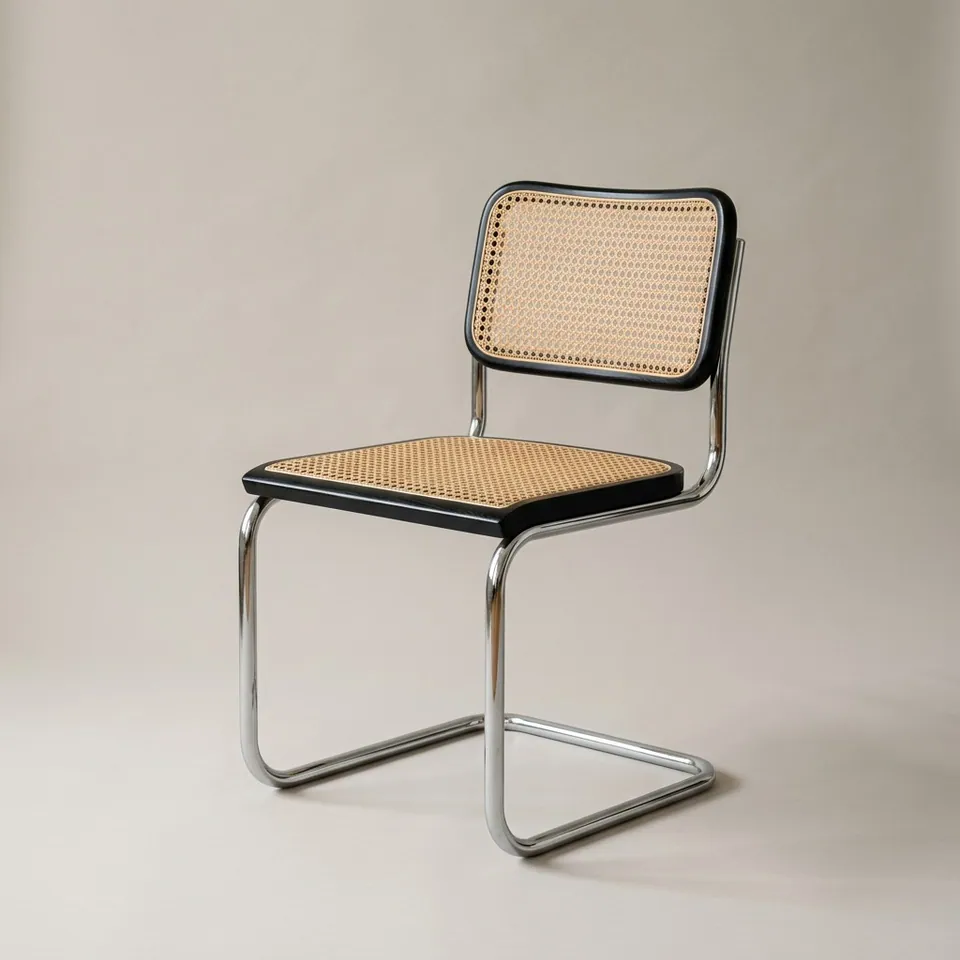
Nº 0209 · Cantilever side chair
Cesca Chair
Steel tube, two runners, and a caned seat.
Why it matters
Mart Stam and Mies van der Rohe had shown cantilever chairs in 1927; Breuer followed in 1928 and here broke his own rule of a continuous tube behind the back. The V&A reads the wood and cane panels as a clear reference to Thonet’s nineteenth-century bentwood chairs, natural textures set against shiny steel.
Breuer designed the chair in 1928, and Gebrüder Thonet began making it as model B32 in about 1930. One run of chrome-plated steel tube forms the frame and stands on two runners with no back legs, and it carries a separate seat and back of black-stained bent beech filled with cane. After lawsuits by Anton Lorenz, who held Stam’s cantilever rights, a court ruled in 1932 that Lorenz alone could make such chairs, and Thonet catalogued the B32 under Stam’s name until 1962 to 1963. It was later named Cesca, after Breuer’s daughter Francesca.
What to notice
- Two runnersThe tube loops along the floor as two runners; there are no back legs.
- The cane backWoven cane in a black-stained bentwood frame, as on Thonet’s older chairs.
- Separate panelsSeat and back are separate wooden panels fixed to the tube, not a tube frame behind the back.
3 min read
The full story
After Stam and Mies
The chair with no back legs was not Breuer’s idea alone. The Dutch architect Mart Stam built one from gas pipe and pipe fittings in late 1926 or early 1927, and both he and Ludwig Mies van der Rohe showed cantilever chairs at the Weissenhof housing exhibition in Stuttgart in 1927. Breuer, who had been bending steel tube into furniture at the Bauhaus in Dessau since 1925, always maintained that he had explained the idea to Stam the year before. No record settles the matter.
In this story
- After Stam and Mies
- Wood braces the steel
- Catalogued under Stam’s name
- Cesca, and its copies

The story continues in the app
- Materials
- Chrome-plated steel tube, bent beech stained black, cane
- Dimensions
- About 82 × 47 × 57 cm (V&A)
- Model
- B32 (Thonet)
- In collection
- MoMA (835.1942) · Victoria and Albert Museum (W.10-1989)
- Status
- Real · designed 1928, made by Thonet from about 1930
Connections
- Marcel Breuer
- Gebrüder Thonet
- Knoll
- Era of the World Wars
- Furniture design
- Steel
- Wood
- Frankenberg (Eder)
Nearby in the archive
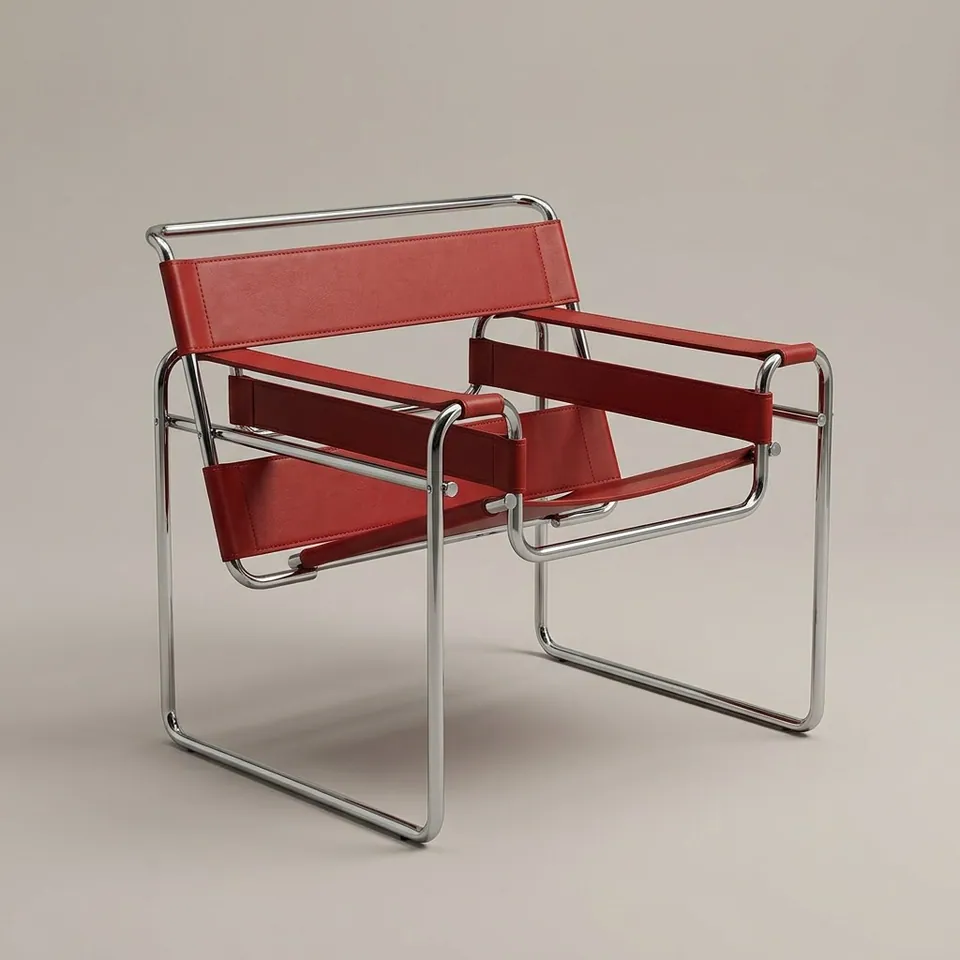 Wassily ChairBreuer · 1925 · his earlier chair in bent steel tube
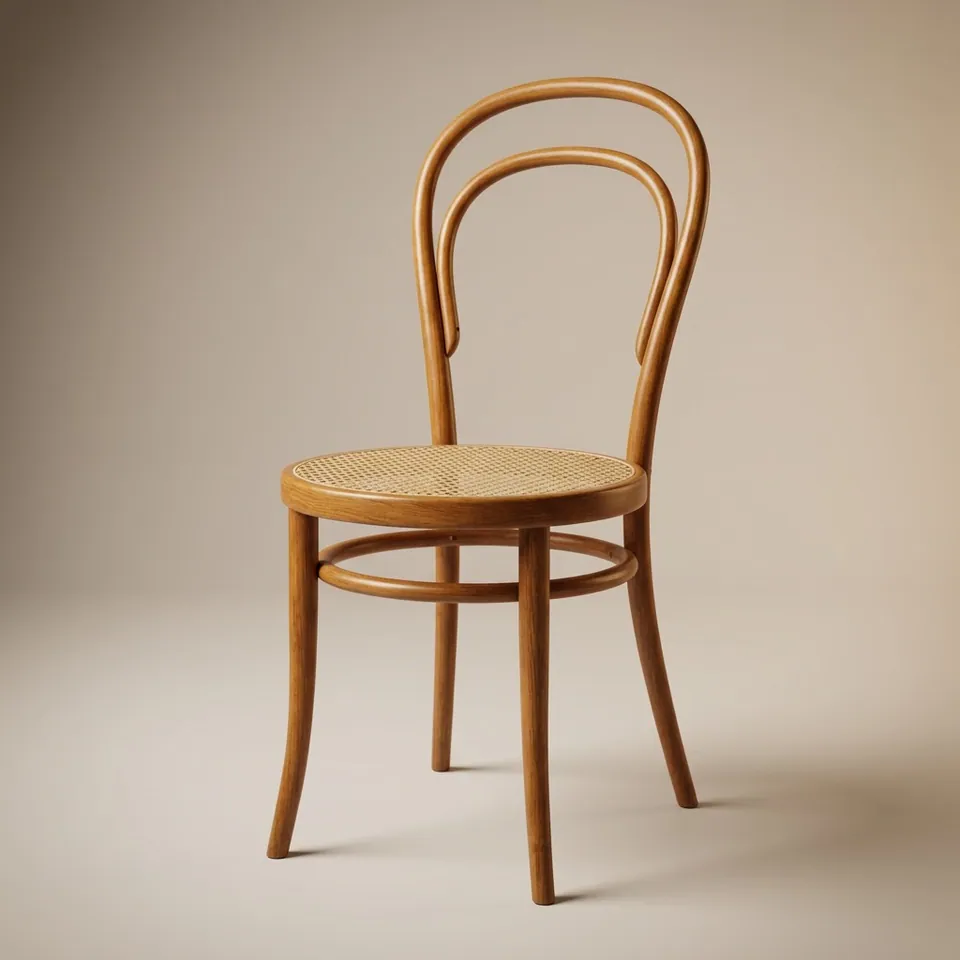 Thonet No. 14Thonet · 1859 · the bentwood cane chair its seat refers to
In collections
Go further
- Marcel Breuer: Furniture and Interiors, Christopher Wilk (1981)The Museum of Modern Art’s exhibition catalogue, free to read from the publisher, with the fullest account of the B32 and the Lorenz lawsuits.
- Model B32, object W.10-1989, Victoria and Albert MuseumThe museum record for a Thonet example, with a summary of the design and the dispute over its credit.
- Marcel Breuer. Cesca Side Chair (model B32), The Museum of Modern ArtThe collection record for MoMA’s Thonet example, object number 835.1942, with photographs and measurements.
- Cantilever chair “B 64” / “S 64” by Marcel Breuer/Mart Stam, Werkbundarchiv, Museum der Dinge (2021)A short museum essay on the armchair version and on why it carries two designers’ names.
- Cantilever chair S 32 V, ThonetThe maker’s page for the chair as it is produced today, with dimensions, weight and the credit to both Breuer and Stam.
Sources
- Model B32, W.10-1989, Victoria and Albert Museum
- Marcel Breuer, Cesca Side Chair (model B32), 835.1942, The Museum of Modern Art
- Freischwinger B 32, exhibition label, Bugholz, vielschichtig: Thonet und das moderne Möbeldesign (2019 to 2020), MAK, Vienna (label text via Wikimedia Commons)
- Wikipedia (English), Wikimedia Foundation


