Nº 0211 · Lounge chair
Diamond Chair
A seat and back of welded wire mesh.
Why it matters
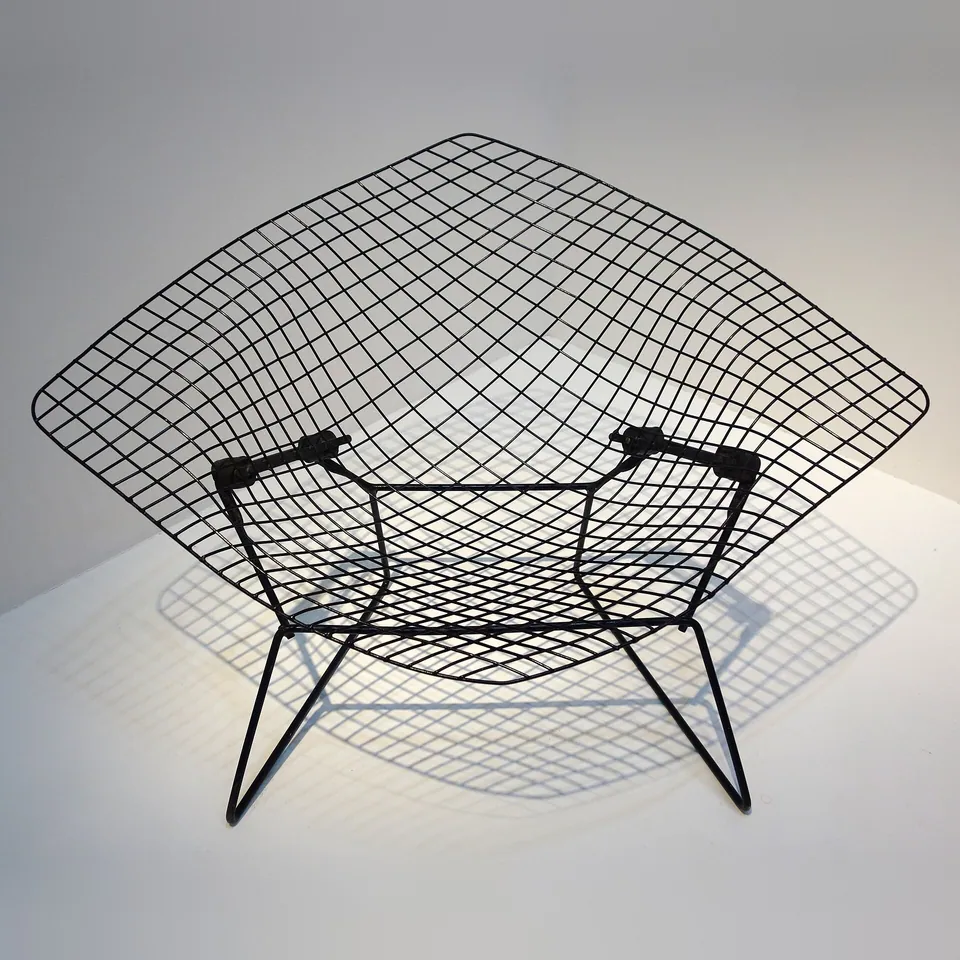
Bertoia called his chairs "studies in space, form, and metal", and the V&A notes that the open grid makes the chair look transparent and weightless. The industrial steel wire stays in plain view and is itself the seat.
Hans and Florence Knoll invited Bertoia, a sculptor trained at Cranbrook, to Pennsylvania in 1950 with a studio and a salary. He designed the Diamond Chair in 1952, and Knoll made it from 1953 at East Greenville. A concave grid of welded wire forms seat and back as one diamond-shaped shell, carried on a separate rod frame with canted legs. Knoll tried to make it by machine but found the shell easier to weld by hand in a jig.
What to notice
- The wire gridA concave grid of welded wire makes seat and back in one diamond shape.
- The frameA separate rod frame with canted legs holds the shell from below.
- Light through itLight passes through the mesh and leaves the grid as a shadow on the floor.
- The seat padMany chairs were sold with a fitted pad laid over the wire, here in yellow.
3 min read
The full story
A garage in Bally
Harry Bertoia was born in 1915 in San Lorenzo, a village in Friuli, and followed his brother to Detroit at fifteen. A scholarship took him to the Cranbrook Academy of Art in 1937, where two years later he reopened the metal workshop. In 1943 he went to California to work with Charles Eames on moulded plywood. The Eameses sent him to a welding class at Santa Monica City College. He left in 1946, and his foundation says his contributions to the Eames chairs went uncredited.
In this story
- A garage in Bally
- Bent by hand, welded in a jig
- Black, white, then chrome
- One collection, then sculpture

The story continues in the app
- Materials
- Welded steel wire and rod; many examples have a fitted seat pad
- Dimensions
- About 78 × 85 × 71 cm (V&A); a larger size also exists
- Maker
- Knoll, East Greenville, Pennsylvania, from 1953
- In collection
- The Met · Victoria and Albert Museum · Brooklyn Museum · Centre Pompidou
- Status
- Real · designed 1952
Connections
- Harry Bertoia
- Knoll
- Postwar era
- Furniture design
- Steel
- East Greenville
Nearby in the archive
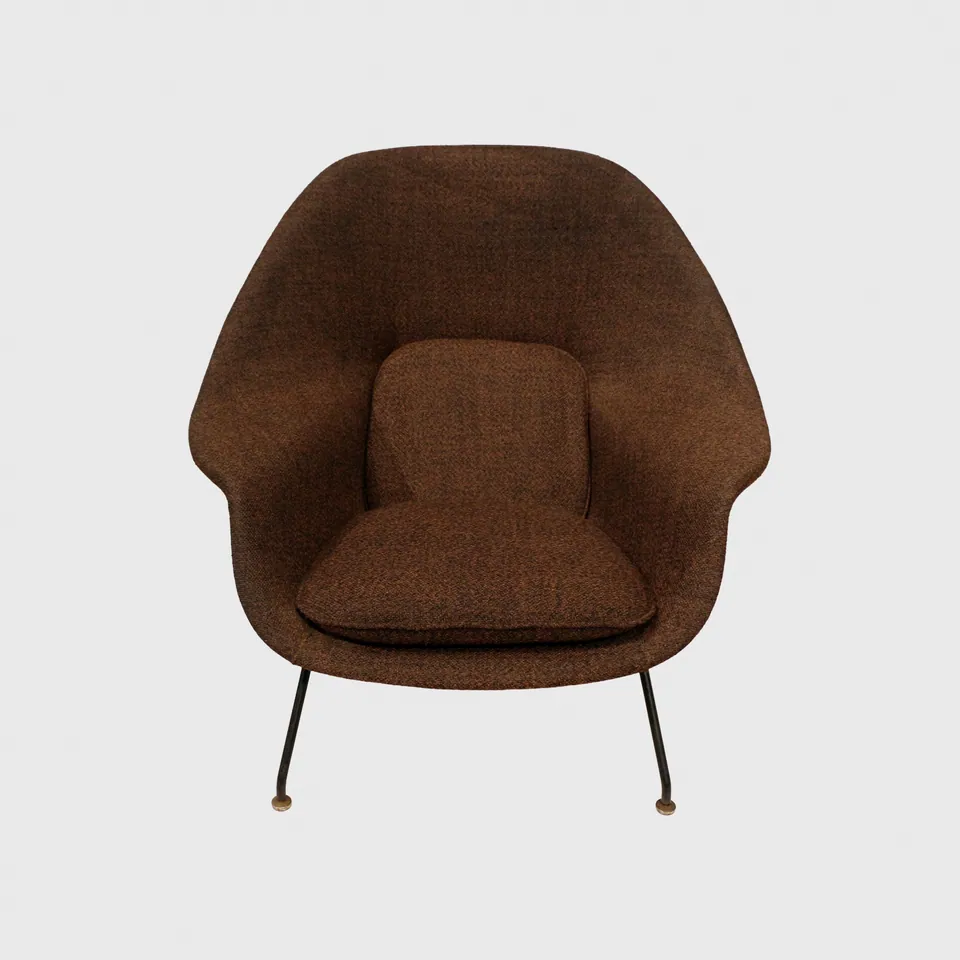 Womb ChairSaarinen · 1948 · the Knoll chair shaped as one shell before it
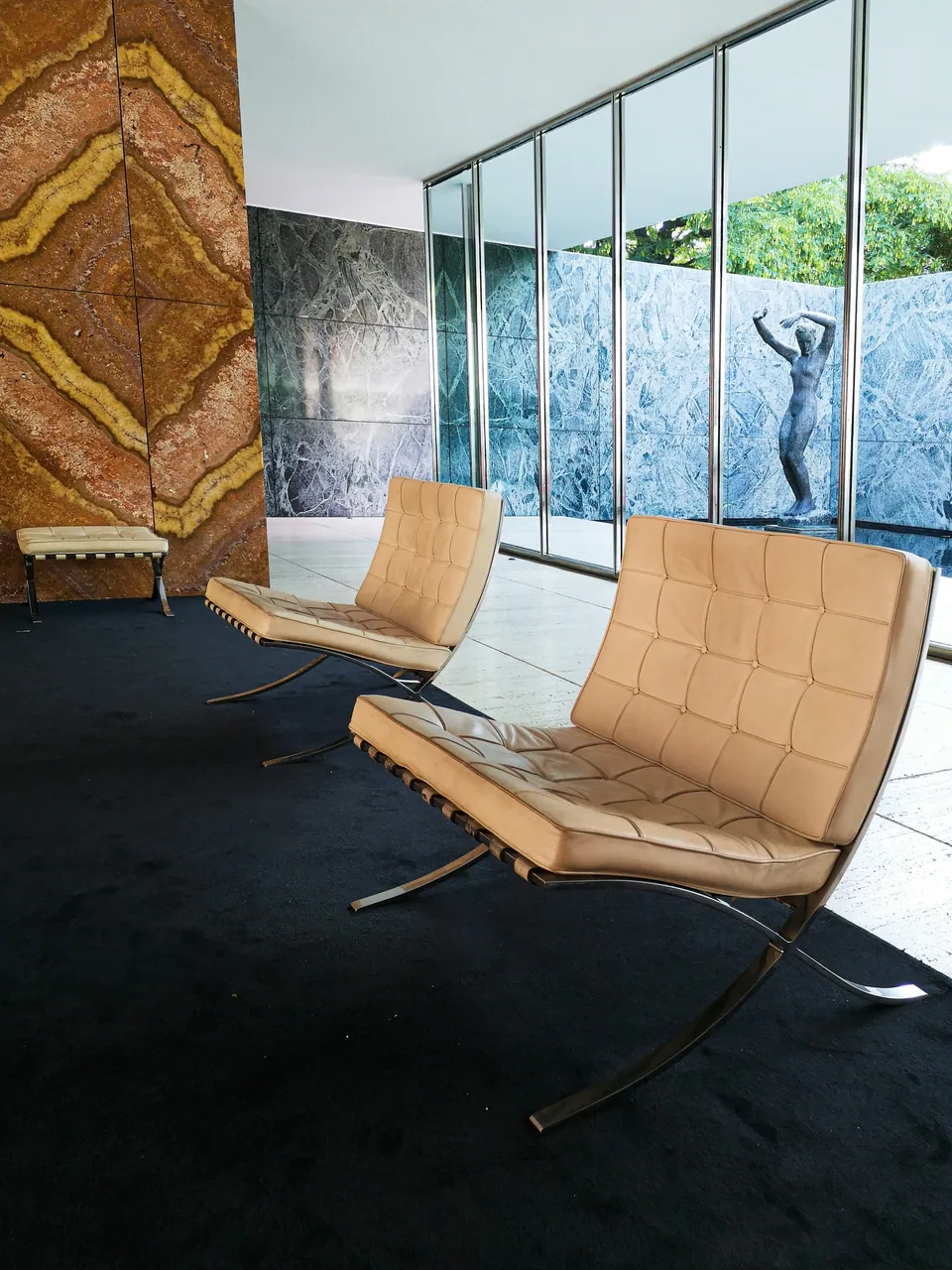 Barcelona ChairMies van der Rohe · 1929 · a steel chair Knoll made in the same years
In collections
Go further
- The Life and Work of Harry Bertoia: The Man, the Artist, the Visionary, Celia Bertoia (2015)A biography by his daughter, covering the Knoll years and the sculpture that followed them.
- Bertoia: The Metalworker, Beverly H. Twitchell (2019)A monograph that sets the chairs beside the jewellery, monotypes, sculpture and sound pieces.
- FAQs: the Bertoia chairs, Harry Bertoia FoundationA detailed production history of the Knoll chairs, covering finishes, the 1986 changes and how to tell an original.
- Diamond Chair, CIRC.82-1969, Victoria and Albert MuseumThe museum record for a chair made in 1953, with measurements and a short curatorial reading.
- Harry Bertoia’s Sculpture, Clifford B. West (1965)A 23-minute film by a Cranbrook friend showing the metal sculpture Bertoia turned to after the chairs.
Sources
- Diamond Chair, CIRC.82-1969, Victoria and Albert Museum
- 'Diamond' Chair, 1984.542.1, The Metropolitan Museum of Art
- 'Diamond' Armchair, 78.128.8, Brooklyn Museum
- Bertoia Chair (Mid-Century Modern), Winterthur Museum
- Diamond Chair, 1952, Cooper Hewitt, Smithsonian Design Museum

