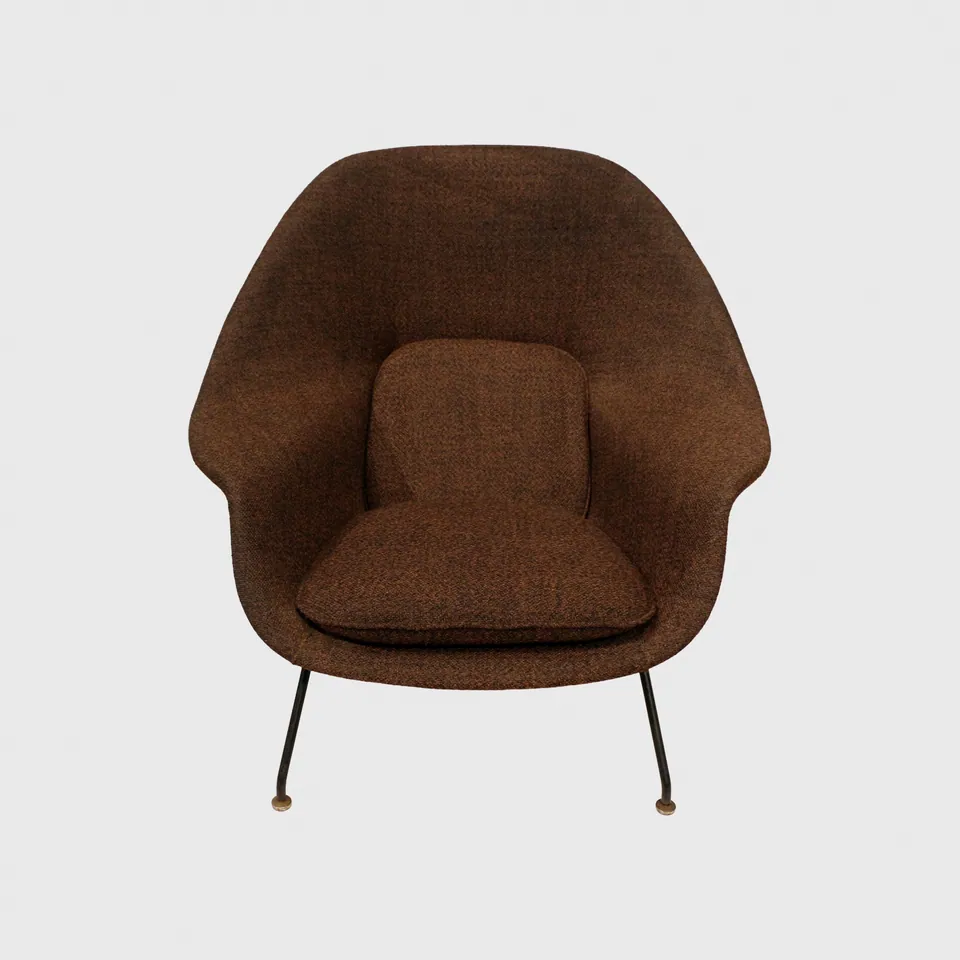
Nº 0210 · Lounge chair
Womb Chair
One fibreglass shell, to sit in any way.
Why it matters
It is a benchmark in both form and technology, in the V&A's words: one moulded shell carries seat, back and arms, made possible by materials developed in the war. Cooper Hewitt counts it, with its side chair and settee, among the first plastic chairs to be mass-produced.
Florence Knoll asked Saarinen for the chair in 1946, and Knoll Associates of New York was making it as model 70 by about 1948. It grew from the moulded plywood chairs that Saarinen and Charles Eames entered in a 1940 MoMA competition, which the war kept from production. The fibreglass shell is padded with foam, upholstered in wool and set on thin steel rods, with a loose seat and back cushion. Saarinen said he chose the name because many people have never felt comfortable and secure since they left the womb.
What to notice
- The shellSeat, back and arms are one moulded shell that curls around the sitter.
- Loose cushionsA separate seat and back cushion rest inside the upholstered shell.
- Rod legsThin steel rods hold the heavy-looking shell clear of the floor.
3 min read
The full story
The big one first
In 1940 Eero Saarinen and Charles Eames, both teaching at the Cranbrook Academy of Art in Michigan, entered two moulded plywood armchairs in the Museum of Modern Art’s competition Organic Design in Home Furnishings. They won, and then the war stopped any manufacture. Saarinen spent it with the Office of Strategic Services, the American intelligence service, and the V&A records that he is said to have gone on designing furniture there. A model of a large lounge chair existed by 1945.
In this story
- The big one first
- A boat builder’s resin
- Sideways, or any other way
- Still moulded at Knoll

The story continues in the app
- Materials
- Fibreglass shell, foam padding, wool upholstery, steel rod legs
- Dimensions
- 92 × 103 × 91 cm (V&A)
- Model
- Knoll model 70; a side chair, settee and ottoman were made to match
- In collection
- Victoria and Albert Museum · Cooper Hewitt · Brooklyn Museum · Milwaukee Art Museum
- Status
- Real · designed by 1946, made by Knoll from about 1948
Connections
- Eero Saarinen
- Knoll
- Postwar era
- Furniture design
- Plastic
- Wool
- Textile
- Steel
- New York
Nearby in the archive
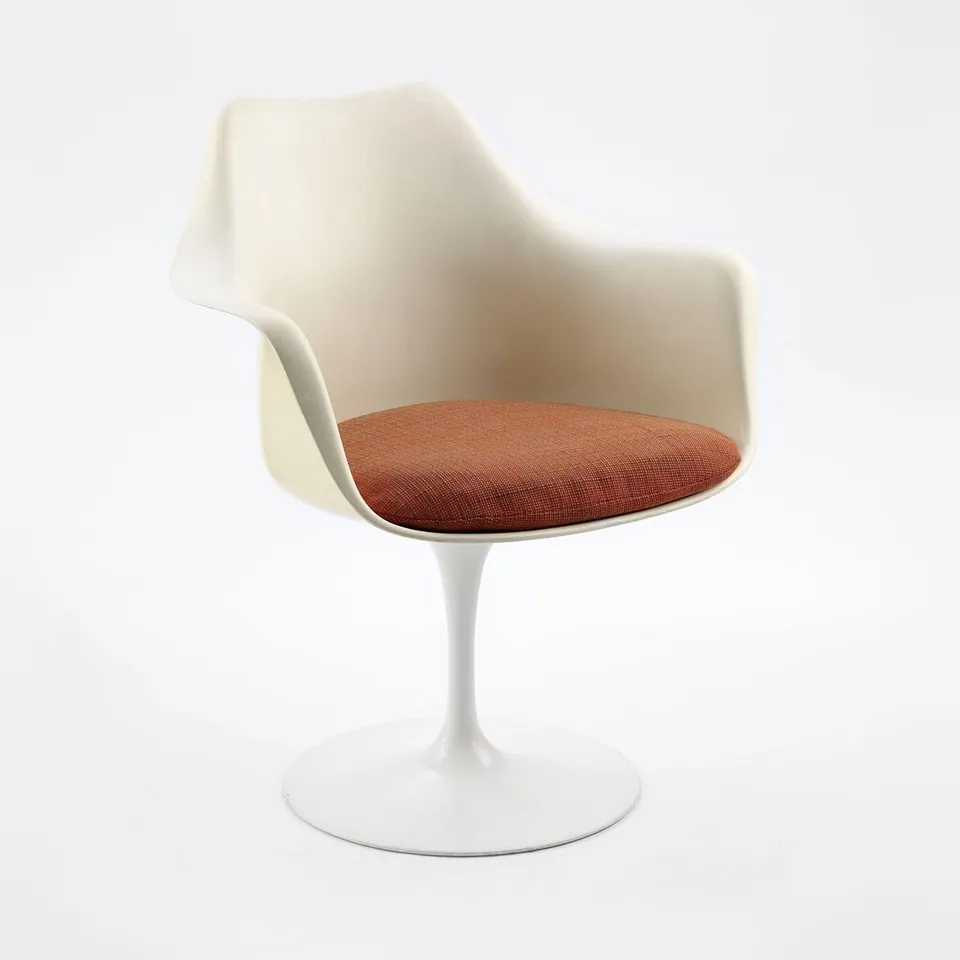 Tulip ChairSaarinen · 1956 · his later Knoll chair, on a single stem
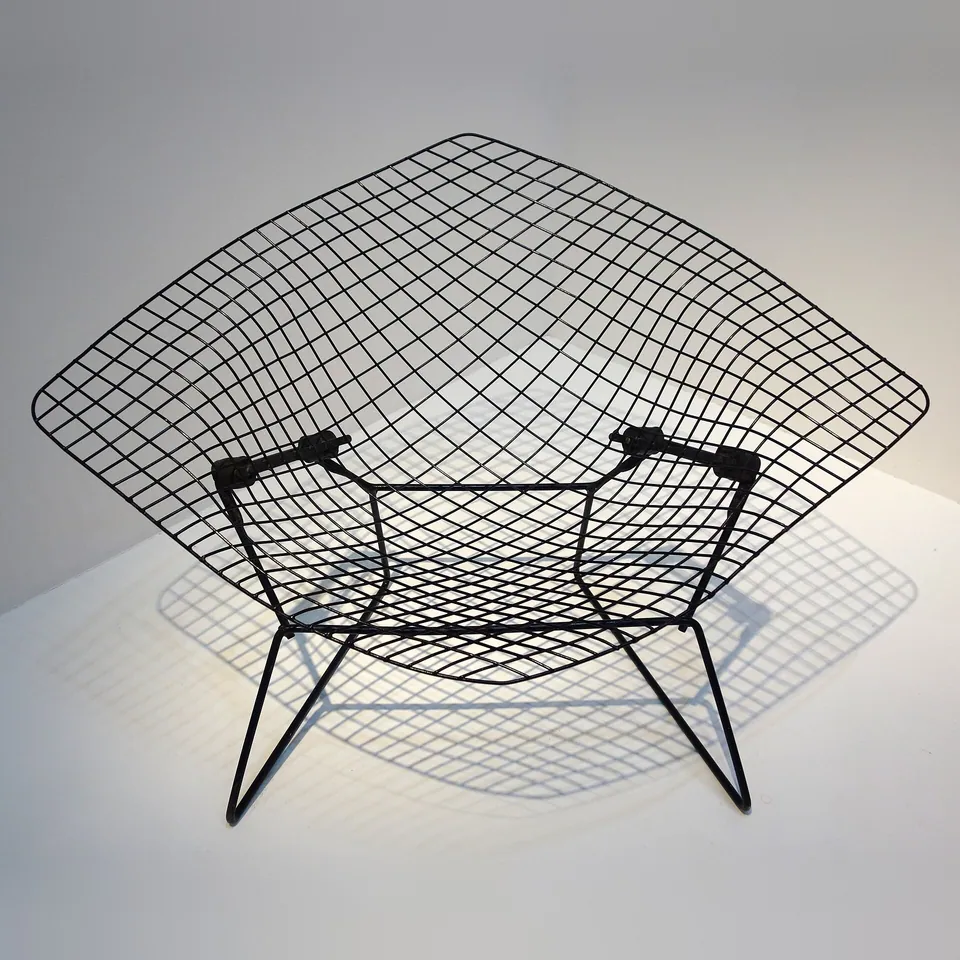 Diamond ChairBertoia · 1952 · another Knoll seat shaped as one shell
In collections
Go further
- Eero Saarinen: Furniture for Everyman, Brian Lutz (2012)The first monograph given over entirely to Saarinen’s furniture, published by Pointed Leaf Press.
- Eero Saarinen: Shaping the Future, Eeva-Liisa Pelkonen and Donald Albrecht (eds), Yale University Press (2006)A survey of the whole career, including the furniture chapter by Brian Lutz that the V&A cites for the origin of the chair’s name.
- Womb chair, W.35-2008, Victoria and Albert MuseumThe museum record for Claire Falkenstein’s chair, with a careful account of the dates and of its use in Cold War exhibitions.
- Womb Chair, KnollThe maker’s page, with Florence Knoll’s recollections of the commission and the chair as it is built today.
Sources
- Womb chair, W.35-2008, Victoria and Albert Museum
- Womb Chair and Ottoman, 1948, Cooper Hewitt, Smithsonian Design Museum
- Womb Chair, Model No. 70, Brooklyn Museum
- Wikipedia (English), Wikimedia Foundation

