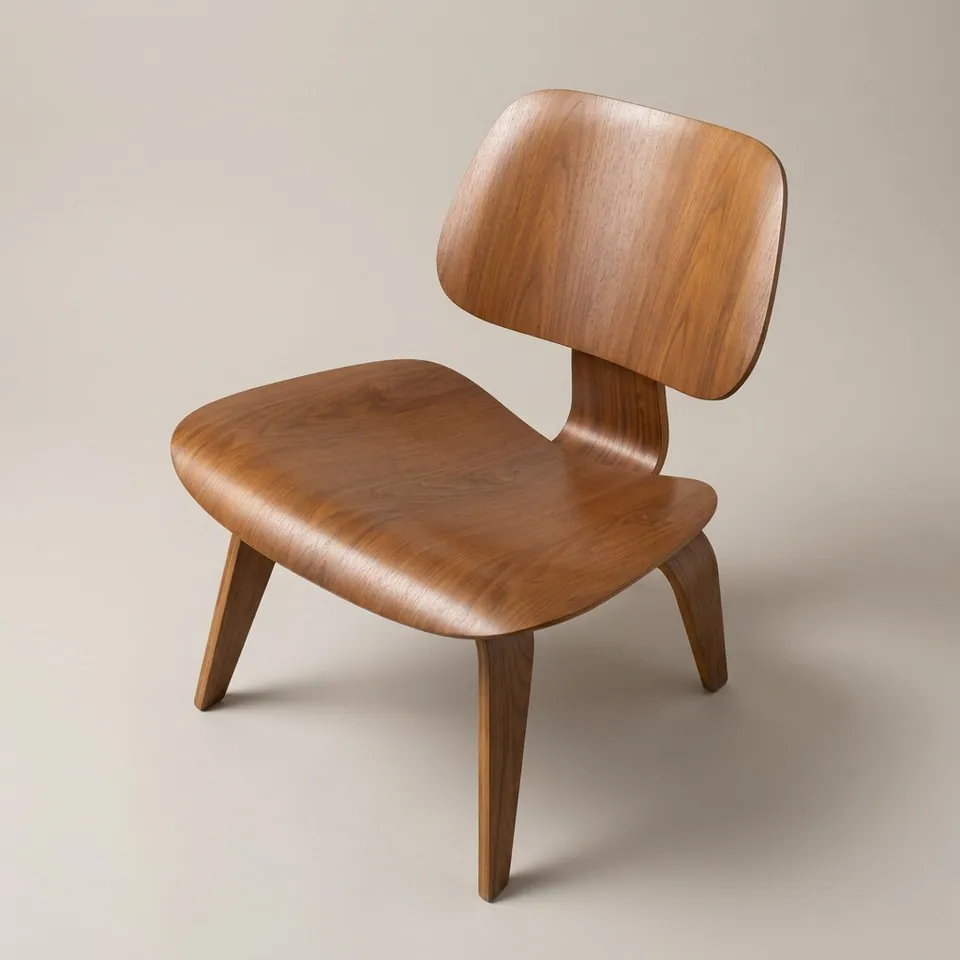
Nº 0157 · Lounge chair
LCW (Lounge Chair Wood)
Plywood moulded like the Navy leg splints before it.
Why it matters
Making plywood leg splints for the US Navy during the Second World War taught Charles and Ray Eames to mould plywood in three dimensions, and the LCW put that method into a chair for the home. Denver Art Museum notes that one material forms both the parts that carry the load and the parts that hold the sitter.
The Eameses designed the chair in 1945 and 1946. It has five moulded plywood parts: a seat and a back of five plies, joined by a curved spine to two U-shaped leg units of seven plies, with rubber shock mounts at the joints instead of bolts through the wood. The Evans Products Company made the first chairs in Venice, Los Angeles, for Herman Miller, which marketed them from 1946 and still makes the design. The chair photographed, with a teak veneer, belongs to the Honolulu Museum of Art.
What to notice
- The backThe back is a separate shell, curved to meet the shoulders, and stands clear of the seat.
- The spineA single curved plywood spine rises from under the seat to carry the back.
- The legsEach pair of legs is one bent plywood piece, splayed outward, with the plies visible at the edge.
3 min read
The full story
Splints before seats
In 1940 and 1941 Charles Eames and Eero Saarinen won first prizes in the Museum of Modern Art’s Organic Design competition with chairs built on a plywood shell curved in two directions. The war stopped factory work on them. In their Los Angeles apartment Charles and Ray Eames carried on alone, with a home-made press they named the Kazam! machine. Veneers and glue were stacked in a heated plaster mould and forced into shape by a rubber balloon, blown up with a bicycle pump.
In this story
- Splints before seats
- Splitting the shell
- A chair in a barrel
- One material, still made

The story continues in the app
- Materials
- Moulded plywood with a wood veneer, rubber shock mounts
- Dimensions
- About 68 × 56 × 59 cm, seat 39 cm high (V&A example)
- Maker
- Evans Products Company for Herman Miller
- In collection
- V&A · Art Institute of Chicago · The Met · Denver Art Museum · Honolulu Museum of Art
- Status
- Real · still made by Herman Miller
Connections
- Charles Eames
- Ray Eames
- Evans Products Company
- Herman Miller
- Postwar era
- Furniture design
- Plywood
- Wood
- Los Angeles
Nearby in the archive
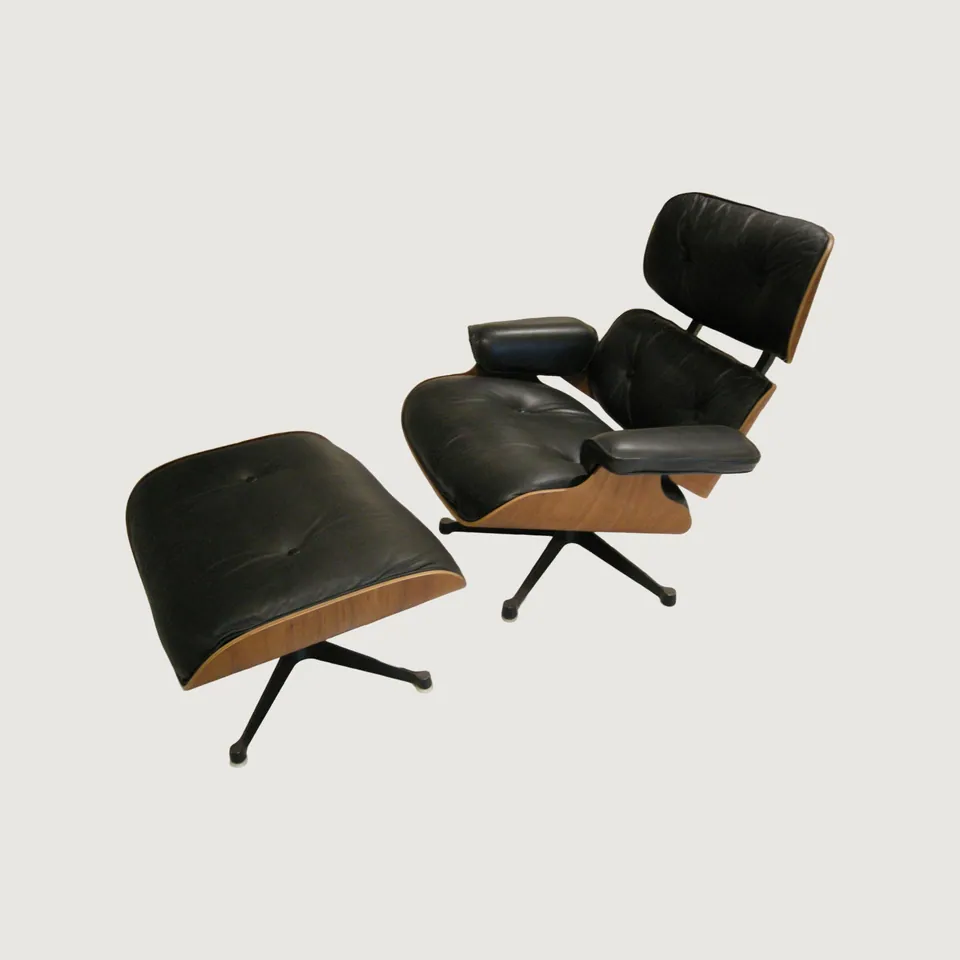 Eames Lounge ChairEames · 1956 · the same designers, plywood with leather
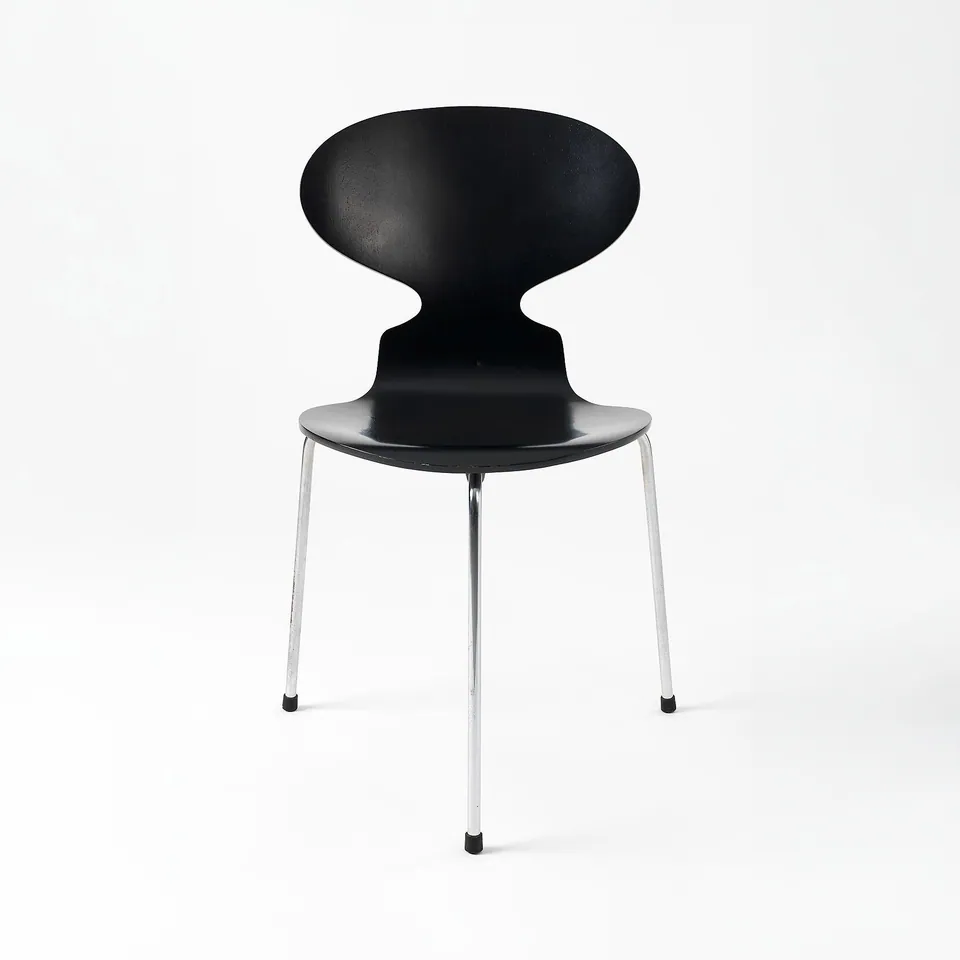 Ant ChairJacobsen · 1952 · seat and back in one plywood shell, not two
In collections
Go further
- Eames Design: The Work of the Office of Charles and Ray Eames, John Neuhart, Marilyn Neuhart and Ray Eames (1989)A year-by-year record of every project the office produced, including the wartime plywood work and the 1946 chairs.
- New Furniture Designed by Charles Eames, The Museum of Modern ArtThe museum’s page for the 1946 exhibition, with installation photographs and the original three-page press release.
- LCW (Lounge Chair Wood), W.17-1989, Victoria and Albert MuseumThe collection record for a chair made by Evans, with a close physical description and its history in a Los Angeles house.
- The Work of Charles and Ray Eames: A Legacy of Invention, Furniture, Library of CongressThe furniture section of the Library’s Eames exhibition, showing the experimental shells that came before the two-piece chair.
Sources
- LCW (Lounge Chair Wood), W.17-1989, Victoria and Albert Museum
- Lounge Chair (model LCW), 1970.1049, Art Institute of Chicago
- "LCW" Side Chair, 1984.566, The Metropolitan Museum of Art
- Lounge Chair (model LCW), 1984.104, Denver Art Museum
- Wikipedia (English), Wikimedia Foundation

