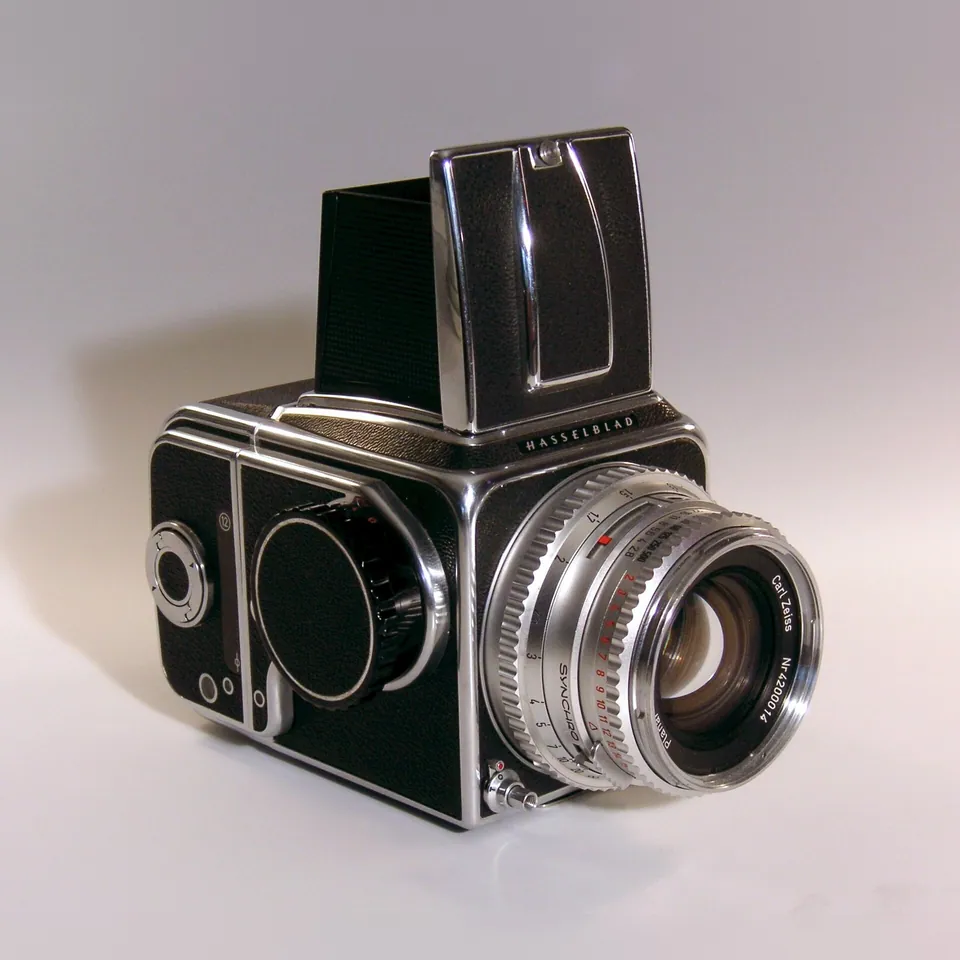
Nº 0246 · Medium-format camera
Hasselblad 500C
A cube of parts that swap: lens, back, finder.
Why it matters
The 500C moved the shutter from the body into each lens, which let one body take interchangeable lenses, film magazines and viewfinders and fire electronic flash at every speed. Hasselblad records that NASA adopted its cameras after Walter Schirra carried his own 500C on the Mercury 8 flight in 1962.
Victor Hasselblad’s company in Gothenburg introduced the 500C in 1957 and made it until 1970, when the 500C/M replaced it. It gave up the focal-plane shutter of the earlier 1600F and 1000F for a leaf shutter in each lens; the standard lens was a Zeiss Planar 80 mm f/2.8 in a Synchro-Compur shutter. The Nasjonalmuseet in Oslo credits the design to Sixten Sason, who had designed Hasselblad’s first civilian camera, the 1600F of 1948. The cameras used on the Moon from 1969 were the motorised 500EL, not this model.
What to notice
- The lensA chrome Zeiss Planar in a Synchro-Compur shutter, with rings for speed and aperture.
- The finderThe folding waist-level finder sits on top and can be exchanged for others.
- The magazineThe film magazine at the back is a separate unit that detaches from the body.
3 min read
The full story
From air force to hand camera
In April 1940 Victor Hasselblad set up a camera workshop in a shed at a Gothenburg car works, after the Swedish Air Force asked him for an aerial camera modelled on a German one that had been recovered. The result, the HK-7, went into series production in 1941, and 240 were made by 1943. Even then, the company's history says, he did not intend to make cameras only for the military.
In this story
- From air force to hand camera
- A shutter in every lens
- Six orbits with Schirra
- Thirteen years, then a family

The story continues in the app
- Format
- 6 × 6 cm on 120 roll film
- Dimensions
- About 10.5 × 11 × 17 cm (Nasjonalmuseet example)
- Materials
- Cast metal, plastic, glass
- In collection
- Nasjonalmuseet · Science Museum Group · Ingenium
- Status
- Real · made 1957 to 1970
Connections
Nearby in the archive
In collections
Go further
- Hasselblad System Compendium, Richard Nordin (2003)A 288-page reference to the Hasselblad cameras, lenses and accessories and their history.
- 500 Series, HasselbladThe maker's own account of the 500C, its production figures and the models that followed it.
- Hasselblad in Space, HasselbladHow Schirra's 500C was modified for Mercury 8 and how NASA's use of the cameras grew from there.
- Camera, Hasselblad, 70mm, with Lens, National Air and Space MuseumThe museum record for a flight camera like Schirra's, with measurements of body, lens and magazine.
- First Hasselblad Camera in Space Sells for $275,000, Robert Z. Pearlman (2014)A report on the sale of Schirra's flown camera, with his account of how he chose and bought it.
Sources
- Hasselblad 500C, NMK.LAAN.2021.0002, Nasjonalmuseet, Oslo
- Hasselblad 500C Camera, 1983-5132, Science Museum Group
- Camera, 1995.1297.001, Ingenium, Ottawa
- The Hasselblad 500 Series, Hasselblad
- Hasselblad in Space, Hasselblad
- Hasselblad 500 C (1957), Mike Eckman
- Apollo 11 Hasselblad cameras, NASA Apollo Lunar Surface Journal

