Nº 0084 · Camera
Leica I
Cine film run sideways through a pocket camera.
Why it matters
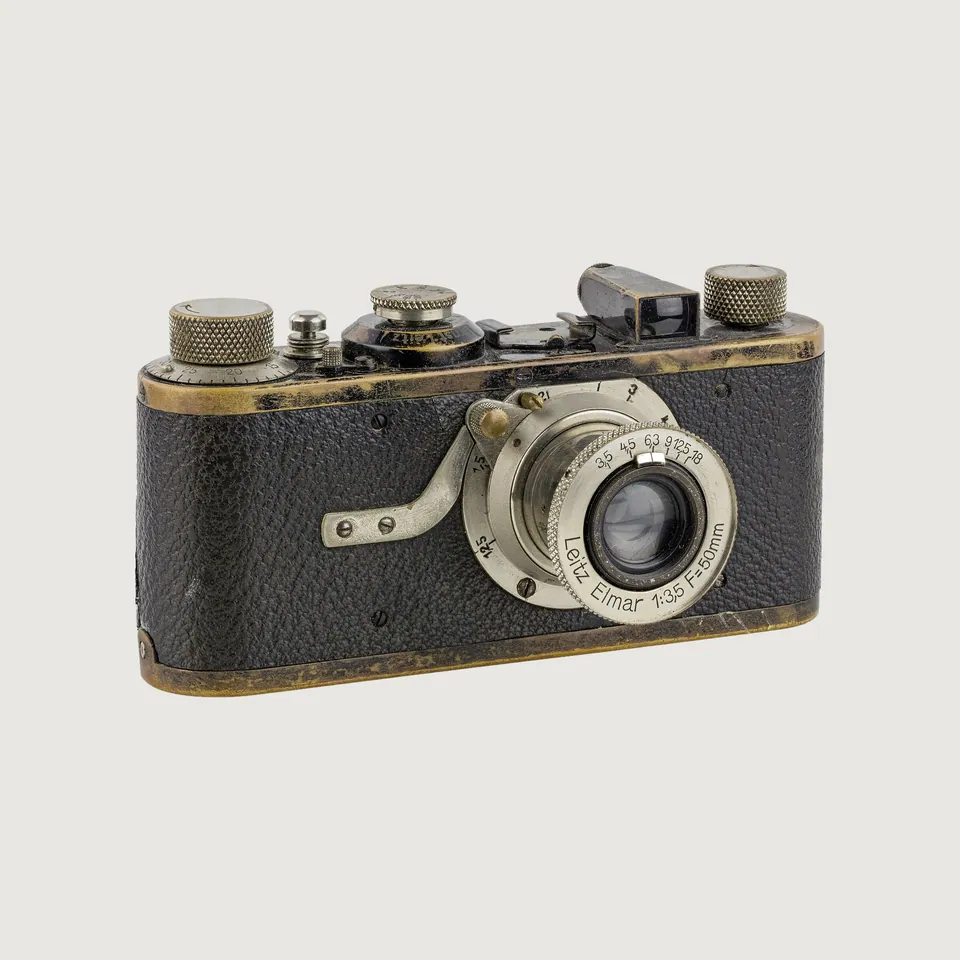
The Leica I was the first commercial Leica and, in the Science Museum Group's description, the first mass-produced 35 mm camera. Running 35 mm cine film sideways gave it a 24 × 36 mm frame, in a body small enough to carry all day.
Oskar Barnack, an engineer at Ernst Leitz in Wetzlar, built a prototype, the Ur-Leica, in 1913 or 1914. Leitz showed the production camera at the Leipzig Spring Fair in 1925 and sold roughly a thousand in the first year. It had a focal plane shutter from 1/20 to 1/500 second, a direct vision finder and a fixed 50 mm f/3.5 lens: first the Anastigmat, then the Elmax, then the Elmar. The camera photographed here is No. 5193 of 1926 or 1927, with an Elmar lens.
What to notice
- The Elmar lensLeitz Elmar 1:3,5 F=50mm is engraved on the lens ring.
- The finderA small direct vision finder sits on the top plate.
- The wind-on knobA knurled knob on the top plate winds the film on.
3 min read
The full story
A test strip for cine film
Oskar Barnack joined Ernst Leitz in Wetzlar in 1911, aged 32, after leaving Zeiss. Leitz was a microscope maker, and Barnack worked there on a cine camera that used the standard 35 mm film of the cinema. Film stock of the time varied in speed, so he built a small metal device to expose short test lengths. In 1913 or 1914 he carried the idea over into a still camera, the Ur-Leica.
In this story
- A test strip for cine film
- Small negative, sharp lens
- Stands 194 and 195
- The frame outlasts the film

The story continues in the app
- Frame
- 24 × 36 mm on 35 mm film
- Lens
- Fixed 50 mm f/3.5
- Name
- Leica, from Leitz and camera
- In collection
- Science Museum Group
- Status
- Real · production ended
Connections
Nearby in the archive
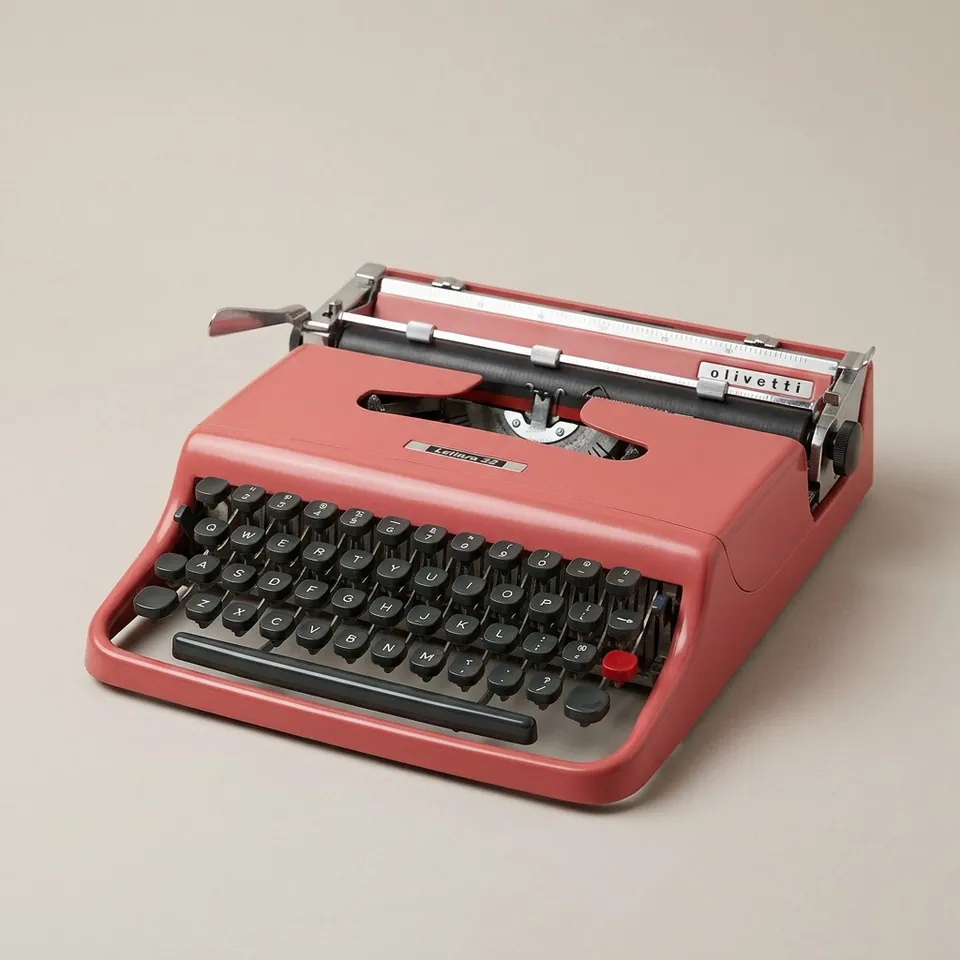 Lettera 22Nizzoli · 1950 · a working tool made small enough to carry
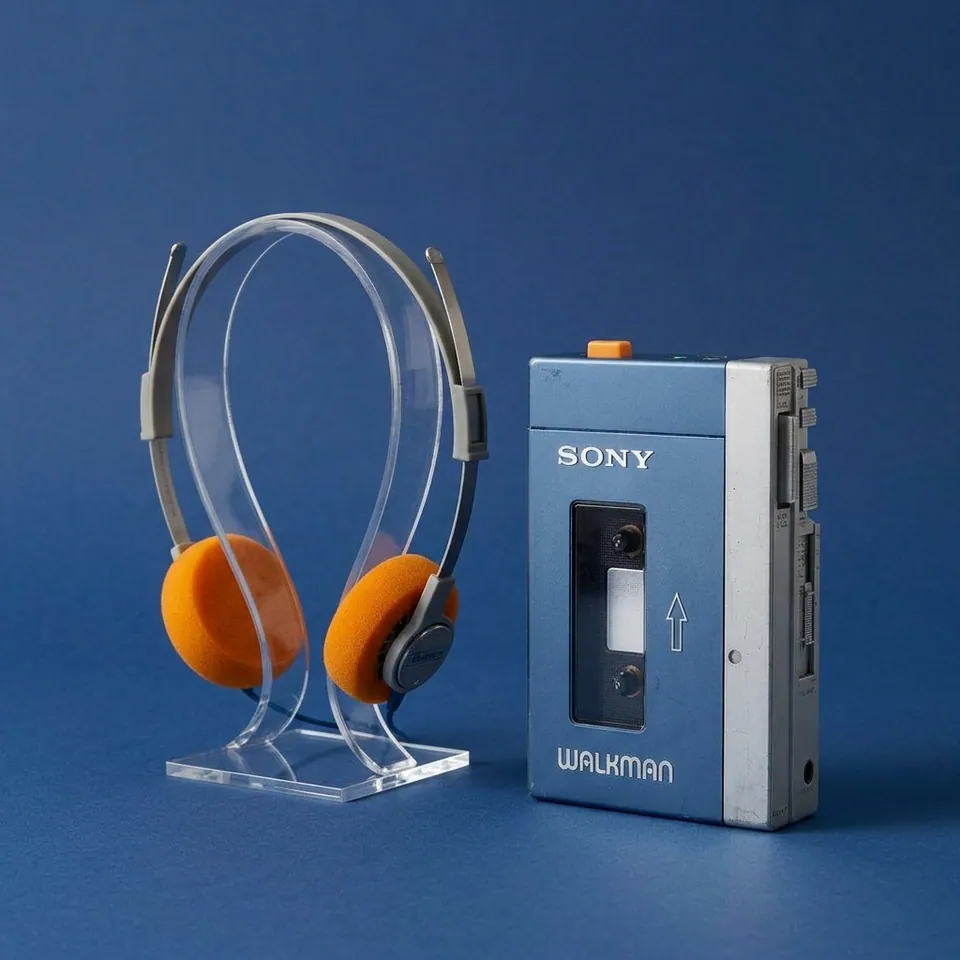 Walkman TPS-L2Sony · 1979 · another machine built around a small format
In collections
Go further
- Leica Collectors Guide, Dennis Laney (1992)A reference guide to Leica cameras, lenses and accessories from the first models onwards, with a short history of the Leitz company.
- Eyes Wide Open! 100 Years of Leica Photography, Hans-Michael Koetzle (2015)A 563-page survey of the photographs made with Leica cameras over a century.
- How the World's first Leica camera came to be, John Wade, Amateur Photographer (2025)A camera historian traces the steps from Barnack's exposure tester to the Ur-Leica, the trial series and the first production models.
- Leica I camera, object 1990-5036/1714, Science Museum GroupThe museum record for a 1930 Leica I from the Kodak Collection, with a description and measurements.
- Ernst Leitz Museum, Leitz-Park, WetzlarVisitor page for the museum of photography at Leitz-Park in Wetzlar.
Sources
- Leica 1 Camera, 1979-559/750, Science Museum Group
- Leica I camera, 1990-5036/1714, Science Museum Group
- The Historic and Groundbreaking Leica I 35mm Camera Turns 100 Years Old Today, PetaPixel
- How the World's first Leica camera came to be, Amateur Photographer
- Leica Camera, Wikipedia

