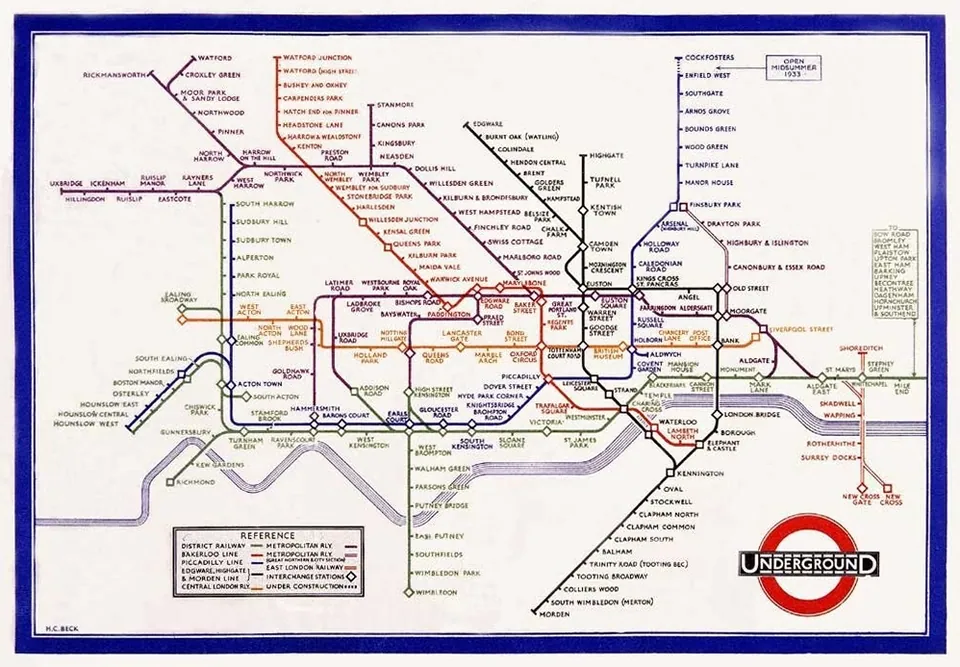
Nº 0422 · Diagram
London Underground diagram
A railway map redrawn as a circuit diagram, first printed in 1933.
Why it matters
Harry Beck gave up geographic accuracy and kept the connections between stations, and passengers found the result easier to use. He remained the principal designer of the Tube map until 1959.
Harry Beck, an electrical draughtsman, based his diagram on electrical circuit diagrams. He used only horizontal, vertical and 45-degree lines and enlarged the central area. The publicity department first judged it too radical, a trial in 1932 succeeded, and it was first printed in 1933.
2 min read
The full story
A draughtsman between jobs
Harry Beck was born in Leyton, Essex, in 1902. He joined London Underground in the mid-1920s as a junior draughtsman in the signal engineers’ office, where he drew electrical circuit diagrams, and over the next six years his work was intermittent. He was unemployed when he developed his diagram.
In this story
- A draughtsman between jobs
- Straight lines and a larger middle
- Too radical
- Whose map is it

The story continues in the app
- First printed
- 1933
- Trial
- 1932
- Geometry
- Horizontal, vertical and 45-degree lines; enlarged centre
- Principal designer
- Harry Beck, until 1959
Connections
Nearby in the archive
Go further
- Harry Beck’s Tube map, Transport for LondonThe diagram’s origin and reception.
- How Harry Beck revolutionised the Tube map, London MuseumThe design’s geometry and Beck’s later years on the map.
Sources
- Harry Beck’s Tube map, Transport for London
- How Harry Beck revolutionised the Tube map, London Museum
- Harry Beck, Wikipedia
- Transforming the Tube map: Harry Beck’s iconic design, London Transport Museum
- Harry Beck, blue plaque, English Heritage
- Harry Beck, first edition of the London Underground map, January 1933, The Map House

