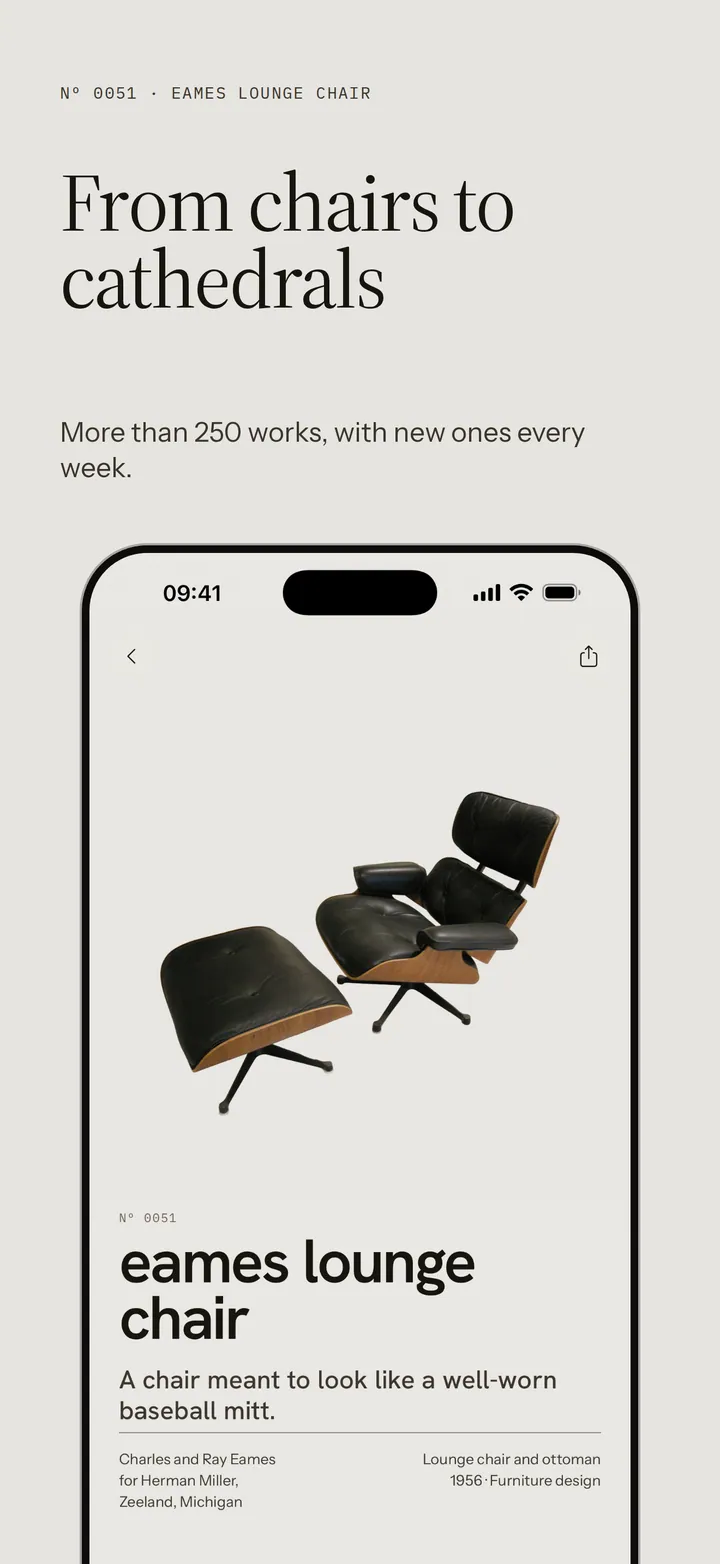
Nº 0147 · Synthesizer
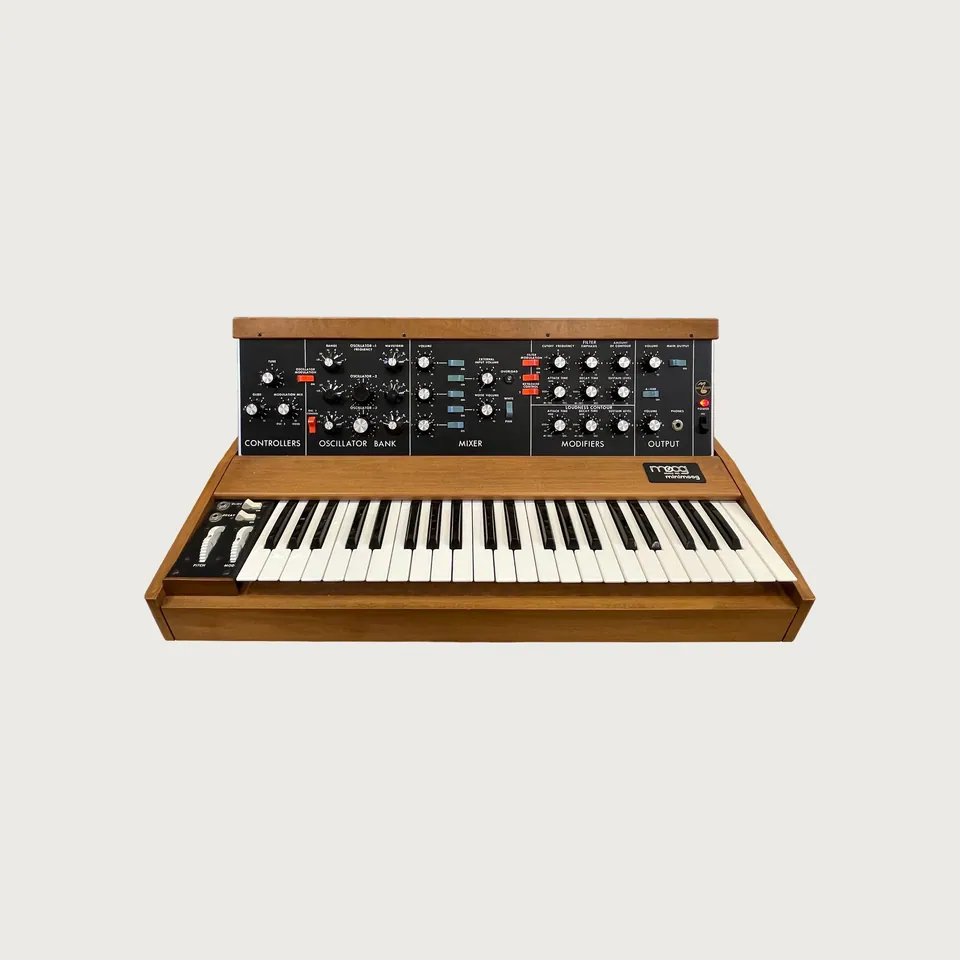
Minimoog Model D
Modular synthesizer sounds, without the patch cords.
Why it matters
The modular synthesizers before it had to be wired up with patch cords; the Minimoog put the main modules in one cabinet, so a player could change the sound while playing, with knobs, switches and wheels. Ingenium calls it the first synthesizer to become a classic, and more than 12,000 were made between 1970 and 1981.
It was developed at R. A. Moog Inc. in Trumansburg, New York: Bill Hemsath built the first prototype, the Min A, from a keyboard cut in half and spare modular parts, and Jim Scott led the project with Chad Hunt and Robert Moog. The production Model D followed in 1970. It has three oscillators and a low-pass filter, set from a panel that tilts up above a short keyboard. The company moved to Williamsville, near Buffalo, in 1971 and became Moog Music in 1973; the example photographed carries the Moog Music badge and comes from the collection of Van Taylor.
What to notice
- The oscillator bankThree oscillators, each set by a range knob and a waveform knob.
- Pitch and modulation wheelsTwo wheels left of the keys, marked pitch and mod.
- The filterThe filter and loudness contour knobs shape each note after the oscillators.
- The R. A. Moog badgeAn early example carries the R. A. Moog name, used before the firm became Moog Music.
3 min read
The full story
A keyboard sawn in half
In 1969 R. A. Moog Inc. of Trumansburg, New York, made modular synthesizers: cabinets of separate units that had to be joined with patch cords before they gave a sound. Late that year the engineer Bill Hemsath, working with Chad Hunt, wired five discarded 900 Series modules into a small wooden case with a three-octave keyboard. This was the Min A. It had two oscillators, a filter, an envelope generator and a slider for bending pitch, and the composer David Borden was the first to use it.
In this story
- A keyboard sawn in half
- Wheels instead of sliders
- Serial 1001 and after
- Out of production, then back

The story continues in the app
- Materials
- Wooden case, metal control panel, plastic keys and knobs
- Dimensions
- About 72 × 43 × 15 cm (Ingenium example)
- Built
- More than 12,000, 1970 to 1981
- In collection
- Ingenium, Canada (2005.0095.001)
- Status
- Real · reissued by Moog Music
Connections
- Bill Hemsath
- Jim Scott
- Chad Hunt
- Robert Moog
- R. A. Moog Inc. (Moog Music)
- Space Age
- Instrument making
- Wood
- Trumansburg, New York
Nearby in the archive
In collections
Go further
- Analog Days: The Invention and Impact of the Moog Synthesizer, Trevor Pinch and Frank Trocco (2002)A history of the Moog synthesizer built on interviews with the engineers, salesmen and musicians involved.
- The Birth of the Minimoog, Bob Moog Foundation / MoogseumAn illustrated account of the four prototypes, A to D, with who built each and what changed.
- Sun Ra & the Minimoog, Thom HolmesA historian traces how Sun Ra came to own a prototype and the first recordings he made with it.
- Minimoog Model D Synthesizer, object 2005.0095.001, Ingenium, Canada's Museums of Science and InnovationThe museum record for Paul Hoffert's 1971 example, with materials, measurements and a short history.
- Moog Minimoog Model D, Gordon Reid, Sound On Sound (2016)A detailed review of the 2016 reissue that compares it part by part with an original instrument.
Sources
- Minimoog Model D Synthesizer, 2005.0095.001, Ingenium, Canada Science and Technology Museums
- MinA Prototype, Bob Moog Foundation, Moogseum, on Google Arts and Culture
- Moog Minimoog D, EBOARDMUSEUM, on Google Arts and Culture
- Wikipedia (English), Wikimedia Foundation