Nº 0121 · Puzzle
Rubik’s Cube
Built to show students how a structure moves.
Why it matters
Rubik made the cube to show his students how the parts of a three-dimensional structure could move while the whole held together, and its coloured faces turned the model into a puzzle. The V&A records that it won design prizes and was shown at MoMA in 1981.
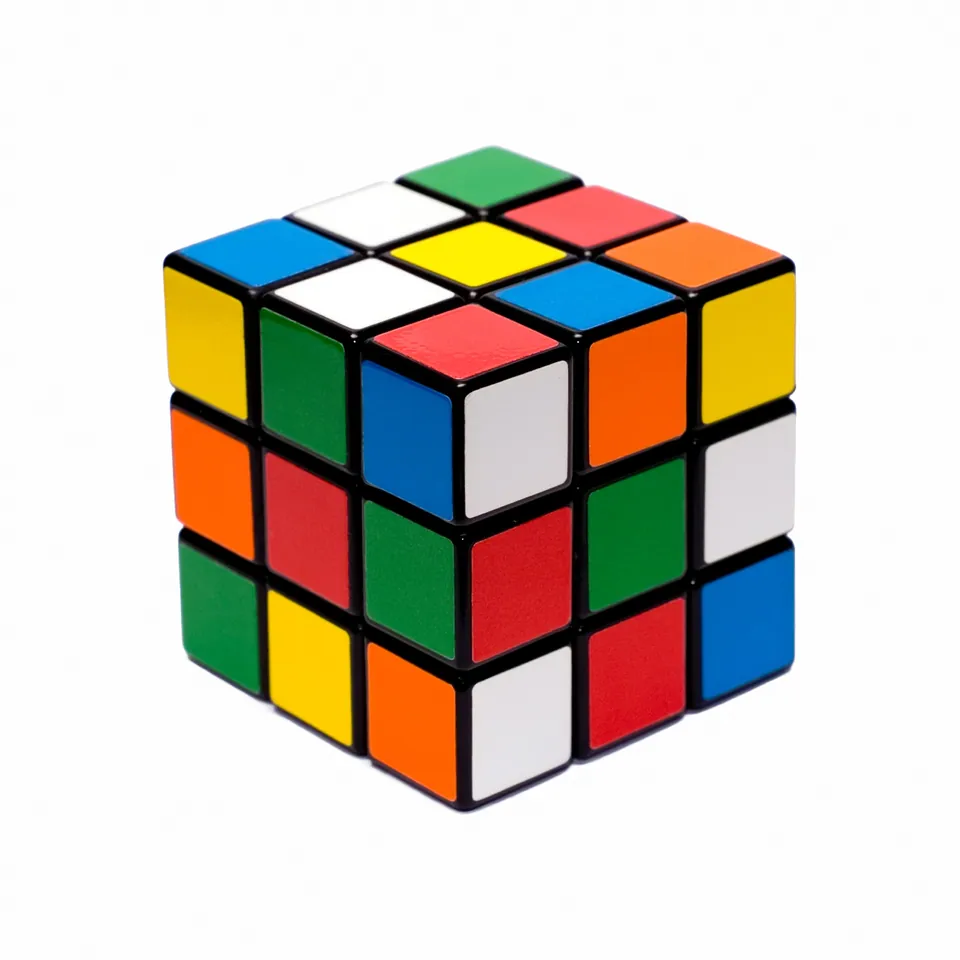
Ernő Rubik, who taught interior design at the Academy of Applied Arts and Crafts in Budapest, made the first working model in 1974 and applied for a Hungarian patent on 30 January 1975. Sold in Hungary as the Magic Cube, it was in Budapest toy shops by late 1977. Tibor Laczi took it to the Nuremberg Toy Fair in 1979, where Tom Kremer of Seven Towns saw it, and the Ideal Toy Corporation launched it as Rubik’s Cube in 1980. The cube in the photograph is a recent production example.
What to notice
- A corner pieceA corner piece carries three colours, one on each face it touches.
- A centre squareThe centre squares stay fixed relative to each other; the layers turn around them.
- The gridEach face is a 3 × 3 grid of coloured squares on a black plastic body.
3 min read
The full story
A model that fell apart
Ernő Rubik was born in Budapest in 1944, the son of an engineer who designed gliders and a mother who was a writer and artist. He took an architecture degree in 1967 and went on to teach interior design at the Academy of Applied Arts and Crafts. In the spring of 1974 he set himself a construction problem: a block of small cubes in which each layer could turn without the block coming to pieces.
In this story
- A model that fell apart
- Held by its own shape
- Two years of mania
- Twenty moves at most

The story continues in the app
- Construction
- 26 visible cubelets turning on a hidden central mechanism
- Colours
- Red, white, green, blue, yellow, orange
- Dimensions
- About 5.7 cm a side
- Patent
- Hungarian application, 30 January 1975
- In collection
- V&A, MISC.524-1988; Science Museum Group, Y1988.641.2
Connections
Nearby in the archive
 TetrisPajitnov · 1984 · a puzzle of turning shapes, ten years later
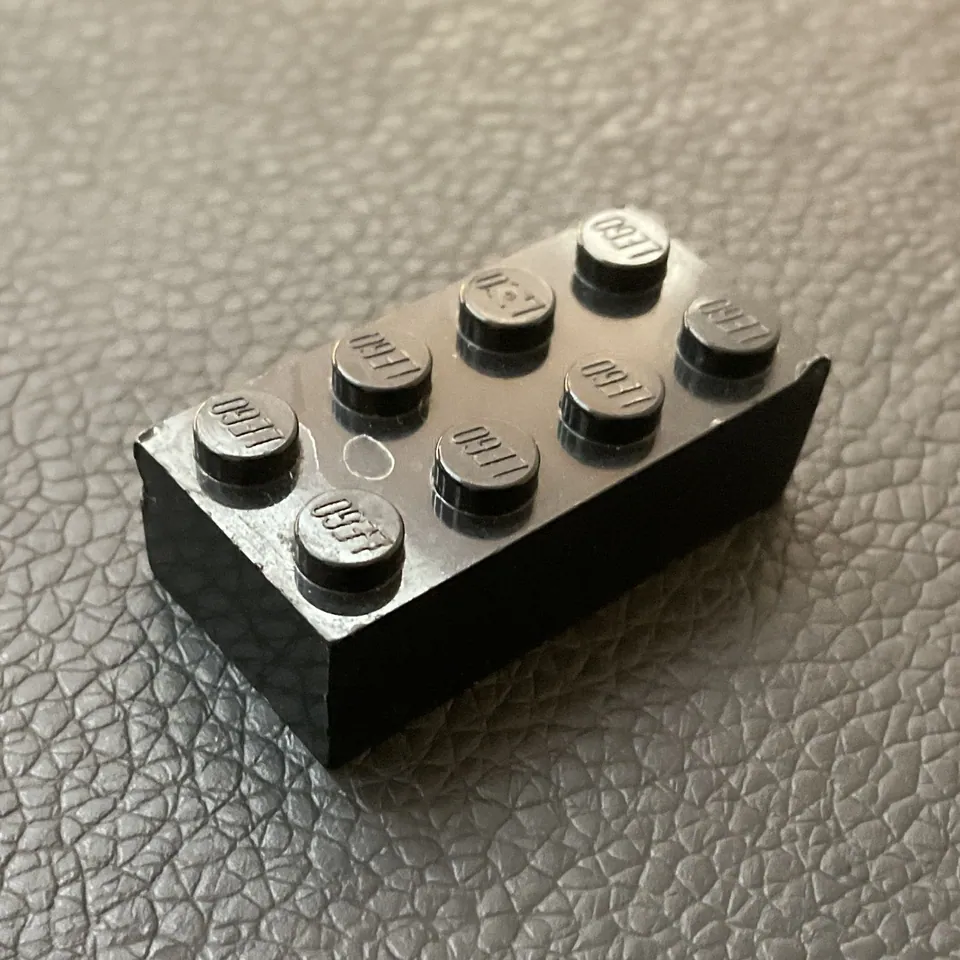 LEGO brickChristiansen · 1958 · a plastic toy built from one geometric system
In collections
Go further
- Cubed: The Puzzle of Us All, Ernő Rubik (2020)Rubik’s own account of making the cube and of what followed, written more as reflection than as chronology.
- A Brief History of the Rubik’s Cube, Hope Reese, Smithsonian Magazine (2020)A short history built around Rubik’s memoir, from the first wooden blocks to speed-solving.
- Rubik’s Cube puzzle, MISC.524-1988, Victoria and Albert MuseumThe museum record for an English-made Ideal cube of about 1985, with photographs and a short summary.
- God’s Number is 20, Tomas Rokicki, Herbert Kociemba, Morley Davidson and John Dethridge (2010)The researchers’ own explanation of how they showed that no position needs more than 20 moves.
- Rubik’s Cube, National Toy Hall of Fame, The Strong National Museum of PlayThe 2014 induction entry, with the museum’s account of the early 1980s craze.
Sources
- Erno Rubik, Lemelson-MIT
- Rubik’s Cube puzzle (MISC.524-1988), Victoria and Albert Museum
- Rubik’s Cube (Y1988.641.2), Science Museum Group
- Half a century of the Rubik’s Cube, Telex
- Hungarian patent HU170062, Google Patents
- Wikipedia (English), Wikimedia Foundation

