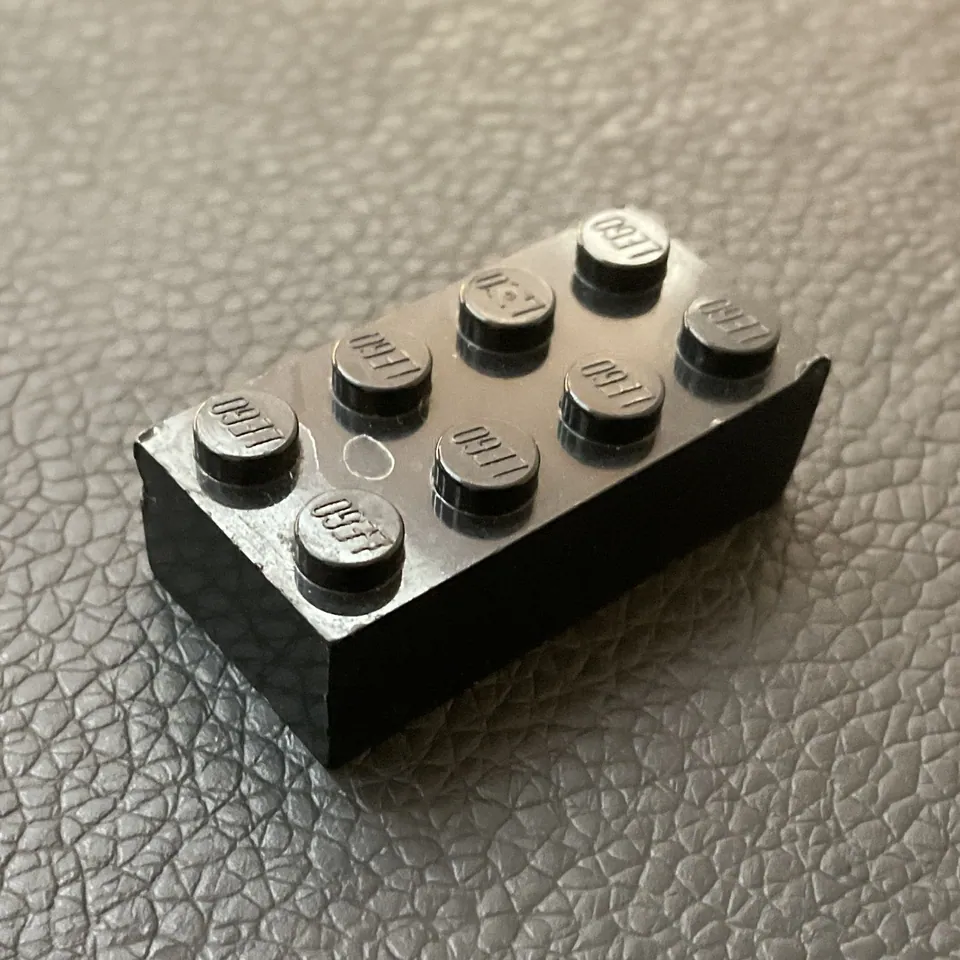
Nº 0122 · Toy building brick
LEGO brick
Tubes inside made the bricks hold together.
Why it matters
Earlier LEGO bricks were hollow, which limited how stable a model could be; the 1958 design added tubes inside the brick that hold the studs of the brick below. LEGO counts 915,103,765 ways to combine six 2 × 4 bricks of this kind.
On 23 January 1958 Godtfred Kirk Christiansen met Axel Thomsen, head of LEGO’s German sales office, about the stability problem and sketched several solutions, among them the tubes. LEGO filed the Danish application for a toy building element five days later, on 28 January 1958. The US patent, Toy Building Brick, granted in 1961, describes a hollow block open on one face, with cylindrical studs on top and tubes inside. Kiddicraft had made studded plastic bricks earlier, to Hilary Page’s design, and LEGO bought those rights in 1981.
What to notice
- The studsThe word LEGO is moulded into the top of every stud.
- Two by fourEight studs in two rows of four; the tubes that grip them are hidden underneath.
- The patent bricksClear bricks labelled Fig. 1 to Fig. 11 show the tubes inside.
3 min read
The full story
A buyer’s complaint
Ole Kirk Kristiansen, a carpenter in Billund, founded the company in 1932 to make wooden toys. Its first plastic injection-moulding machine arrived late in 1947, and in 1949 it launched Automatic Binding Bricks, small studded blocks whose design came from Hilary Fisher Page’s British firm Kiddicraft. They were moulded in cellulose acetate and were hollow underneath.
In this story
- A buyer’s complaint
- Tubes between the studs
- Wood dropped for plastic
- After the patents ran out

The story continues in the app
- Materials
- Cellulose acetate at first; ABS from 1963
- Patent
- Danish application 28 January 1958; US 3,005,282, granted 1961
- Combinations
- Six 2 × 4 bricks: 915,103,765 ways, by LEGO’s count
- Maker
- The LEGO Group, Billund
- On display
- Danmarks Tekniske Museum, Helsingør: the first patented bricks
Connections
Nearby in the archive
 Rubik’s CubeRubik · 1974 · a plastic toy built on one geometric system
 Nakagin Capsule TowerKurokawa · 1972 · a building assembled from standard units
In collections
Go further
- The LEGO Story: How a Little Toy Sparked the World’s Imagination, Jens Andersen, translated by Caroline Waight (2022)A history of the company and the family that owns it, from the carpentry workshop of 1932 onwards.
- Brick by Brick, David C. Robertson with Bill Breen (2013)An account of how LEGO nearly failed in the early 2000s and rebuilt its business around the brick.
- The stud and tube principle, The LEGO GroupThe company’s own short history of the January 1958 meeting and the patent application that followed.
- US Patent 3,005,282, Toy Building Brick, Godtfred Kirk Christiansen (1961)The full patent text and drawings, showing the tubes and the ways the elements join.
- LEGO System, object B.659:1-3-2010, Victoria and Albert MuseumThe museum record for a set of about 1970, with a summary of how the system developed from Hilary Page’s bricks.
Sources
- The stud and tube principle, The LEGO Group
- US Patent 3,005,282, Toy Building Brick, Google Patents
- LEGO System (B.659:1-3-2010), Victoria and Albert Museum
- Godtfred Kirk Christiansen, Lex.dk
- Wikipedia (English), Wikimedia Foundation

