Nº 0186 · Colour television
Sony Trinitron KV-1310
One gun, three beams, and a grille of wires.
Why it matters
The Trinitron used one electron gun with three cathodes in a line, and an aperture grille in place of the shadow mask, giving a brighter picture that held its alignment. IEEE Spectrum calls it the first major advance in colour television since the early 1950s. The Science Museum Group says it raised Sony’s standing and helped establish Japan as a maker of advanced electronics.
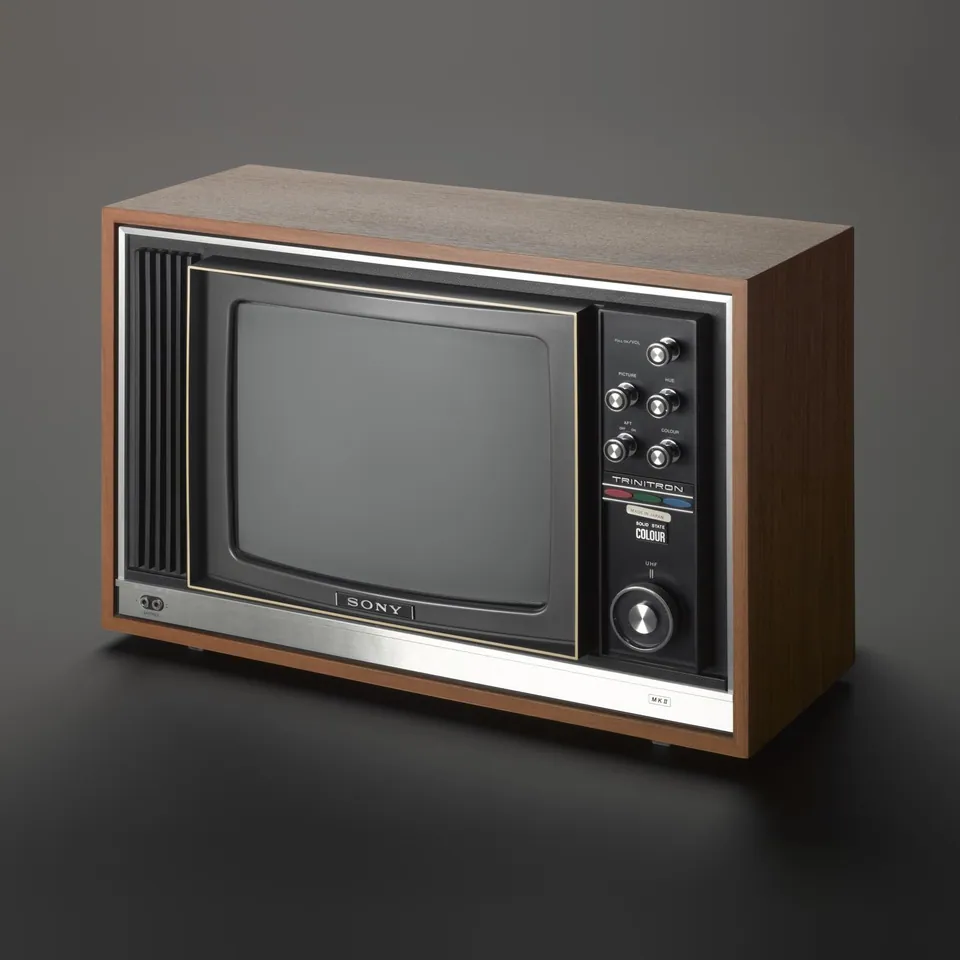
Sony built its own tube after the Chromatron design it licensed in 1961 proved unreliable in mass production. The team of Susumu Yoshida, Akio Ohgoshi and Senri Miyaoka, supervised by Masaru Ibuka, announced the Trinitron on 15 April 1968, and the first set, the KV-1310, was on sale in Japan that October; the US version, the KV-1210U, followed in 1969 at $319.95. No source read names a designer for the cabinet. The set photographed is a KV-1320UB of 1969 to 1970, a later 12-inch Trinitron in the Science Museum Group collection.
What to notice
- The Trinitron badgeThe Trinitron name over three bars in red, green and blue.
- The controlsChrome knobs for volume, picture, hue and colour in a column beside the screen.
- The cabinetA wood-grain cabinet with a brushed metal strip along the base.
3 min read
The full story
The Chromatron years
In 1961 Sony executives saw a colour set by Chromatic Television Laboratories at a trade show of the Institute of Radio Engineers and, by IEEE Spectrum’s account, agreed a licence more or less on the spot. The tube, called the Chromatron, followed an idea of the physicist Ernest O. Lawrence: a single electron gun, and a grid of charged wires in place of the perforated shadow mask used in other colour sets. Sony announced its Chromatron television in September 1964.
In this story
- The Chromatron years
- Three beams, one gun
- Ibuka’s October promise
- Forty years of tubes

The story continues in the app
- Technology
- One gun with three in-line cathodes, aperture grille
- First model
- KV-1310, on sale in Japan October 1968
- Materials (KV-1320UB)
- Wood, plastic and metal, 12-inch tube
- Sold
- 280 million Trinitron units, until 2008
- In collection
- Smithsonian NMAH (KV-1310) · Science Museum Group (KV-1320UB)
Connections
Nearby in the archive
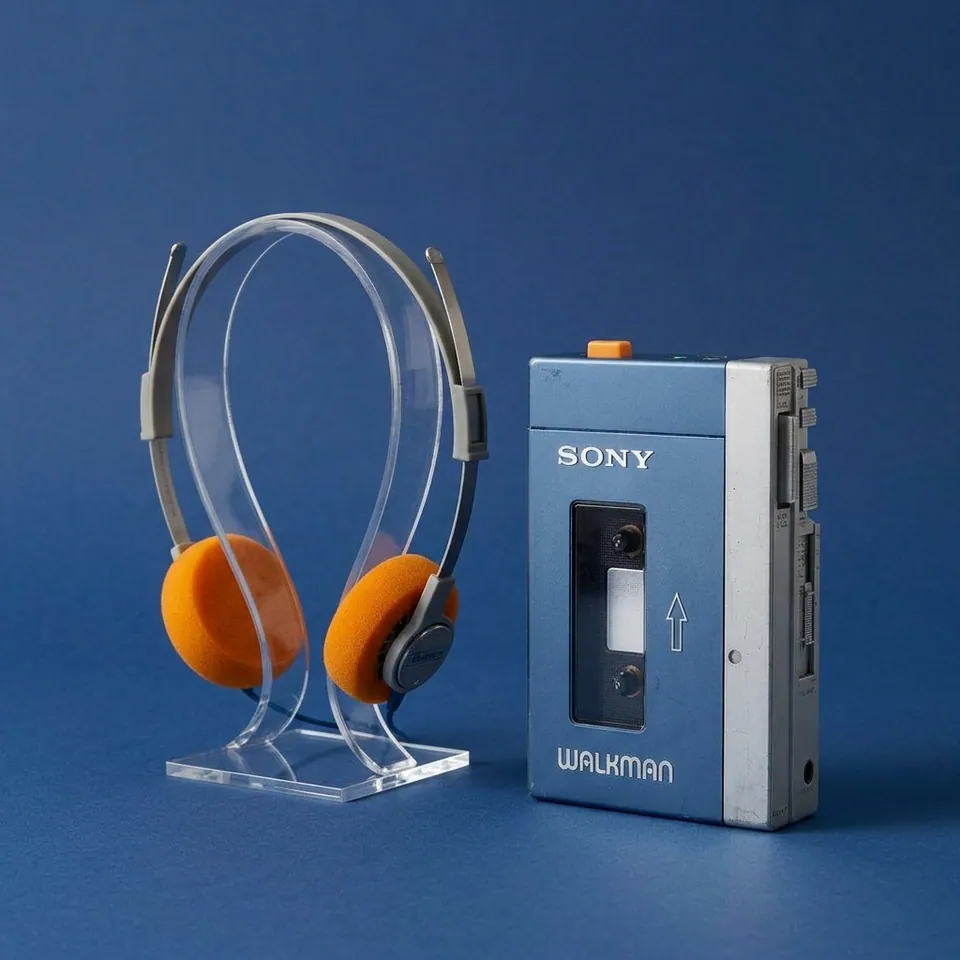 Walkman TPS-L2Sony · 1979 · Sony again, a decade later
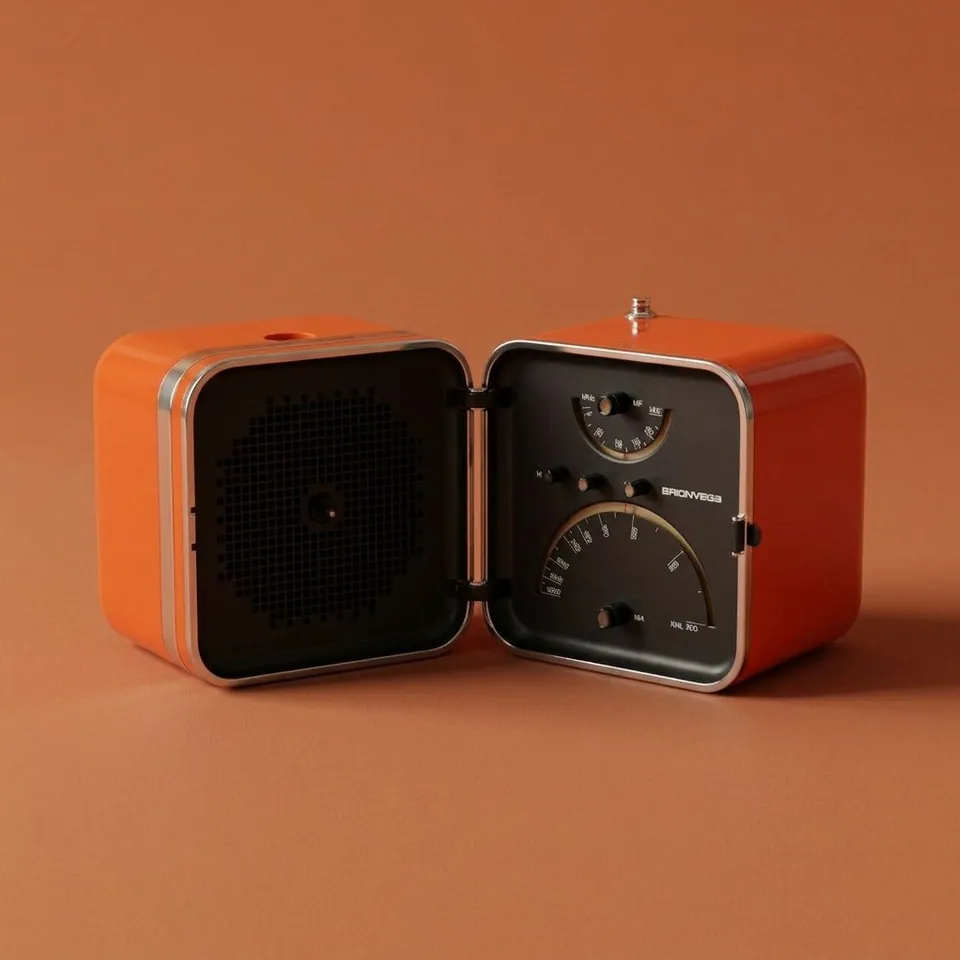 TS 502Marco Zanuso and Richard Sapper · 1964 · a set for the home from the same years
In collections
Go further
- Sony: The Private Life, John Nathan (1999)A history of the company and of its founders, Ibuka and Morita, drawn from interviews with its executives.
- Sony History, Chapter 16: Personal Reasons, Sony Group CorporationSony’s own account of the Chromatron’s failure, the single gun, the aperture grille and the April 1968 press conference.
- The Consumer Electronics Hall of Fame: Sony Trinitron, Brian Santo, IEEE Spectrum (2018)A short, clear explanation of how shadow mask tubes worked and what the Trinitron did differently.
- Sony ‘Trinitron’ Colour Television, 1969-1970, Science Museum GroupThe museum record for the KV-1320UB shown in the Information Age gallery, with photographs, materials and measurements.
- Sony “Trinitron” model KV 1310 color television receiver, Smithsonian National Museum of American HistoryThe Smithsonian record for a KV-1310 given to the museum by Sony.
Sources
- The Consumer Electronics Hall of Fame: Sony Trinitron, IEEE Spectrum
- Sony Trinitron colour television, 1969 to 1970, 2014-67, Science Museum Group
- Sony Trinitron model KV 1310 color television receiver, EM.334925, Smithsonian National Museum of American History
- Wikipedia (English), Wikimedia Foundation