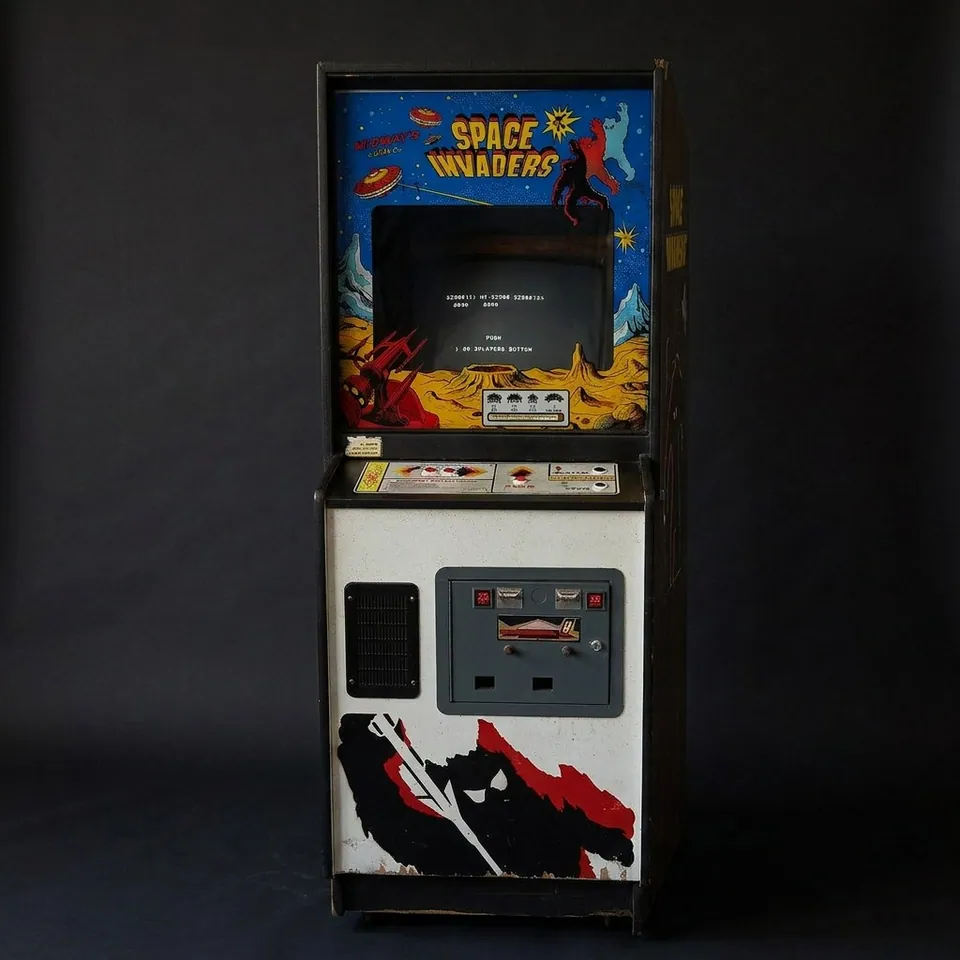
Nº 0072 · Arcade game
Space Invaders
Rows of aliens that march faster as they thin.
Why it matters
Its success showed that video games were not a passing fad and drew other Japanese companies into the market, The Strong says. It was the first Japanese game to use a microprocessor, and it made the on-screen high score a standard feature.
Tomohiro Nishikado, an engineer at Taito, designed the game, drew its graphics, wrote its sound and built its hardware himself, since microcomputers were then barely used in Japan. Taito released it in Japan in 1978, and Midway made it under licence for North America, with buttons in place of the joystick. The aliens speed up as their numbers fall, a side effect of the processor drawing fewer figures that Nishikado kept. Early screens were black and white, with strips of coloured cellophane laid over the monitor.
What to notice
- The screenThe screen shows the score line and a prompt to push the one or two player button.
- The points cardA card under the screen gives the points for each alien and for the mystery ship.
- The buttonsTwo buttons move the laser base left and right, a third fires: the Midway layout, with no joystick.
- The coin doorTwo coin slots, each marked 25 cents.
3 min read
The full story
Tanks, then Martians
Tomohiro Nishikado, an engineer who had joined Taito in 1969, began work on a new shooting game in 1977. He took the grid of targets from Atari’s Breakout, in which a ball knocks bricks out of a wall, and let the targets fire back. His first idea had the player shooting at tanks, aeroplanes and soldiers. By his own account, Taito refused: there were to be no human targets and nothing that looked like war.
In this story
- Tanks, then Martians
- One engineer, one processor
- Bowling alleys, then living rooms
- Thirty-eight years to the hall

The story continues in the app
- Hardware
- Intel 8080 processor
- Screen
- Black and white, under a colour overlay
- Maker
- Taito, Tokyo · Midway, under licence
- In collection
- Centre for Computing History, Cambridge · World Video Game Hall of Fame, 2016
- Status
- Real · original cabinets survive
Connections
Nearby in the archive
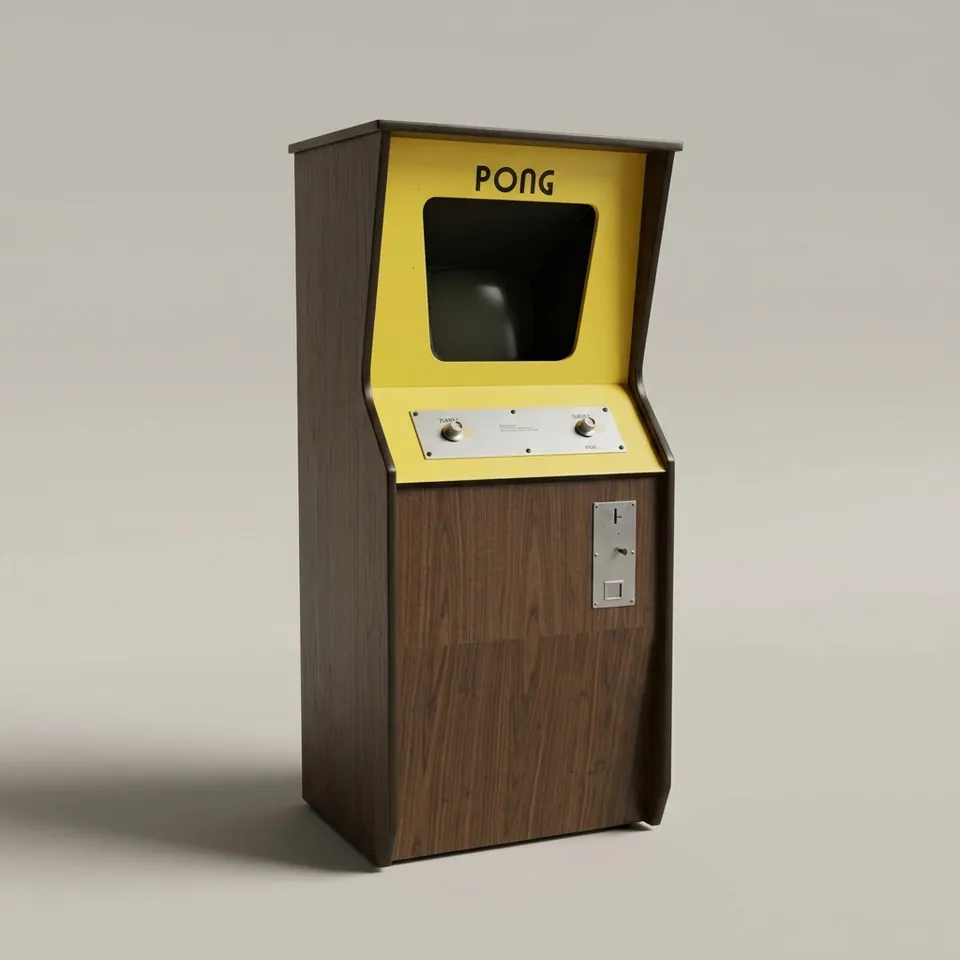 PongAtari · 1972 · the arcade before the microprocessor
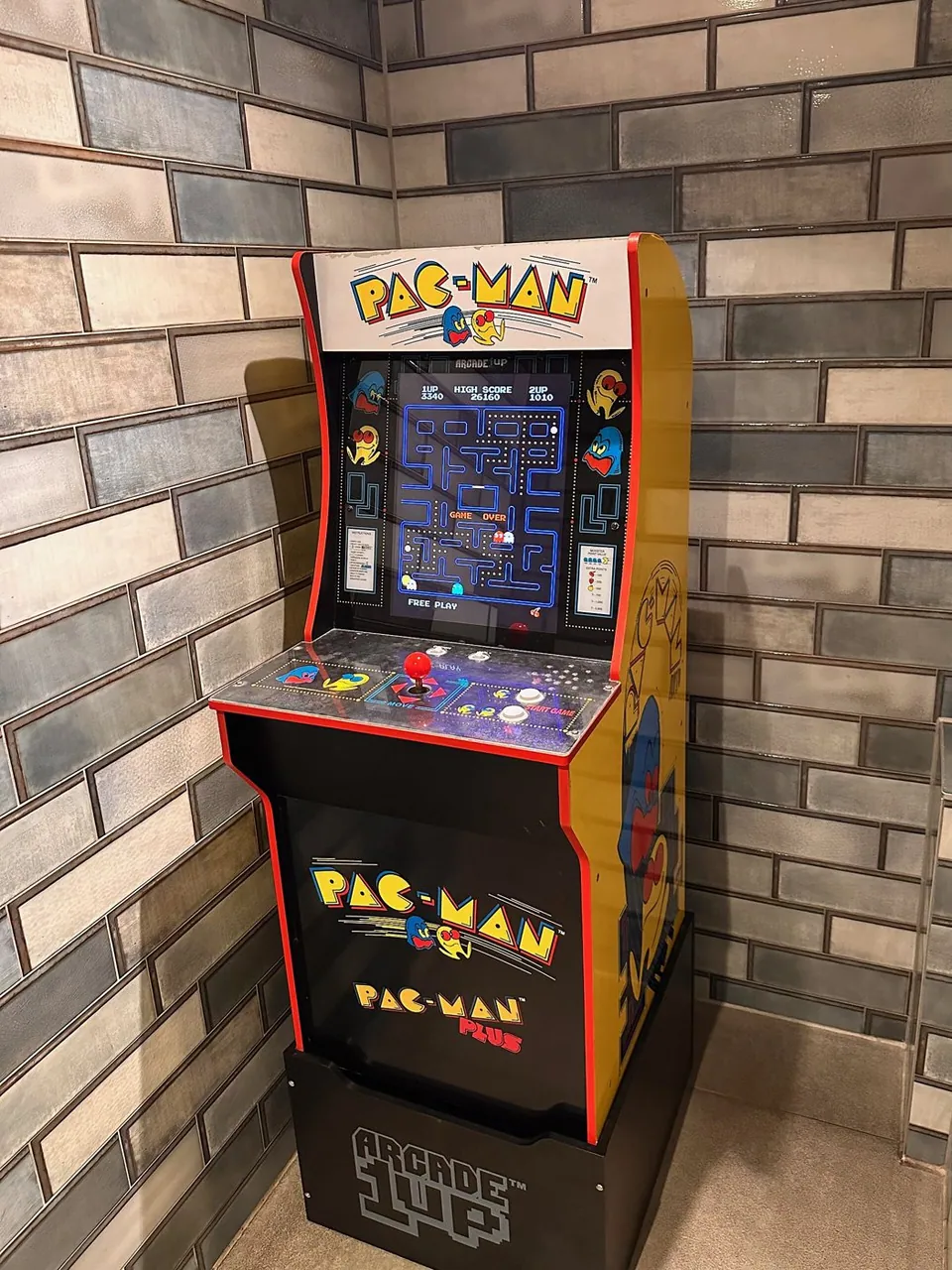 Pac-ManNamco · 1980 · another Tokyo arcade game, two years on
In collections
Go further
- Invasion of the Space Invaders, Martin Amis (1982)A novelist’s illustrated guide to the arcade games of the early 1980s, written while the craze was still on.
- Thirty-five years ago today: Space Invaders conquer the Earth, Tony Smith, The Register (2013)A long anniversary feature on the hardware, the rejected first designs and the rivals that followed.
- Space Invaders, World Video Game Hall of Fame, The Strong National Museum of PlayThe 2016 induction entry, which sets out why the museum counts the game as a turning point.
- Space Invaders Arcade Cabinet, CH62820, Centre for Computing HistoryThe catalogue record for an original American cabinet of 1978 held in Cambridge, with photographs.
Sources
- Space Invaders, The Strong National Museum of Play
- Space Invaders Arcade Cabinet, CH62820, Centre for Computing History, Cambridge
- Space Invaders at 35, The Register
- Space Invaders, International Arcade Museum, Killer List of Videogames
- Wikipedia (English), Wikimedia Foundation

