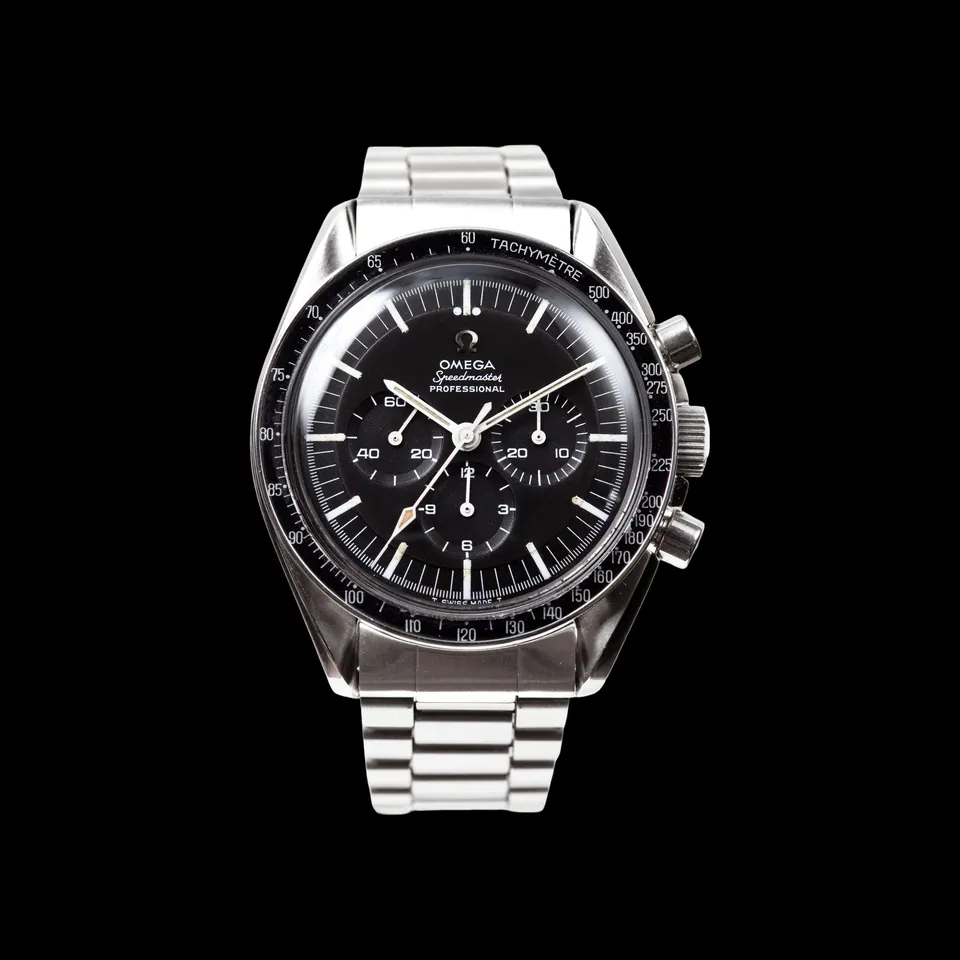
Nº 0120 · Wristwatch, chronograph
Speedmaster Professional
The chronograph that went to the Moon on its own merits.
Why it matters
The first chronograph to move the tachymeter scale from the dial to the bezel, which made the dial legible and the bezel a signature. NASA tested it against the field in 1965 and it was the only one that survived.
Introduced in 1957 alongside the Seamaster 300 and Railmaster, the Speedmaster was drawn for racing drivers. Its later life came by accident: NASA bought chronographs anonymously, ran them through heat, cold, vacuum and shock, and qualified the Omega for all manned missions. Buzz Aldrin wore one on the lunar surface in July 1969.
What to notice
- Dial and subdialsThree registers, step dial, no date. Nothing on the dial that is not read in a glance.
- The bezelThe tachymeter lives on the bezel, the change that made the watch.
- Calibre 1861 movementHand wound, still, as on the Moon in 1969.
3 min read
The full story
A chronograph for drivers
Omega launched the Speedmaster in 1957 as reference CK 2915, a wrist chronograph for sport and motor racing. The firm was already the official timekeeper of the Olympic Games, and its advertising aimed the new watch at “men who reckon time in seconds”: drivers, engineers, anyone who worked with a stopwatch. The name followed the pattern set by the Seamaster and Railmaster.
In this story
- A chronograph for drivers
- The scale moves outwards
- Tested close to destruction
- Still wound by hand

The story continues in the app
- Case
- Steel, 42 mm, Hesalite crystal
- Movement
- Manual, cal. 1861 · 48 h reserve
- In collection
- Smithsonian NASM, Washington · Armstrong's Apollo 11 watch
- Status
- Real · in production since 1957
Connections
- Claude Baillod
- Omega
- Space Age
- Watchmaking
- Steel
- Biel/Bienne
Nearby in the archive

In collections
Go further
- Moonwatch Only: The Ultimate OMEGA Speedmaster Guide, Grégoire Rossier and Anthony MarquiéThe standard collector’s reference, which catalogues every Speedmaster reference, dial, bezel and movement in turn.
- Chronograph, Armstrong, Apollo 11, Smithsonian National Air and Space MuseumThe museum record for Neil Armstrong’s issued watch, with materials, dimensions and the requirements NASA set.
- 1965: NASA tests and qualifies the Speedmaster, OmegaThe maker’s own account of the qualification of 1 March 1965.
- The truth about the real Armstrong’s and Aldrin’s Speedmaster references and how the Omega Speedmaster became the Moonwatch, Brice Goulard, Monochrome Watches (2014)Sets out the test dates and the Apollo 11 reference numbers from NASA documents and James Ragan’s account.
- Introducing: The Omega Speedmaster Professional Moonwatch ‘Master Chronometer’ With Co-Axial Caliber 3861, Jack Forster, Hodinkee (2021)A close look at what the 2021 model changed and what it kept.
Sources
- Omega Museum, Biel, Omega
- NASA qualification records 1965, NASA
- Smithsonian NASM, Armstrong Apollo 11 chronograph, Smithsonian

