Nº 0180 · Helmet
Sutton Hoo helmet
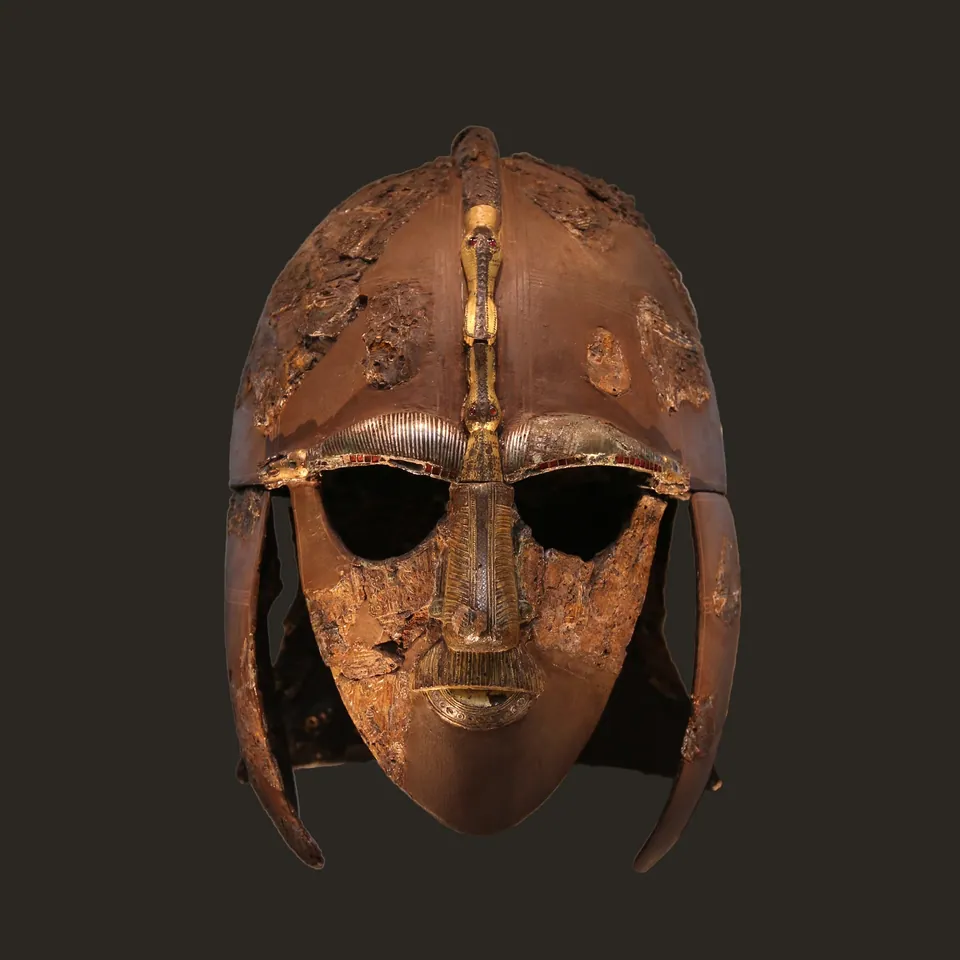
An iron face rebuilt twice from rusted fragments.
Why it matters
It came from the ship burial in Mound 1 at Sutton Hoo, which the British Museum dates to the early 600s AD and describes as commemorating a leading figure of East Anglia. It belongs to the class of Scandinavian helmets known from Vendel and Valsgärde, which derive from Roman helmets of the fourth and fifth centuries, and is richer than any of them.
It was excavated in 1939 from the burial chamber of Mound 1, a ship 27 m long, as hundreds of rusted fragments; the collapse of the chamber roof had shattered it. Herbert Maryon made a first reconstruction in 1946, and Nigel Williams rebuilt it in 1970 to 1971 on a form of jute textile and plaster. The iron cap, cheek pieces, mask and neck guard were covered in tinned copper alloy panels, stamped from dies with animal interlace and two warrior scenes. An iron crest inlaid with silver wire ends in animal heads, and the eyebrows, nose and moustache, with gilded boar heads and garnets, read together as a dragon.
What to notice
- The dragonEyebrows, nose and moustache read together as a dragon.
- The crestAn iron crest runs over the cap and ends in a gilded animal head.
- Stamped panelsFragments of stamped panels, set into the modern cap where they were found.
3 min read
The full story
Crushed under Mound 1
In 1939 Edith Pretty, owner of the Sutton Hoo estate in Suffolk, asked the local archaeologist Basil Brown to open the largest burial mound on her land. Inside he found the rivets of a ship 27 metres long, its timbers gone but their shape held in the sand. A team under Charles Phillips took over the burial chamber. On 28 July Phillips noted in his diary the crushed remains of an iron helmet.
In this story
- Crushed under Mound 1
- One sheet of iron
- Two attempts at a puzzle
- A white helmet

The story continues in the app
- Materials
- Iron, tinned and gilded copper alloy, silver wire, garnets
- Dimensions
- 31.8 cm high, 21.5 cm wide, 25.5 cm deep, as reconstructed
- Reconstructed
- Herbert Maryon, 1946; Nigel Williams, 1970 to 1971
- In collection
- British Museum, London (1939,1010.93)
- Status
- Real · reconstructed from fragments; the person buried is not identified
Connections
- Middle Ages
- Metalwork
- Iron
- Copper, brass and bronze
- Gold and silver
- Sutton Hoo
- London
Nearby in the archive
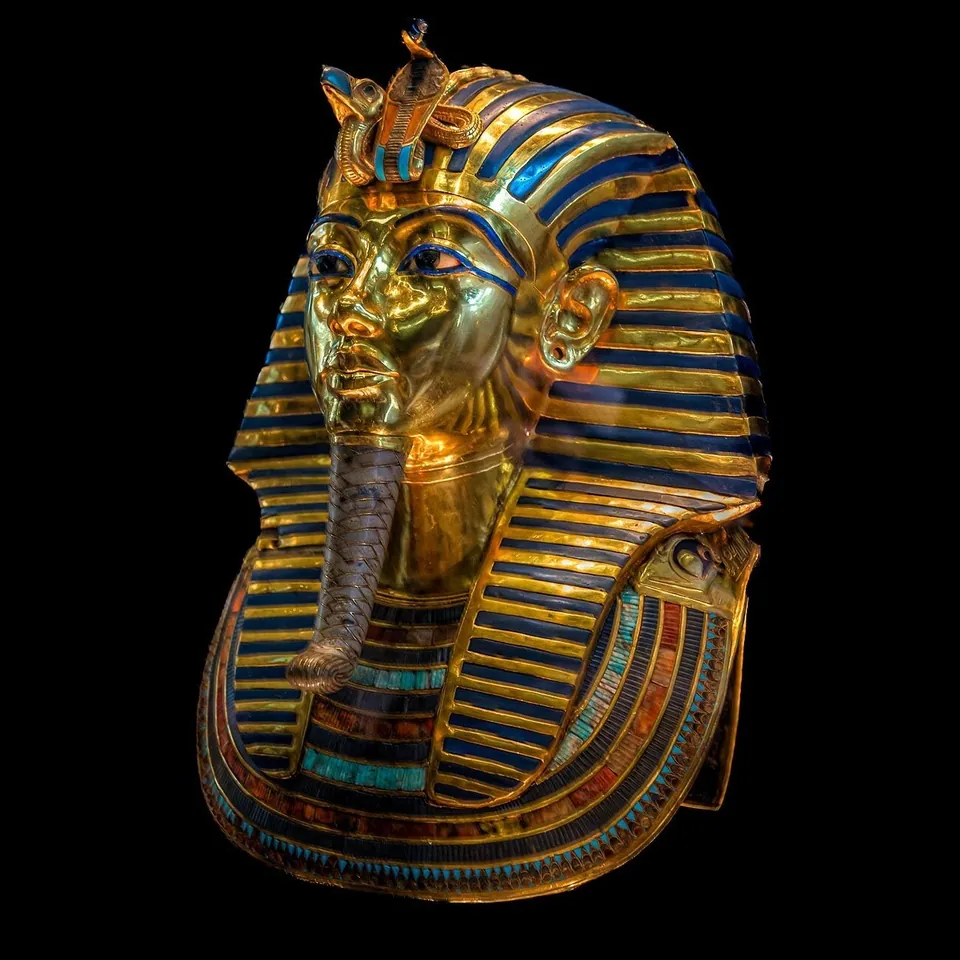 Mask of TutankhamunMakers unknown · c. 1323 BC · another metal face laid in a burial
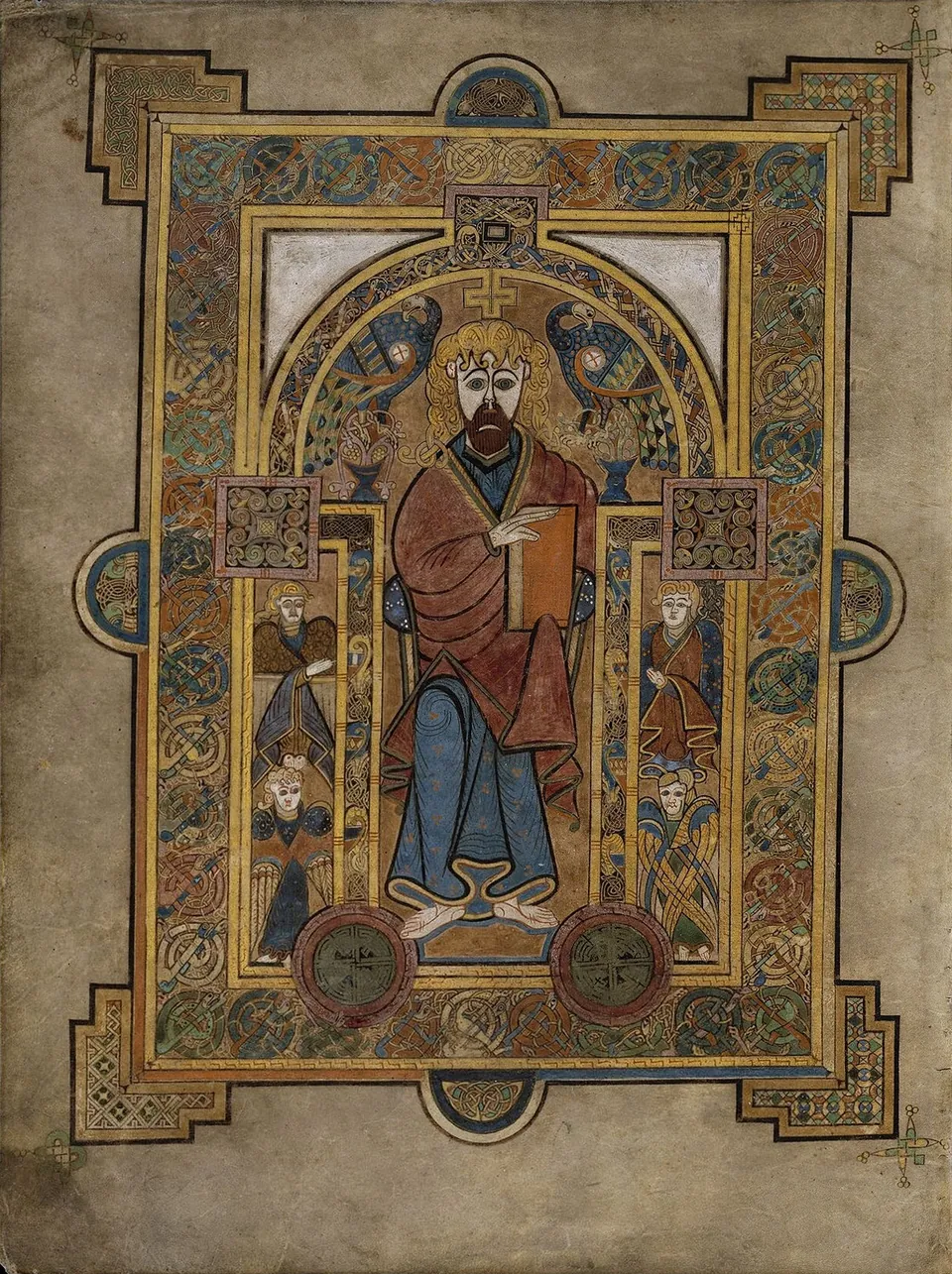 Book of KellsUnknown scribes · c. 800 · interlace again, in an insular manuscript
In collections
Go further
- The Sutton Hoo Helmet, Sonja Marzinzik (2007)A short British Museum Objects in Focus volume on the helmet, its making, its discovery and its two reconstructions.
- The Sutton Hoo Helmet, museum number 1939,1010.93, British MuseumThe collection record, with the museum’s description, measurements, materials and bibliography.
- Sue Takes on the Sutton Hoo Helmet, Curator’s Corner, British Museum (2021)The museum’s curator of early medieval Europe talks through the helmet on its official channel.
- Eighty years (and more) of Sutton Hoo, Sue Brunning, British Museum (2019)A curator’s account of the 1939 excavation, Edith Pretty’s gift and what the burial changed.
- A History of the World in 100 Objects, episode 47: Sutton Hoo helmet, Neil MacGregor, BBC Radio 4 (2010)The transcript of the radio programme, with the National Trust archaeologist at the site and Seamus Heaney on Beowulf.
Sources
- Helmet, 1939,1010.93, British Museum
- The Anglo-Saxon ship burial at Sutton Hoo, British Museum
- Wikipedia (English), Wikimedia Foundation
- Sutton Hoo helmet, Wikipedia

