Nº 0179 · Funerary mask
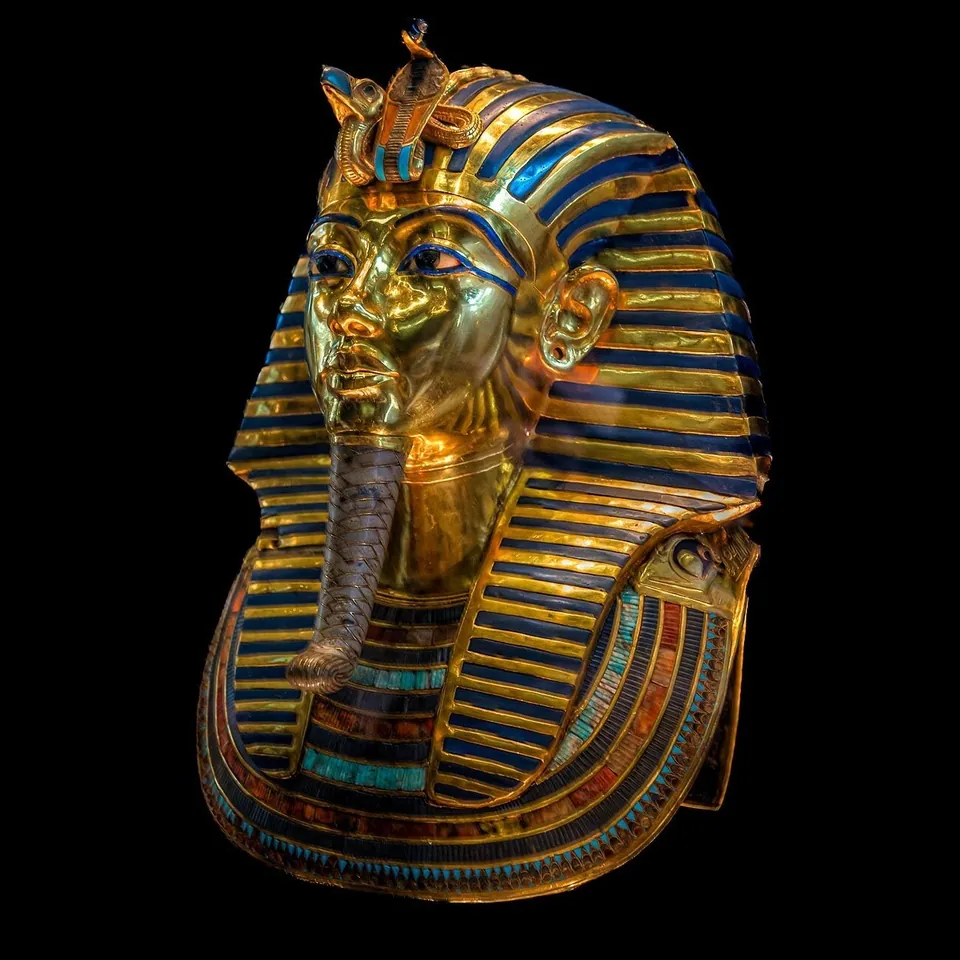
Mask of Tutankhamun
Gold, lapis lazuli and quartz for a king’s mummy.
Why it matters
It represents the highest artistic and technical achievements of the ancient Egyptians in the New Kingdom, in the Global Egyptian Museum’s description. It now stands at the centre of the Grand Egyptian Museum’s display of the complete contents of Tutankhamun’s tomb, shown together for the first time.
It was made for the burial of Tutankhamun, who died about 1323 BC, and lay on his mummy in tomb KV62 in the Valley of the Kings, found by Howard Carter’s team in 1922; the mask was lifted from the mummy during its unwrapping in November 1925. It is 54 cm high and weighs about 10 kg, made of two layers of gold, with eyes of quartz and obsidian, eyebrows and eyelids of lapis lazuli, and a broad collar of stones and coloured glass ending in falcon heads. A vulture and a cobra rise from the brow, and Spell 151 of the Book of the Dead runs across the back and shoulders. The plaited beard came off in 1922 and again in 2014, and a German and Egyptian team refixed it with beeswax in 2015.
What to notice
- The vulture and cobraA vulture head and a rearing cobra on the brow, emblems of Upper and Lower Egypt.
- The inlaid eyesQuartz eyes with obsidian pupils, outlined in lapis lazuli.
- The inscriptionSpell 151 of the Book of the Dead, in columns across the back and shoulders.
3 min read
The full story
A face for the coffin
Tutankhamun died about 1323 BC. The doctors who examined his body in 1925 put his age at about eighteen. The mask was made for his burial in tomb KV62 in the Valley of the Kings, where it was set over the head and shoulders of the wrapped mummy inside the innermost of three coffins. The Global Egyptian Museum record explains its purpose: the portrait let the king’s soul recognise its own body and return to it, and the spell on the back gave protection.
In this story
- A face for the coffin
- Hammered sheet, cut stone
- Lifted on 16 November
- Beeswax and a new gallery

The story continues in the app
- Materials
- Gold, inlaid with lapis lazuli, quartz, obsidian, carnelian, turquoise and coloured glass
- Dimensions
- 54 cm high, 39.3 cm wide, 49 cm deep; about 10 kg
- Excavated
- Carter no. 256a, tomb KV62, 1925
- In collection
- Grand Egyptian Museum, Giza (JE 60672)
- Status
- Real · moved from the Egyptian Museum, Cairo, in 2025
Connections
Nearby in the archive
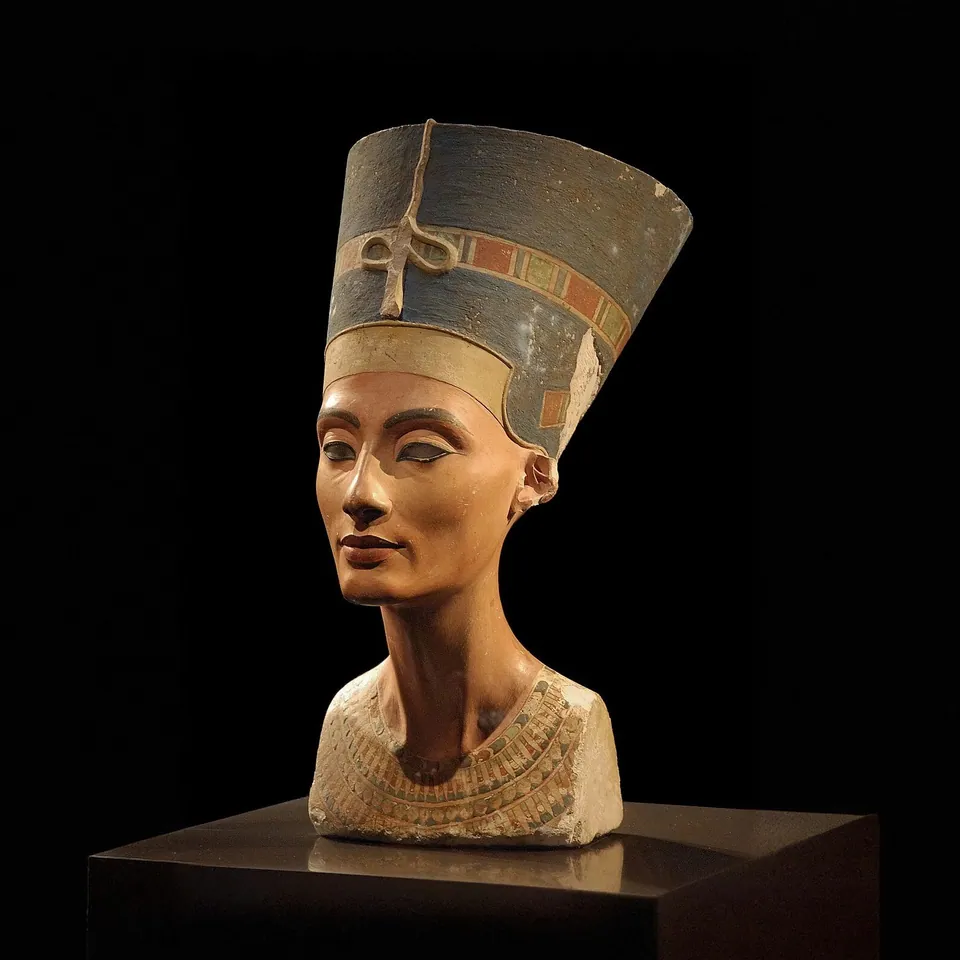 Bust of NefertitiWorkshop of Thutmose · c. 1353 to 1336 BC · a royal portrait from the same dynasty
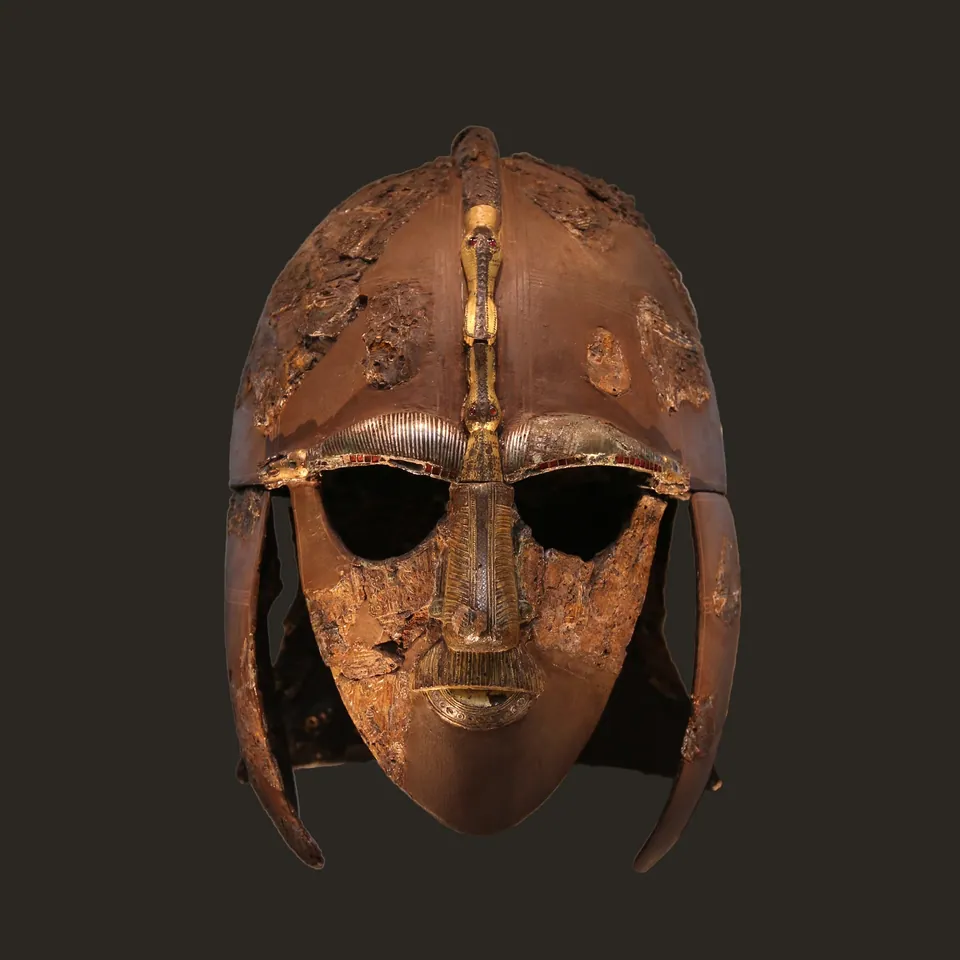 Sutton Hoo helmetMaker unknown · early 7th century AD · another metal face laid in a burial
In collections
Go further
- The Complete Tutankhamun, Nicholas Reeves (2022)The revised edition of a standard guide to the tomb, its contents and the excavation, by the scholar who argues much of it was made for someone else.
- Tutanchamuns Mumienmaske: Chronographie einer Ikone, Katja Broschat and Christian EckmannThe conservators’ technical monograph on how the mask was made and repaired, in German.
- Gold mask of the king, object record 256a, Griffith Institute, University of OxfordThe excavation record for the mask, with Harry Burton’s photographs of it on the mummy and after removal.
- Howard Carter’s excavation journal, 4th season, Griffith Institute, University of OxfordCarter’s day-by-day account of opening the coffins and unwrapping the mummy in autumn 1925.
- King Tut’s Beard Is Back, With Help From a Little Beeswax, Khaled El Samman, National Geographic (2015)A report on the 2015 repair of the beard and what the conservators learned while doing it.
Sources
- Gold mask of the king (256a), Griffith Institute, University of Oxford
- The Gold Mask of Tutankhamun, JE 60672, Global Egyptian Museum
- King Tut mask beard repair, 17 December 2015, National Geographic
- Wikipedia (English), Wikimedia Foundation
- Mask of Tutankhamun, Wikipedia