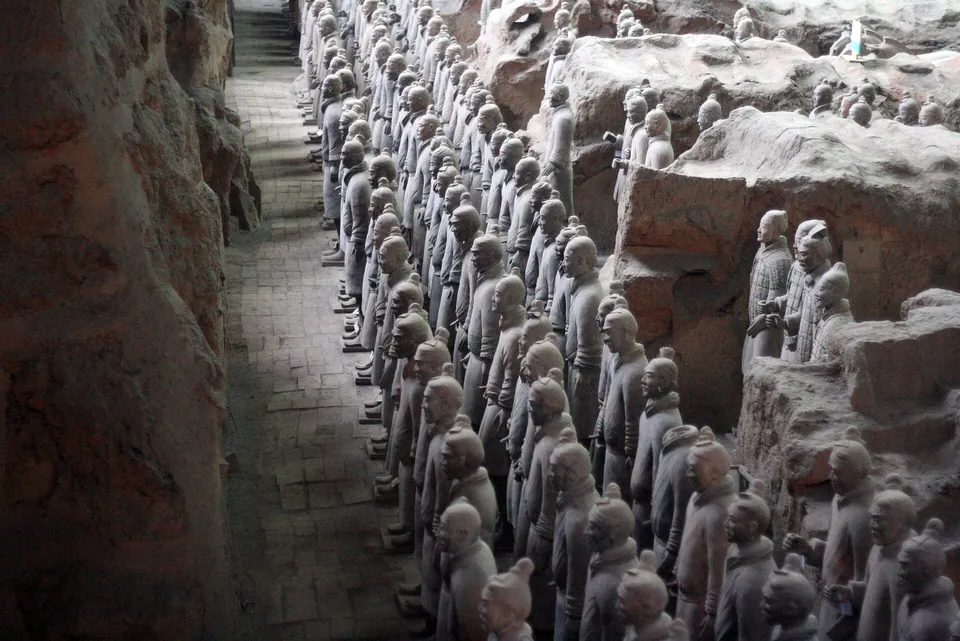
Nº 0170 · Funerary sculpture
Terracotta Army
Thousands of clay soldiers, most still under the ground.
Why it matters
It shows sculpture made by division of labour: standard parts from moulds, details added by hand, and makers’ stamps that name the workshops and artisans. The First Emperor’s own burial chamber nearby is still sealed and has not been excavated.
The figures were buried in pits about 1.5 km east of the tomb mound of Qin Shi Huang, the First Emperor of China, around 210 to 209 BC; work on his mausoleum began in 246 BC, and the historian Sima Qian reports that 700,000 conscripts were sent to build it. Farmers digging a well, among them Yang Zhifa, found the first fragments in March 1974. Heads, arms, legs and bodies were made separately and joined, the faces from a small set of moulds finished by hand, and all were once painted, though today they show the colour of the fired clay. More than 2,000 warriors and horses have been excavated from three pits, and an estimated 6,000 remain buried.
What to notice
- The facesFaces, hairstyles and topknots differ from one soldier to the next.
- The armourSome figures wear armour of small plates, modelled in the clay.
- The earth wallsWalls of earth divide the pit into long corridors.
3 min read
The full story
A kingdom rebuilt underground
Ying Zheng became king of Qin at thirteen, and work on his tomb at the foot of Mount Li started at once. By 221 BC he had conquered the rival states and taken the title of First Emperor. The tomb grew with his territory. The burial ground now covers some 56 square kilometres, and archaeologists read it as a model of the realm he meant to go on ruling after death.
In this story
- A kingdom rebuilt underground
- Loess, sand and lacquer
- Lost, then dug up
- Slow digging, sealed tomb

The story continues in the app
- Figures
- More than 2,000 excavated; about 6,000 more thought to be buried
- Dimensions
- About 1.8 m tall on average; 110 to 300 kg
- Pit 1
- About 230 × 62 m, in eleven corridors
- Weapons
- More than 40,000 bronze weapons found
- Status
- Real · Mausoleum of the First Qin Emperor, UNESCO 1987
Connections
Nearby in the archive
In collections
Go further
- The First Emperor: China’s Terracotta Army, Jane Portal (ed.), British Museum Press (2007)The catalogue of the British Museum exhibition, with essays on the Qin state, the tomb and how the figures were made.
- Building the Terracotta Army: ceramic craft technology and organisation of production at Qin Shihuang’s mausoleum complex, Patrick Sean Quinn, Shangxin Zhang, Yin Xia and Xiuzhen Li, Antiquity (2017)A microscope study of the clay that shows the figures were made near the site from centrally prepared paste.
- Surface chromium on Terracotta Army bronze weapons is neither an ancient anti-rust treatment nor the reason for their good preservation, Marcos Martinón-Torres and others, Scientific Reports (2019)The open-access paper that traces the chromium on the weapons to lacquer and explains their condition by the soil.
- Top 10 facts about the Terracotta Warriors, National Museums LiverpoolA short museum introduction to the find, the makers’ stamps, the lost paint and the other figures buried nearby.
- Mausoleum of the First Qin Emperor, UNESCO World Heritage CentreThe World Heritage listing of 1987, with the official description, maps and conservation reports.
Sources
- Top 10 facts about the Terracotta Warriors, National Museums Liverpool
- China’s First Emperor and the Terracotta Warriors: in numbers, National Museums Liverpool
- Wikipedia (English), Wikimedia Foundation
- Terracotta Army, Wikipedia

