Nº 0417 · Typeface
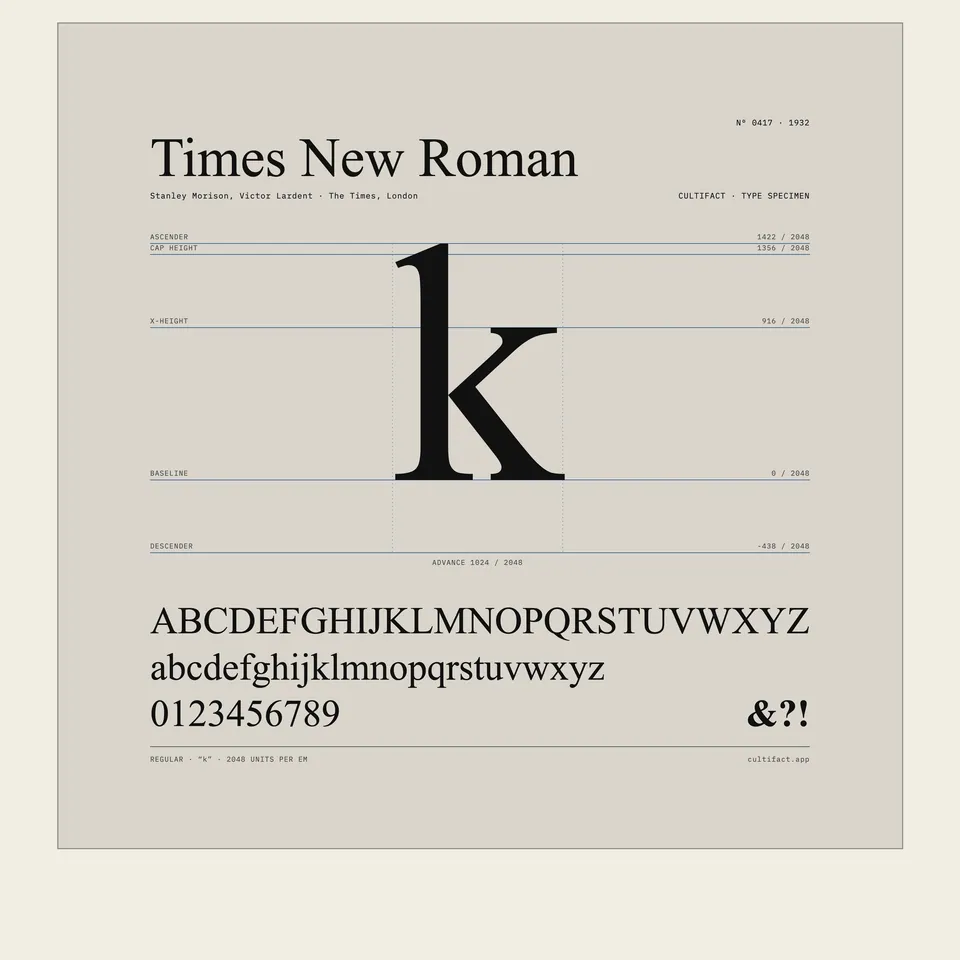
Times New Roman
A newspaper face first set in The Times on 3 October 1932.
Why it matters
The face was commissioned by a newspaper under the typographer Stanley Morison. It replaced a face the paper’s staff called Times Old Roman and stayed in its columns for forty years.
The Times decided in 1929 to change its typeface, under the guidance of Stanley Morison. Victor Lardent worked on the letters under Morison’s direction, and the designs are based on Plantin and Perpetua. The new face first appeared in the paper’s columns on 3 October 1932.
2 min read
The full story
A newspaper faulted
In 1929 Stanley Morison, who advised Monotype, wrote an article criticising The Times for poor printing and an antiquated look. He was invited to submit ideas, and these led to a redesign of the paper in 1932. Sources differ on the date of the commission, with some saying that the paper decided in 1929 to change its typeface and others that Morison was commissioned in 1931. The paper’s old face was unofficially called Times Old Roman.
In this story
- A newspaper faulted
- Plantin, narrowed
- 3 October 1932
- After the newspaper

The story continues in the app
- Decision to change
- 1929, under Stanley Morison’s guidance
- Basis
- Plantin and Perpetua
- Debut
- 3 October 1932, in The Times
- Replaced by
- Times Europa by Walter Tracy, 1972
Connections
In collections
Go further
- Times font, Grapheine, Typorama 05A short history of the face and its replacement in 1972.
Sources
- Times font (Typorama 05), Grapheine
- Times New Roman, Wikipedia
- Stanley Morison: 10 things to know about, Typeroom
- Times New Roman font family, Microsoft Typography