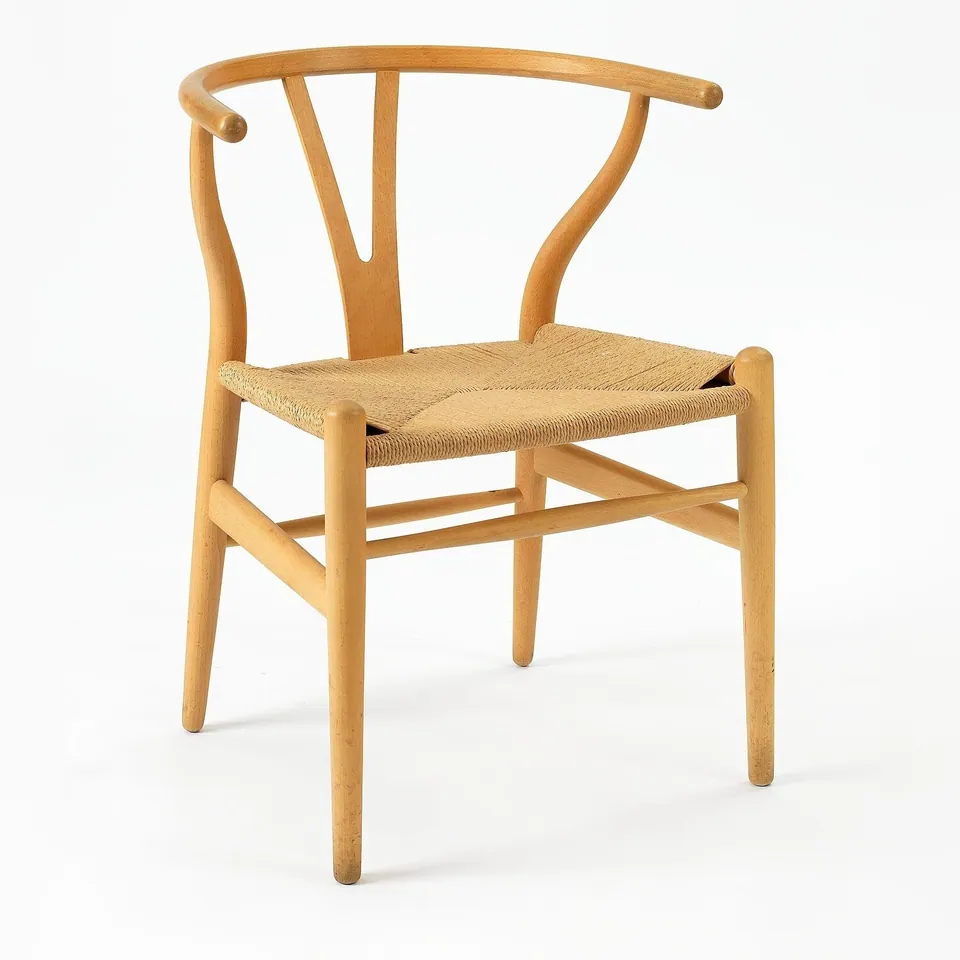
Nº 0158 · Armchair
Wishbone Chair (CH24)
A Y-shaped back and a hand-woven paper cord seat.
Why it matters
It brought the round-backed Chinese chair into post-war Danish furniture, reduced to a curved top rail, a Y-shaped splat and a woven seat. Carl Hansen & Søn has made it without a break since 1950, and says most of its more than 100 production steps are still done by hand.
Wegner designed the chair in 1949 for Carl Hansen & Søn of Odense, the first model he drew exclusively for the firm. It descends from his Chinese chair series of the mid 1940s, which was based on Ming chairs. The maker says the seat takes about an hour to weave and uses around 120 metres of paper cord. The chair photographed, in turned and waxed beech with a braided paper cord seat, was made by Carl Hansen & Søn in 1950 and belongs to the Nasjonalmuseet in Oslo.
What to notice
- The top railOne curved rail forms the back and runs on into both arms, ending in rounded tips.
- The Y-shaped splatThe Y-shaped splat that gives the chair its name supports the rail at the centre.
- The woven seatPaper cord is woven over the seat frame in four triangles that meet at the centre.
3 min read
The full story
Three weeks in Odense
Carl Hansen, a trained cabinetmaker, opened his workshop in Odense in 1908 and made bespoke furniture in the heavy Victorian style of the day. From 1915 a factory let him produce his most popular pieces in small series. His son Holger took over in 1934, in the middle of the Depression. In the late 1940s the firm's sales manager, Ejvind Kold Christensen, approached Hans J. Wegner, a trained cabinetmaker from Tønder who had opened his own drawing office in 1943, and in 1949 Holger Hansen invited him to Odense.
In this story
- Three weeks in Odense
- Fourteen parts, one curve
- A gamble on a new name
- Never out of production

The story continues in the app
- Materials
- Beech, paper cord
- Dimensions
- 72.4 × 57.2 × 51.1 cm (Met example)
- Maker
- Carl Hansen & Søn, Denmark
- In collection
- The Met · Nasjonalmuseet
- Status
- Real · in production since 1950
Connections
- Hans J. Wegner
- Carl Hansen & Søn
- Postwar era
- Furniture design
- Wood
- Paper
- Odense
Nearby in the archive
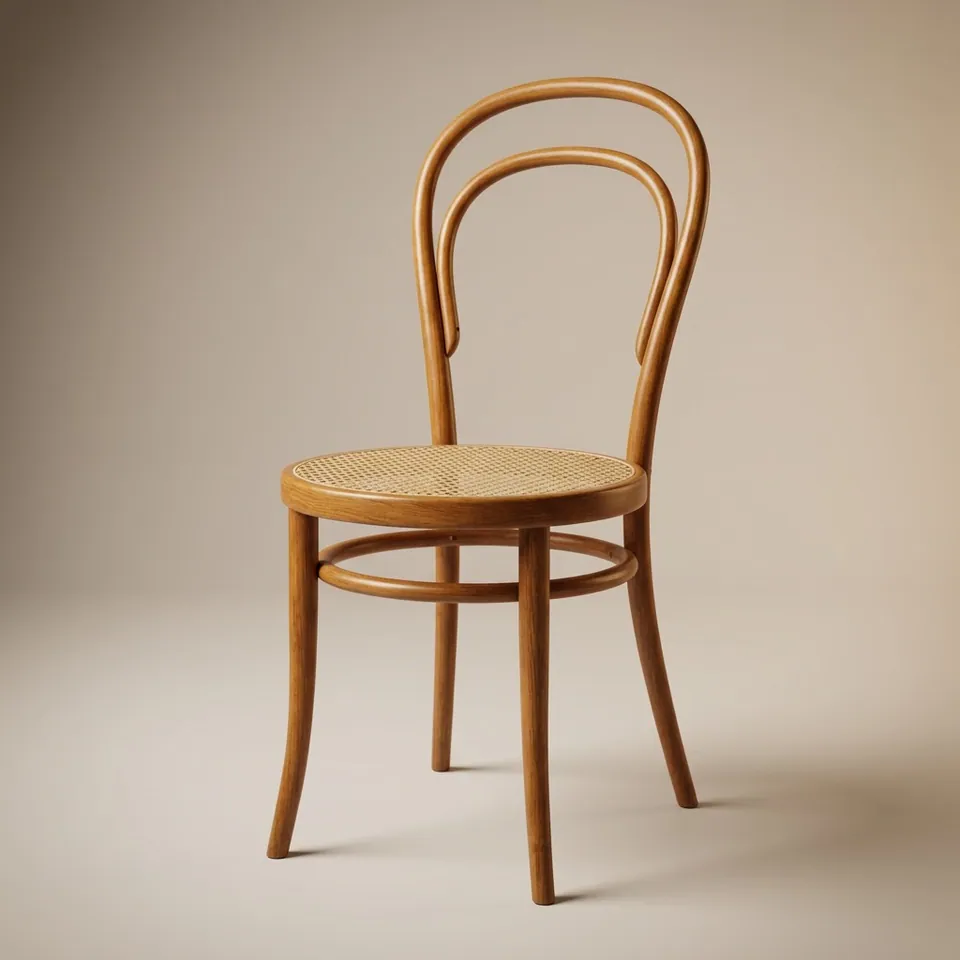 Thonet No. 14Thonet · 1859 · an earlier chair of curved solid beech
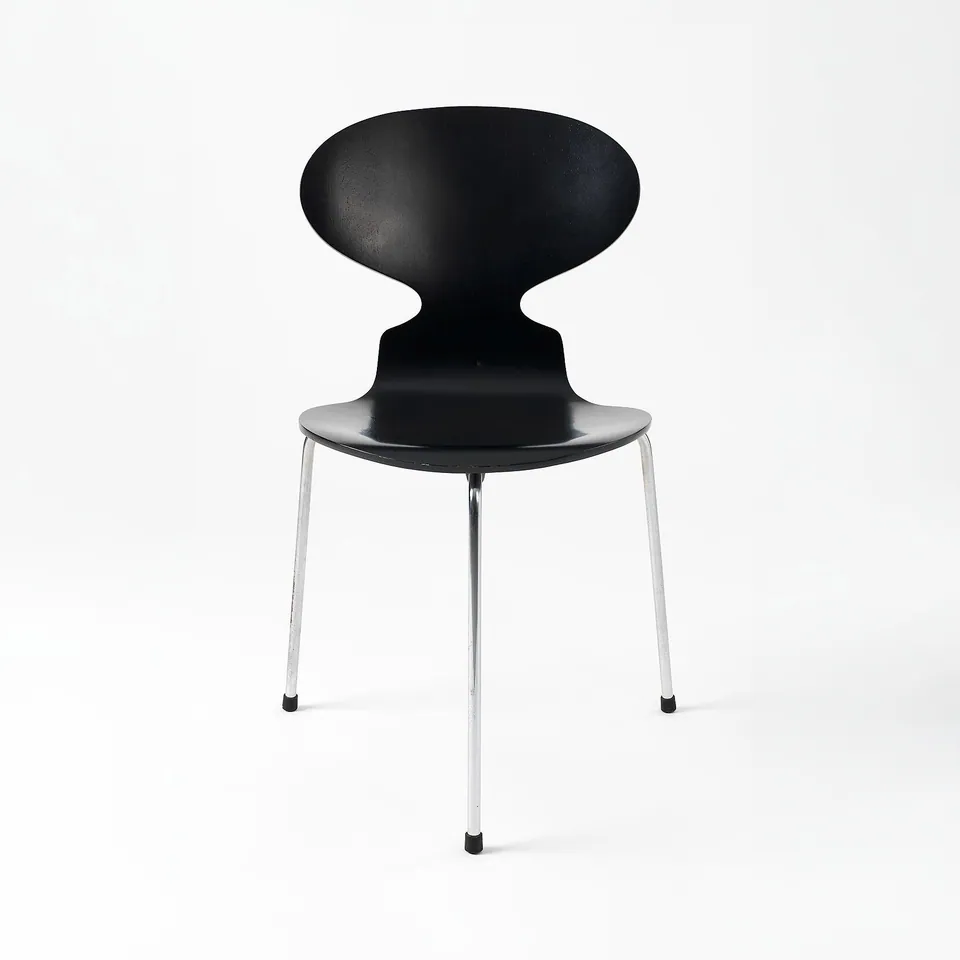 Ant ChairJacobsen · 1952 · Danish seating of the same years, in plywood
In collections
Go further
- Hans J. Wegner: Just One Good Chair, Christian Holmsted Olesen (2014)The fullest study of Wegner's furniture in English, published by Hatje Cantz in 2014, a hundred years after his birth.
- Wishbone Chair, 2017.454, The Metropolitan Museum of ArtThe museum record for a beech and paper cord example made between about 1950 and 1979, with measurements.
- Behind an icon: CH24, Carl Hansen & SønThe maker's own account of how the chair is built, from the fourteen frame parts to the woven seat.
- pp66 / pp56 Chinese Chair, PP MøblerThe workshop that still makes Wegner's Chinese Chair describes the Ming source of the 1945 design.
Sources
- Wishbone Chair, 2017.454, The Metropolitan Museum of Art
- Behind an icon: CH24, Carl Hansen & Søn
- Wikipedia (English), Wikimedia Foundation

