Nº 0123 · Printed book
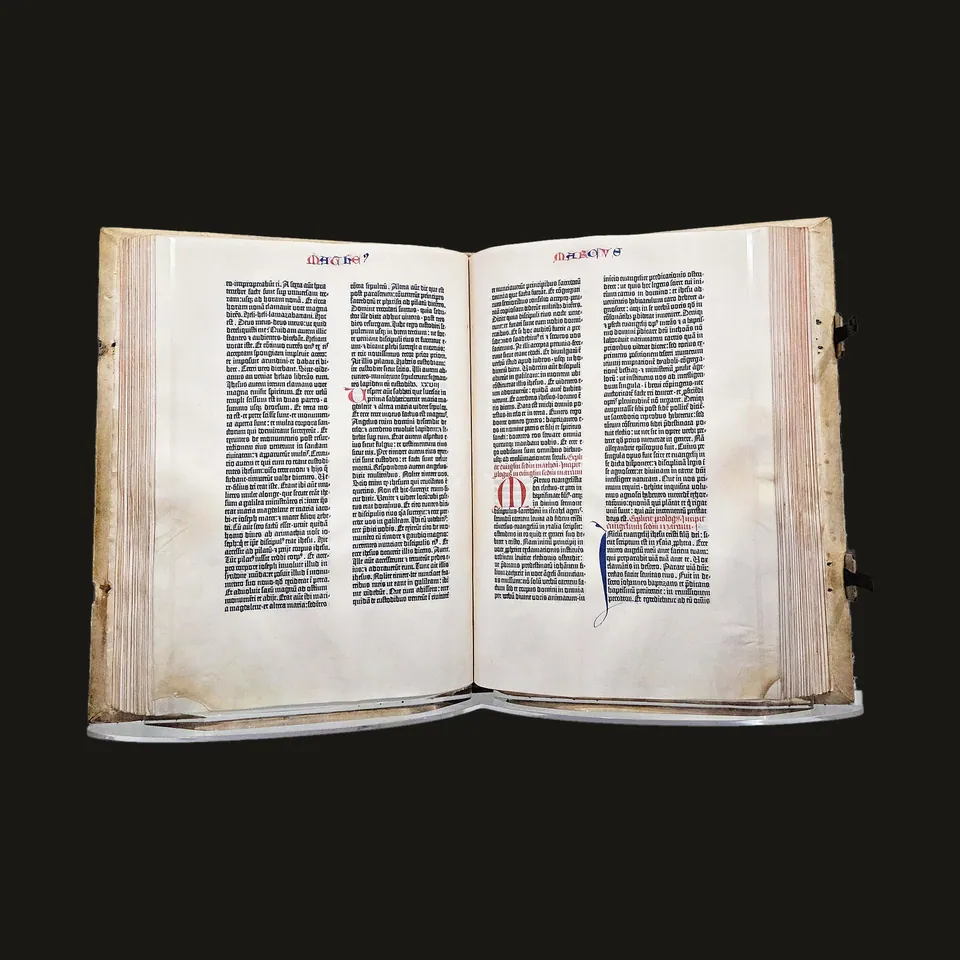
Gutenberg Bible
Printed from metal type, then painted by hand.
Why it matters
It is the first major book printed in Europe from movable metal type, and it showed that a printed book could stand beside a fine manuscript. Its type copied a Gothic missal script in 290 different characters, with abbreviations and joined letters, so the page reads like writing.
Johannes Gutenberg printed this Latin Bible in Mainz, and Princeton dates it to about 1454 to 1455. Only the black text was printed: each buyer had the red headings, initials and binding done separately, so no two copies are alike. The columns were first set at 40 lines and then at 42, which gives it the name 42-line Bible. Forty-nine copies survive in whole or large part; the one shown is on display at the Library of Congress in Washington.
What to notice
- Two columnsTwo dense columns of black type, straight on both edges.
- A red initialA red M, painted in by hand where the printer left a space.
- The running headRed and blue letters at the top of the page, added by hand, name the Gospel.
3 min read
The full story
Borrowed money in Mainz
Johannes Gutenberg was born in Mainz around 1400, into a family with ties to metalworking. He spent years in Strasbourg, where he is recorded until at least 1444 and where, the Bayerische Staatsbibliothek says, he experimented with movable type. By 1448 he was back in Mainz and borrowing money.
In this story
- Borrowed money in Mainz
- Four compositors at once
- Sheets shown in Frankfurt
- Found again in Paris

The story continues in the app
- Materials
- Paper and vellum, printed black text, hand-painted decoration
- Dimensions
- Leaf about 42 × 30 cm
- Type
- 290 characters after a Gothic missal script
- In collection
- Gutenberg-Museum, Mainz · Bayerische Staatsbibliothek · Princeton
- Status
- Real · 49 copies survive in whole or large part
Connections
- Johannes Gutenberg
- Early modern period
- Book design
- Paper
- Parchment
- Mainz
Nearby in the archive
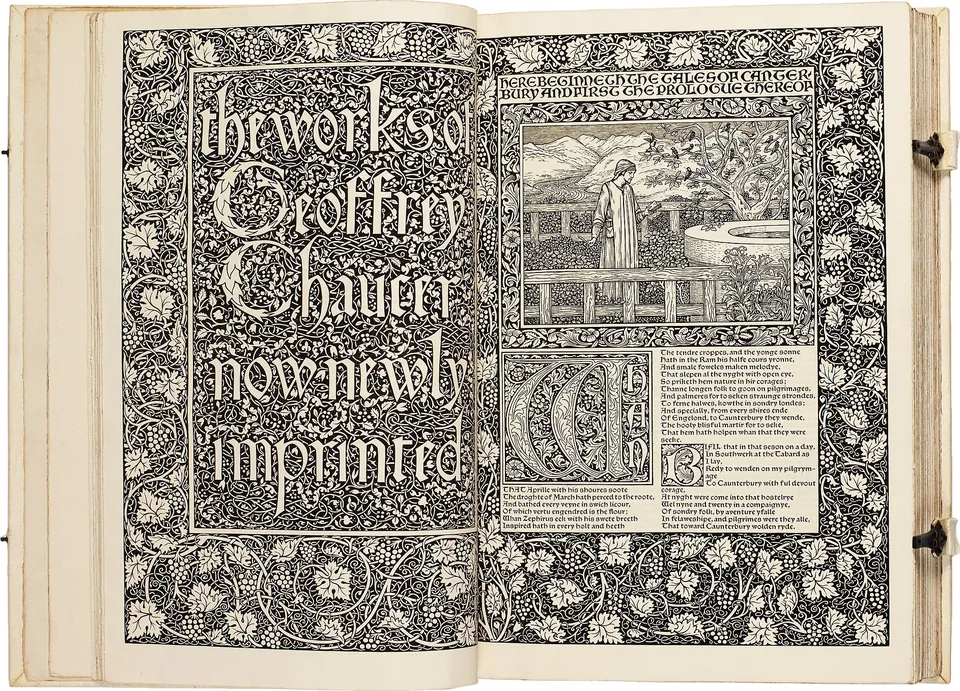 Kelmscott ChaucerMorris · 1896 · a Victorian press modelled on early printed books
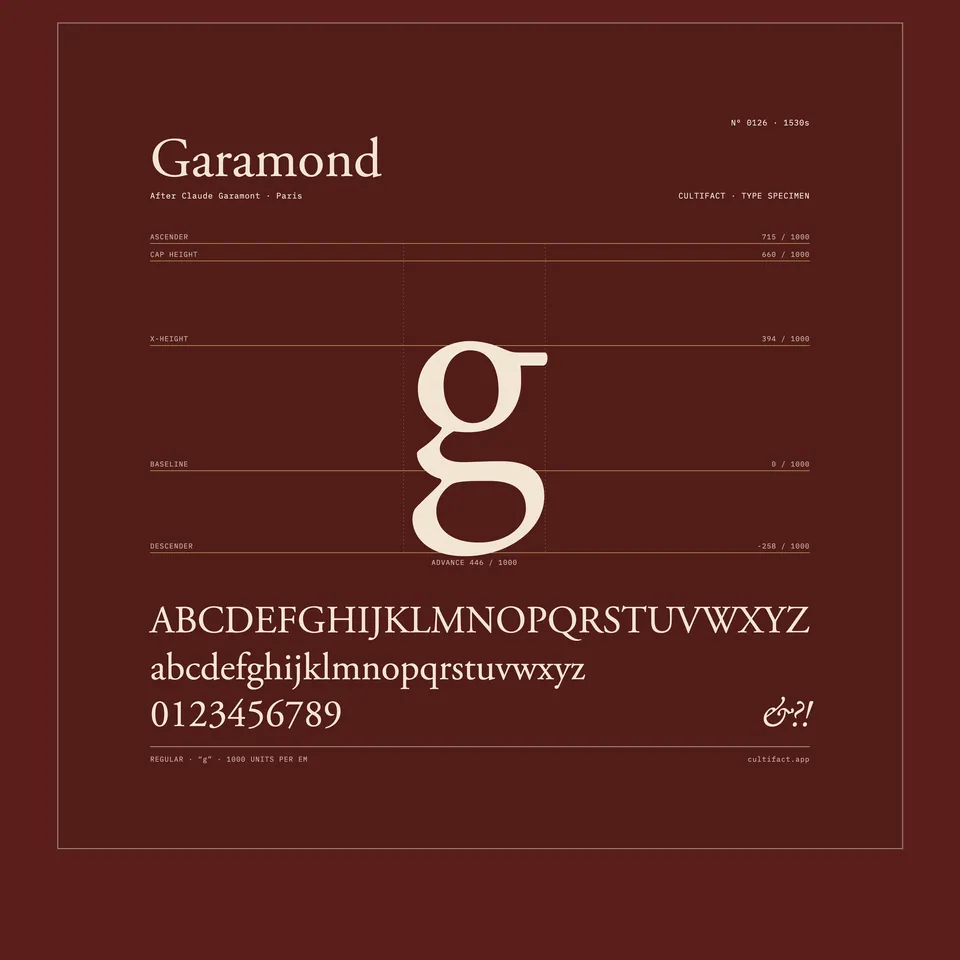 GaramondGaramont · 1530s · roman type, eighty years after this Gothic letter
In collections
Go further
- Editio princeps: A History of the Gutenberg Bible, Eric Marshall White (2017)Follows each of the 49 surviving copies from the Mainz workshop through its owners to the present day.
- The Gutenberg Bible, Princeton University LibraryA short scholarly account of how the edition was set and printed, with the three fifteenth-century documents that record it.
- Gutenberg Bible, Bayerische StaatsbibliothekThe Munich copy digitised in full, with notes on the type and the printed table of rubrics.
- The Gutenberg Bible, Harry Ransom Center, The University of Texas at AustinThe library’s page for its complete paper copy, which is always on view and can be read online.
- 42-line Gutenberg Bible, printed on vellum, and its contemporary documentary background, UNESCO Memory of the WorldThe register entry for the Göttingen vellum copy and the two documents kept beside it.
Sources
- Gutenberg Bible, Bayerische Staatsbibliothek, Munich Digitization Center
- The Gutenberg Bible, Princeton University Library
- Gutenberg Bibeln, Gutenberg-Museum Mainz
- Gutenberg 42-line Bible, Keio University Library
- Wikipedia (English), Wikimedia Foundation

