Nº 0126 · Typeface
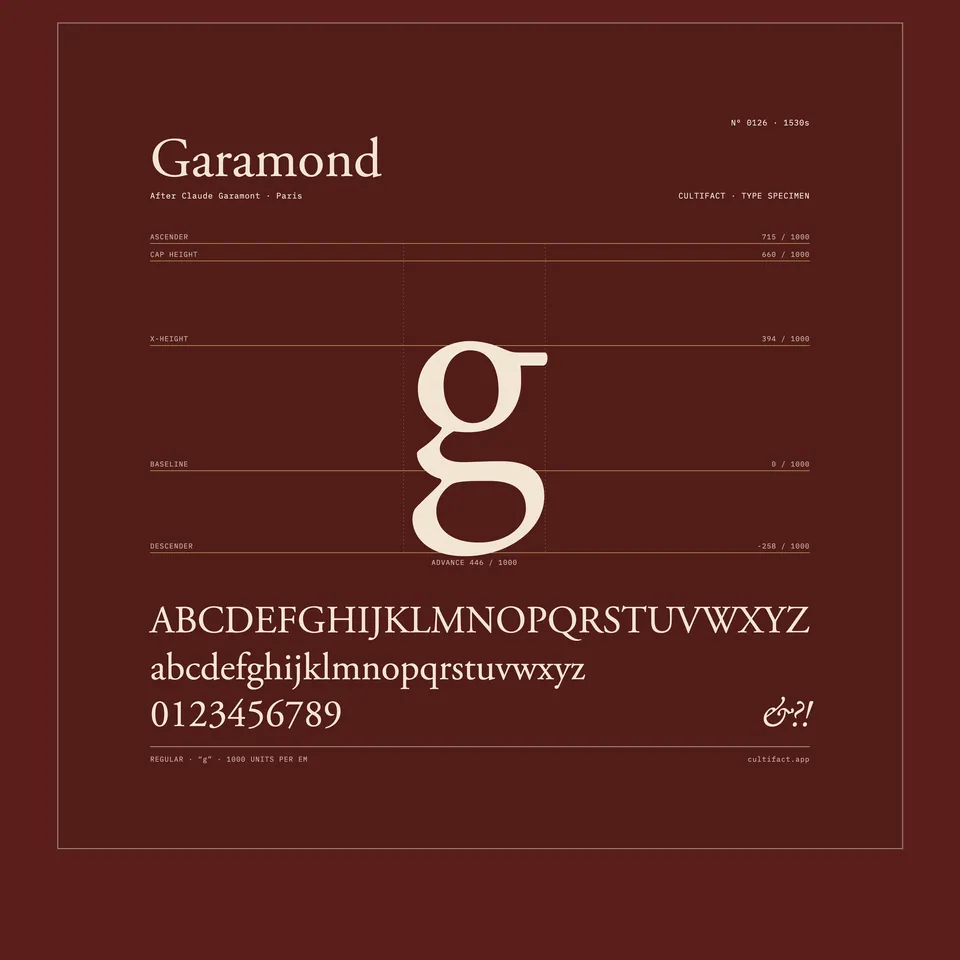
Garamond
Punches from his workshop survive in Antwerp.
Why it matters
Garamont was one of the Paris punchcutters who, in the 1530s, made a new roman type modelled on letters from the press of Aldus Manutius in Venice; Vervliet counts forty-seven romans cut in the city in that decade. After his death his name went to types that were not his: in 1926 Beatrice Warde showed that the Garamond of the Imprimerie nationale was Jean Jannon’s type of 1621.
Claude Garamont, born about 1510, trained with Antoine Augereau according to Guillaume Le Bé, and cut type for Paris printers including Robert Estienne. His earliest roman attributed to him with some certainty is a Pica first seen in August 1536, in an edition of Cicero; the Estienne roman of 1530 often given to him was cut by another hand. From about 1540 he cut Greek types for Francis I, and after his death in November 1561 his punches and matrices were sold to Christophe Plantin and others. The type shown is his Vraye Parangonne roman, from a Plantin specimen of about 1585.
What to notice
- The eThe e has a small eye, well above the line.
- The aThe bowl of the a turns sharply at its top left.
- The italicThe name Antisthenes is in an italic; the specimen does not give it to Garamont.
3 min read
The full story
A Venetian letter in Paris
Until the middle of the 1520s, Paris printers set Latin in romans descended from Nicolas Jenson’s Venetian type of 1470: dark on the page, with a slanted bar to the e. In the autumn of 1530 the scholar-printer Robert Estienne brought out three romans of a different kind. Their model was a type that Aldus Manutius had used in Venice from 1495, first seen in Pietro Bembo’s De Aetna, and then dropped after about a dozen books.
In this story
- A Venetian letter in Paris
- Steel, copper and a Pica
- Sold by the set
- Whose Garamond

The story continues in the app
- Class
- Old-face roman
- First secure roman
- Pica, Paris, August 1536
- Materials
- Steel punches, copper matrices, cast type
- In collection
- Plantin-Moretus Museum, Antwerp: original punches and matrices
- Status
- Real · most fonts called Garamond are later revivals
Connections
- Claude Garamond
- Early modern period
- Type design
- Steel
- Copper, brass and bronze
- Paris
- Antwerp
Nearby in the archive
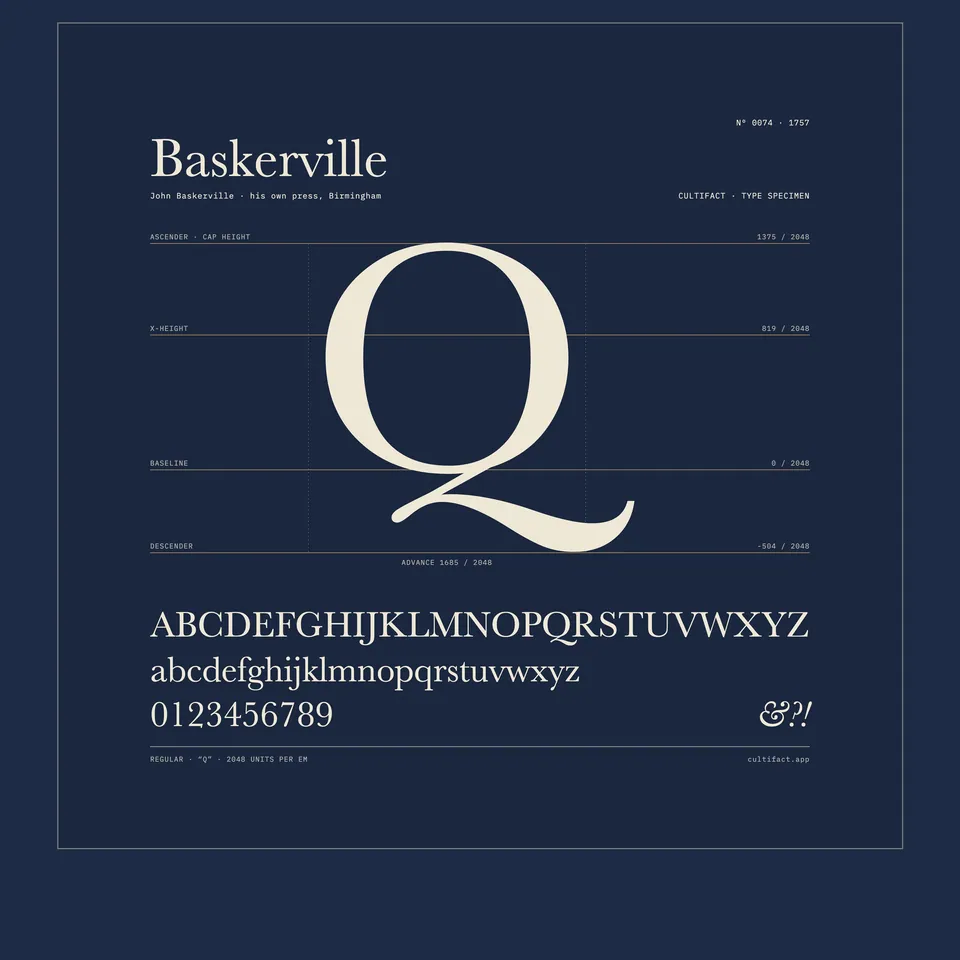 BaskervilleBaskerville · 1757 · two centuries on, sharper contrast
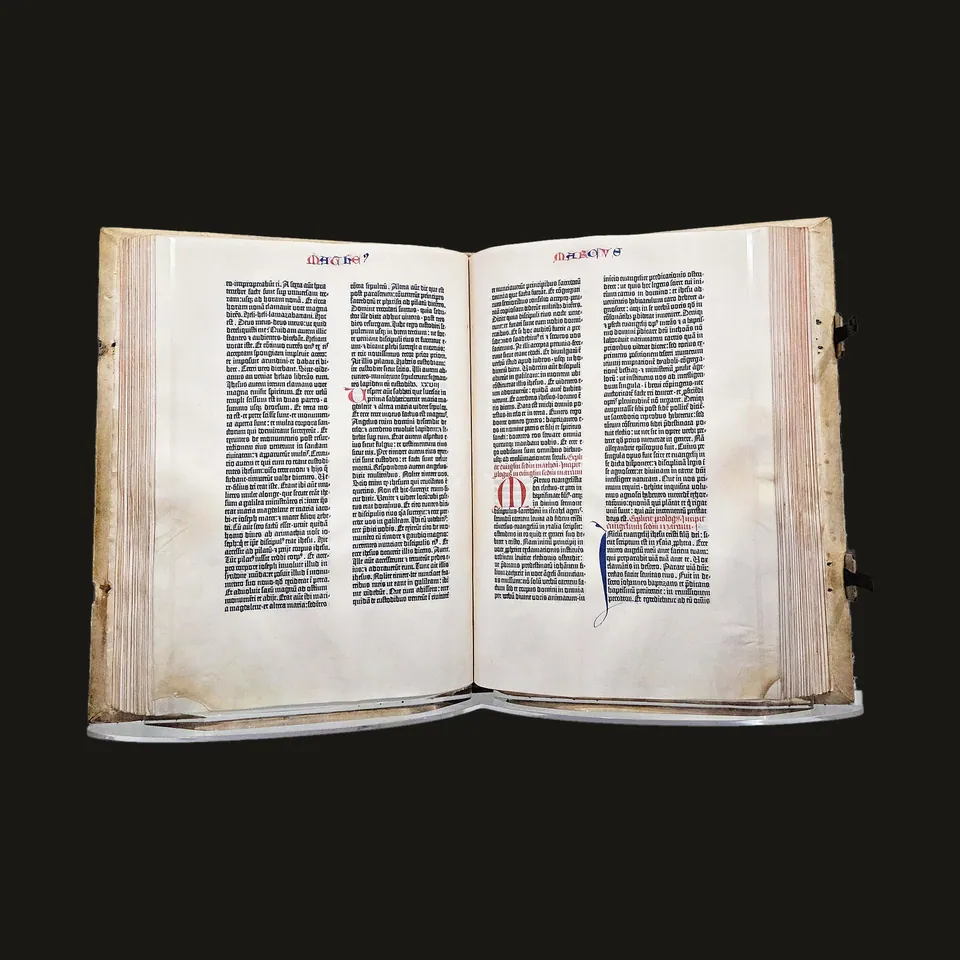 Gutenberg BibleGutenberg · c. 1455 · type modelled on Gothic script, not roman letters
In collections
Go further
- French Renaissance Printing Types: A Conspectus, Hendrik D. L. Vervliet (2010)Facsimiles and first-use records for 409 typefaces cut in sixteenth-century France, Garamont’s among them.
- The young Garamont: roman types made in Paris from 1530 to 1540, Hendrik D. L. Vervliet, Typography Papers 7 (2007)The study that sorts the forty-seven Paris romans of the 1530s by punchcutter and dates Garamont’s first Pica to 1536.
- Garamond or Garamont?, James Mosley, Typefoundry (2011)A type historian traces the spelling of the name and how Jannon’s types came to be sold as Garamond.
- Matrices for the Parangonne Romaine, MPM.MA.097, BaTyR, Université de ToursThe database record for the copper matrices in Antwerp that the museum’s catalogue attributes to Garamont.
- The collections, Museum Plantin-MoretusThe museum’s overview of its holdings, including the punches, matrices and lead type of the Plantin printing office.
Sources
- The young Garamont: roman types made in Paris from 1530 to 1540 (Typography Papers 7), Hendrik D. L. Vervliet, University of Reading and Hyphen Press, 2007
- Matrices for the Parangonne Romaine, MPM.MA.097, BaTyR, Université de Tours
- Wikipedia (English), Wikimedia Foundation
- Garamond, Wikipedia