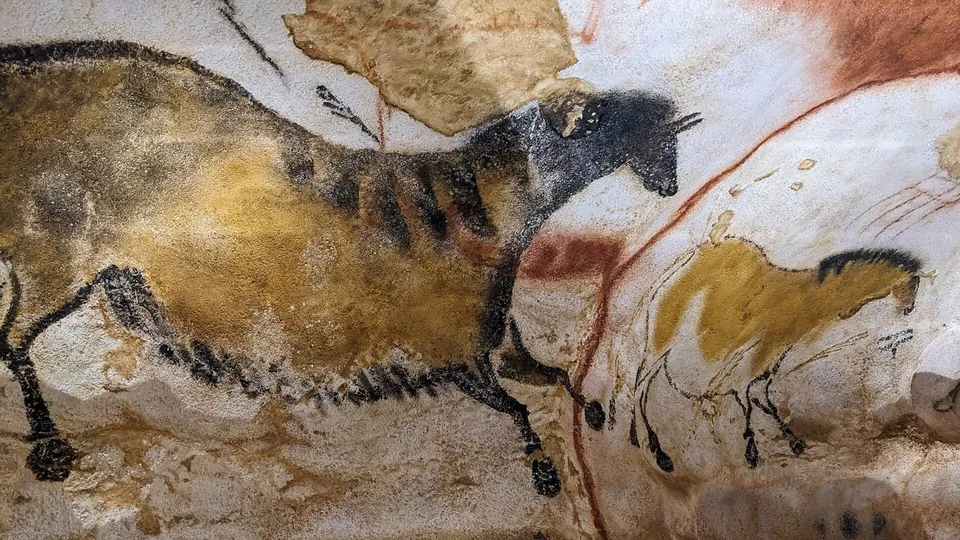
Nº 0002 · Parietal painting
Hall of the Bulls, Lascaux
Motion drawn on a curved wall, by a hand with no name.
Why it matters
About six hundred animals painted before writing, before the wheel, before cities. The first time a surface was designed to be read in sequence.
Found in September 1940 by four teenagers and a dog, the cave was opened to the public after the war and closed again in 1963 when the visitors' breath began to grow algae on the walls. The paintings follow the rock: a bulge becomes a shoulder, a crack becomes a back line, and the animals seem to run around the room as the light moves.
What to notice
- Twisted perspectiveTwisted perspective: the body in profile, the horns turned to face you.
- Overlapping outlinesOverlapping outlines, drawn over centuries, never erased.
- PigmentsThree mineral colours: black, and ochres from yellow to red.
3 min read
The full story
A hole on the hill
The painters left no record of themselves beyond the cave. The French Ministry of Culture places the main body of work between 20,000 and 18,000 years ago, and reindeer bones from the floor, dated more recently, point a little earlier still. For their largest animals they chose the first chamber, a hall about 20 metres long with pale walls.
In this story
- A hole on the hill
- Black bulls on white calcite
- Eighteen hundred a day
- A cave kept shut

The story continues in the app
- Date
- c. 17,000 BC · range 15,000 to 19,000
- Length of hall
- About 20 m · 36 animals
- Technique
- Mineral pigment, blown and brushed
- Status
- Original sealed · replica public
Connections
- Prehistory
- Parietal art
- Montignac
Nearby in the archive
In collections
Go further
- The Splendour of Lascaux, Norbert Aujoulat (2005)A book-length study of the cave and its paintings by the prehistorian Norbert Aujoulat.
- Prehistoric Painting: Lascaux or the Birth of Art, Georges Bataille (1955)The 1955 Skira volume pairing the writer's essay on the paintings with plates of the cave.
- Lascaux, Ministère de la CultureThe Ministry's virtual visit, with pages on the rock, pigments, lamps, techniques and dating.
- La grotte de Lascaux nous émerveille depuis 80 ans, Ministère de la Culture (2020)A short account, in French, of the discovery, the 1963 closure and how the cave is looked after now.
- Lascaux IV: The International Centre for Cave Art, Snøhetta (2016)The architects' account of the building and of how the facsimile was scanned, cast and painted.
Sources
- Ministère de la Culture, Lascaux archive, Ministère de la Culture

