Nº 0222 · Tea infuser
Tea infuser MT 49
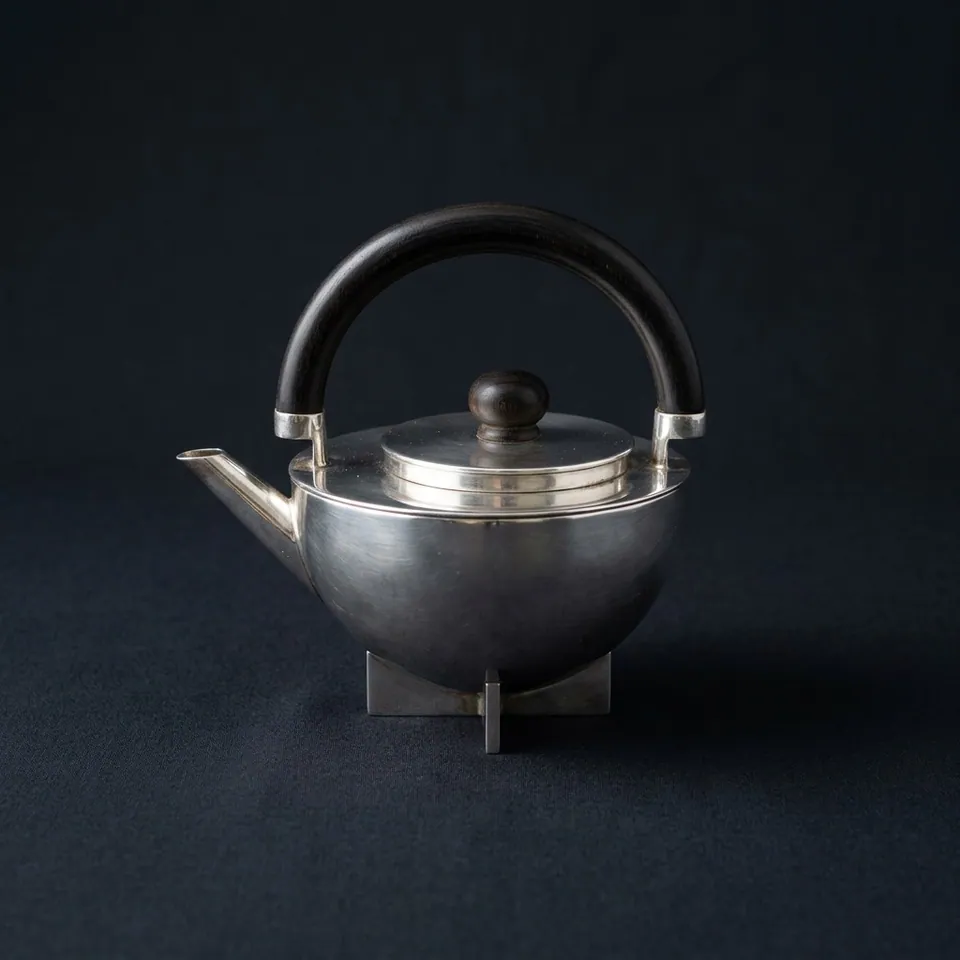
A silver hemisphere with an ebony handle.
Why it matters
Brandt made it as a student in the Bauhaus metal workshop, building a small vessel from a hemisphere, a flat disc lid and a straight tube spout. It never went into serial production and was made by hand in silver and ebony, costly materials that, Bauhaus Kooperation notes, were often criticised at the school.
Marianne Brandt, born in Chemnitz in 1893, made the infuser in 1924, in her first year in the Bauhaus metal workshop in Weimar under László Moholy-Nagy. The Met example, dated about 1924, is silver and ebony in three parts, about 8 cm high and 16.5 cm long. It was made by hand and never entered serial production; in 2024 the Cologne auction house Lempertz counted nine known examples, in silver, tombac, brass and nickel silver. The one shown is in silver with an ebony handle and knob; its Commons description places it in the Smart Museum of Art, Chicago.
What to notice
- The ebony knobA D-shaped slab of ebony stands upright on the round lid.
- The handle hingeThe arched handle is hinged where it meets the flat top of the bowl.
- The spoutA short straight tube, set at an angle, serves as the spout.
- The footThe round bowl rests on a small cross-shaped foot.
3 min read
The full story
A painter in the workshop
Marianne Brandt came to the Bauhaus in Weimar as a trained artist. Born in Chemnitz in 1893, she had studied painting and sculpture at the Weimar art school from 1911 to 1917, married the Norwegian painter Erik Brandt in 1919 and in 1920 travelled for a year in France. At the Bauhaus she took classes with Josef Albers, Wassily Kandinsky and Paul Klee before moving, in 1924, into the metal workshop led by László Moholy-Nagy.
In this story
- A painter in the workshop
- Circle, cross and semicircle
- Single pieces, costly metal
- Nine known examples

The story continues in the app
- Materials
- Silver and ebony (Met); other examples in tombac, brass or nickel silver
- Dimensions
- 8.3 × 10.8 × 16.5 cm, 0.2 kg (Met 2000.63a)
- Maker
- Bauhaus metal workshop, Weimar; made by hand
- In collection
- The Met · British Museum · Klassik Stiftung Weimar · Kamm Teapot Foundation
- Status
- Real · nine known examples (Lempertz, 2024)
Connections
- Marianne Brandt
- Bauhaus
- Era of the World Wars
- Metalwork
- Gold and silver
- Weimar
Nearby in the archive
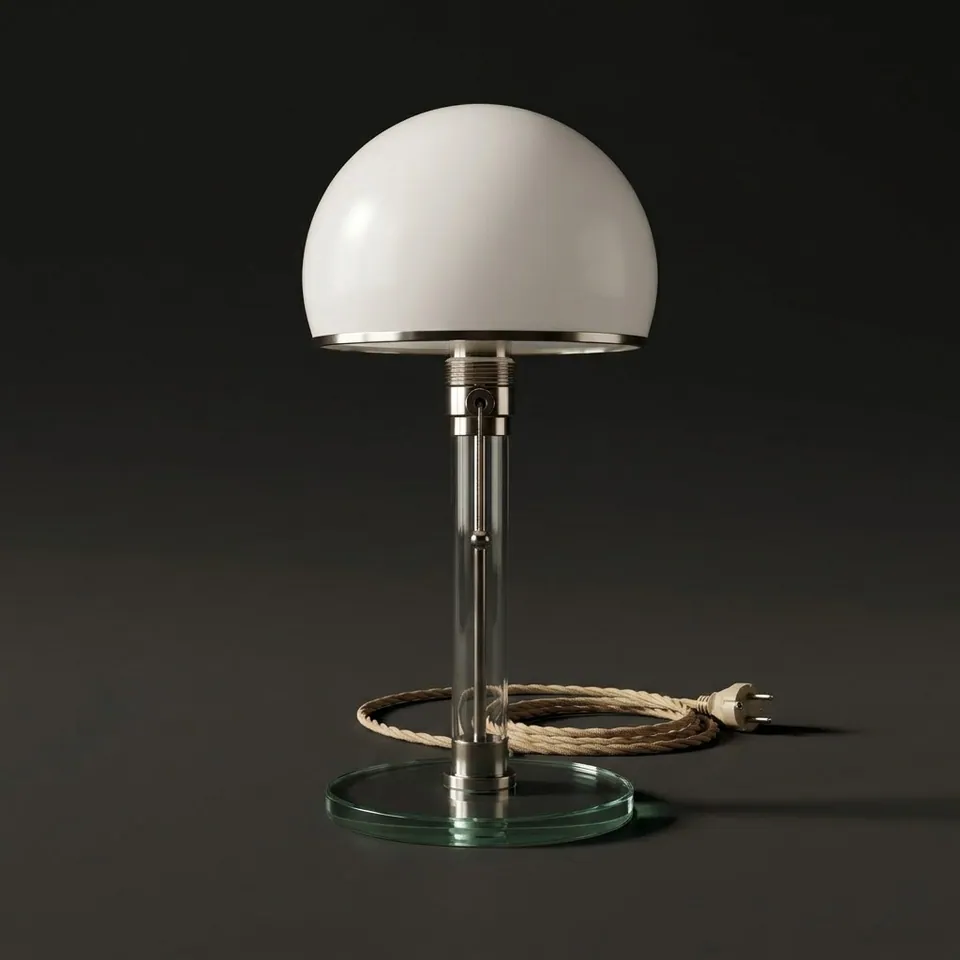 Bauhaus Table LampWagenfeld and Jucker · 1924 · made in the same Bauhaus metal workshop
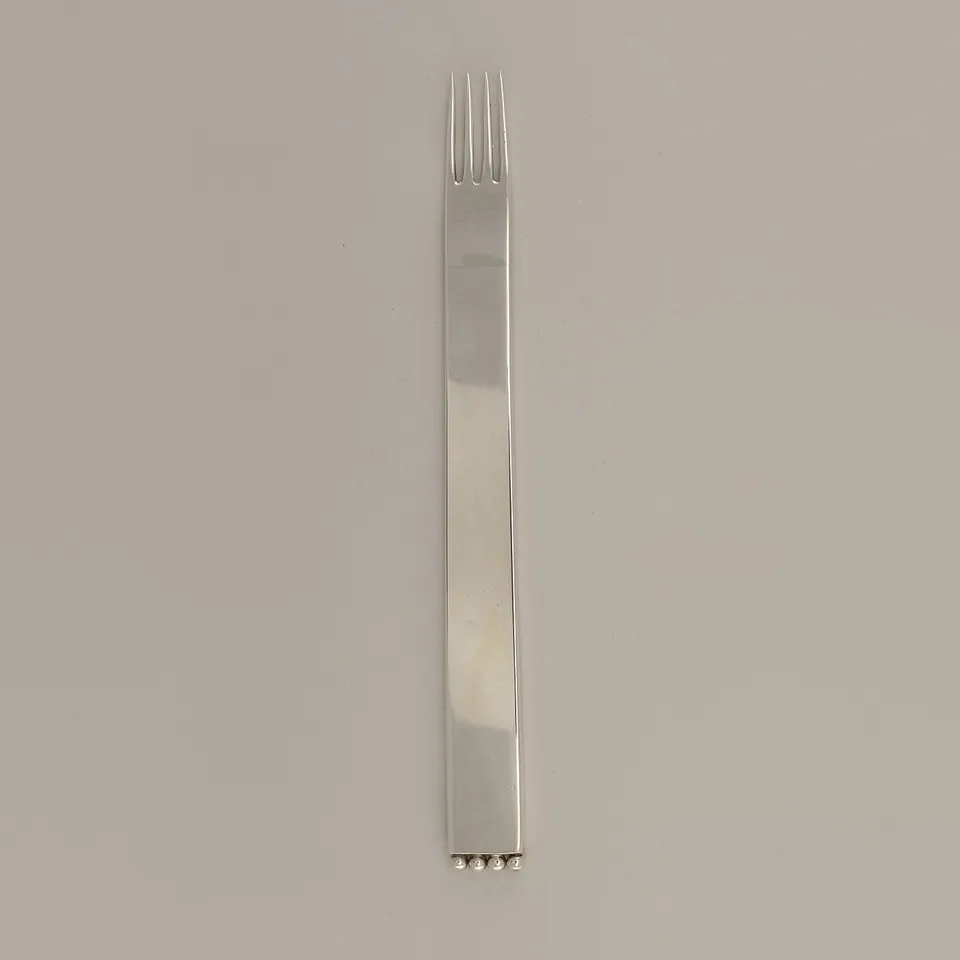 Flat Model cutleryJosef Hoffmann · 1903 · earlier table silver with almost no ornament
Go further
- Bauhaus Women, Ulrike Müller (2009)A survey of the women who worked at the Bauhaus as painters, photographers, architects, sculptors and designers.
- Tea Infuser and Strainer, 2000.63a to c, The Metropolitan Museum of ArtThe museum record for the silver and ebony example, with measurements for all three parts and a short essay on its form and use.
- Tea Infuser (MT 49), Bauhaus KooperationThe entry by the three German Bauhaus institutions, with Lucia Moholy's 1924 photograph of the design.
- A Bauhaus Icon by Marianne Brandt, Lempertz (2024)The auction house's account of a newly found ninth example in nickel silver and where the other eight are kept.
- Marianne Brandt (German, 1893-1983) Tea Infuser, Kamm Teapot FoundationThe record for the silver-plated brass example shown in Leipzig in 1927, with its provenance.
Sources
- Tea Infuser and Strainer, Marianne Brandt, 2000.63a to c, The Metropolitan Museum of Art
- Tea Infuser (MT 49), Bauhaus Kooperation
- A Bauhaus Icon by Marianne Brandt, Auction 1244, lot 562, Lempertz, Cologne
- Marianne Brandt Tea Infuser, 2007.147.1, Kamm Teapot Foundation
- Wikipedia (English), Wikimedia Foundation