Nº 0076 · Museum
Solomon R. Guggenheim Museum
A museum built around one continuous ramp.
Why it matters
Wright organised a whole museum around a single spiralling ramp instead of a sequence of rooms. The critic Paul Goldberger, quoted by the museum, wrote that it made a highly expressive, personal museum building socially and culturally acceptable.
Solomon R. Guggenheim and Hilla Rebay commissioned Frank Lloyd Wright in 1943 to design a permanent home for the Museum of Non-Objective Painting. Wright made about 700 sketches and six sets of working drawings, and ground was broken in August 1956. He died in April 1959, six months before the museum opened on 21 October. Inside, a reinforced concrete ramp climbs the rotunda to a domed skylight, rising one unit in twenty.
What to notice
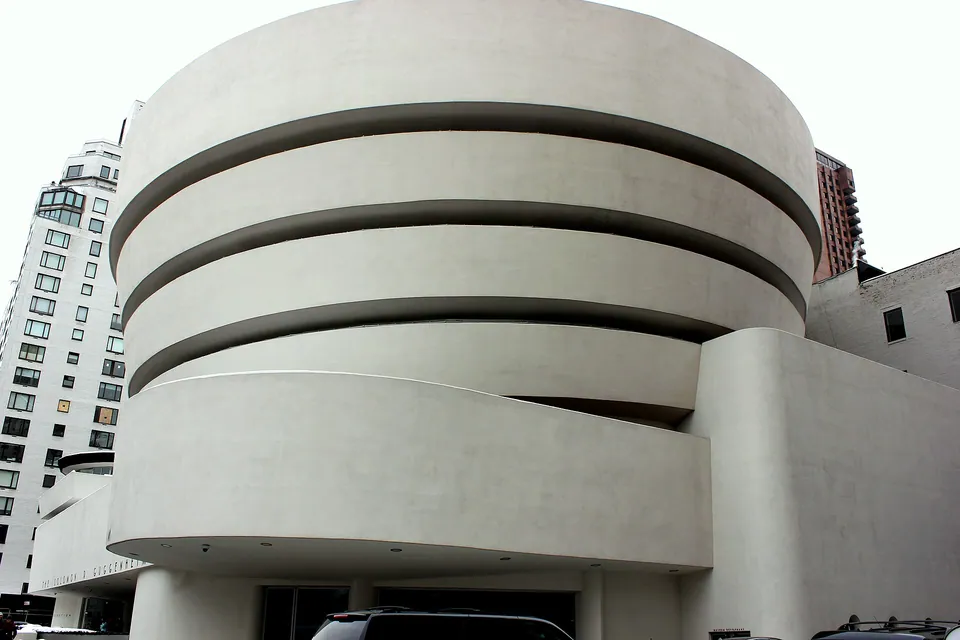
- The bandsDark recessed bands between the white rings follow the ramp inside.
- The widening ringsEach ring sits a little further out than the one below, so the drum grows toward the top.
- The smaller drumA smaller round block stands beside the main rotunda.
3 min read
The full story
Sixteen years of delay
The Museum of Non-Objective Painting opened in 1939 in rented rooms at 24 East 54th Street, showing Solomon R. Guggenheim’s collection of abstract art under its director, Hilla Rebay. When the two approached Wright in 1943 there was no site. Plots on 36th Street, on Park Avenue and in Riverdale in the Bronx were considered before the foundation settled on Fifth Avenue, facing Central Park. It bought the block front between East 88th and 89th Streets in three parcels from 1944 to 1951.
In this story
- Sixteen years of delay
- Sprayed concrete, no joints
- Pictures on a slope
- Cracks, repairs, protection

The story continues in the app
- Materials
- Reinforced concrete
- Address
- 1071 Fifth Avenue, New York
- Built
- Commissioned 1943, opened 1959
- Designation
- New York City Landmark, 1990 · UNESCO World Heritage, 2019
- Status
- Real · in use as a museum
Connections
- Frank Lloyd Wright
- Solomon R. Guggenheim Foundation
- Organic architecture
- Space Age
- Architecture
- Concrete
- New York
Nearby in the archive
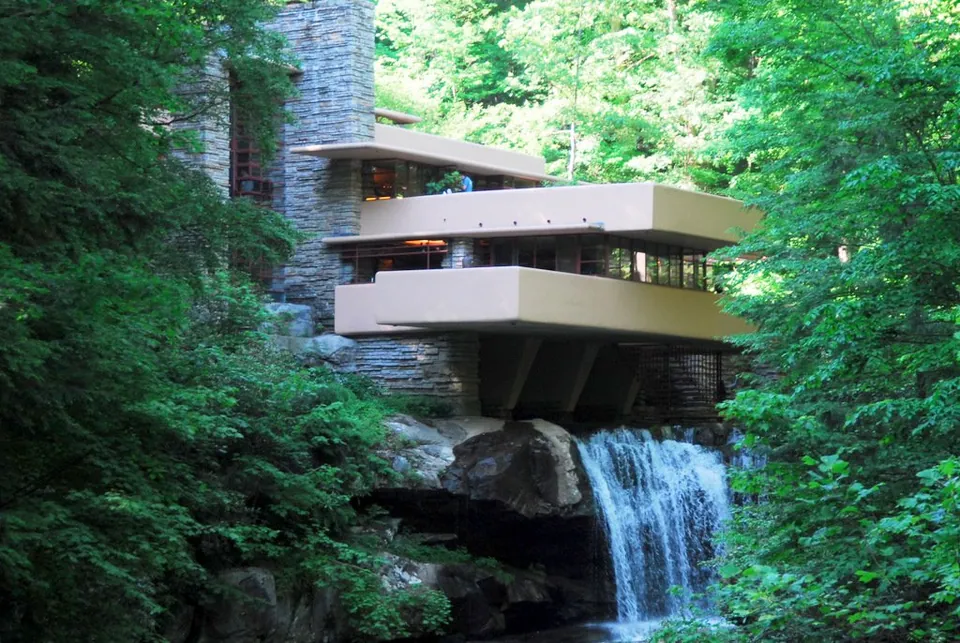 FallingwaterWright · 1935 to 1937 · the same architect, a house in the woods
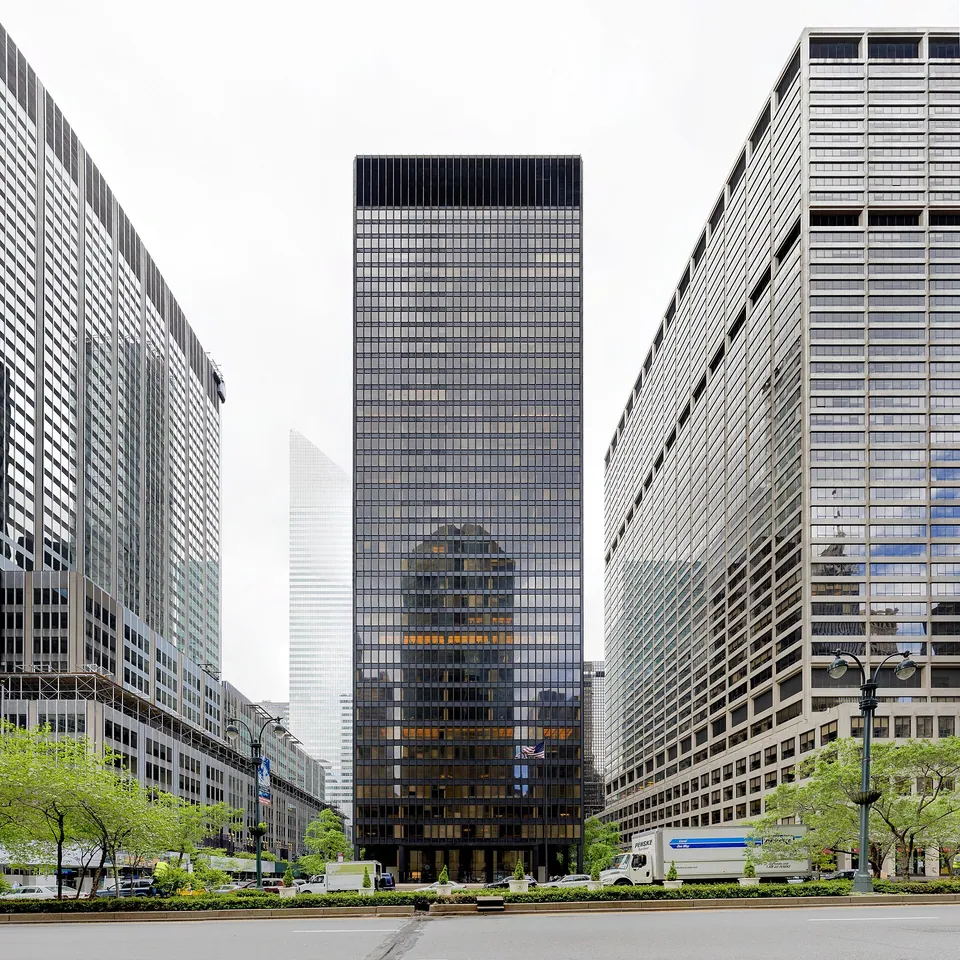 Seagram BuildingMies van der Rohe · 1958 · New York in the same years, in bronze and glass
In collections
Go further
- The Guggenheim: Frank Lloyd Wright and the Making of the Modern Museum, Solomon R. Guggenheim Museum (2009)The museum’s fiftieth-anniversary volume on how the building was designed, built and altered.
- Frank Lloyd Wright: The Guggenheim Correspondence, Frank Lloyd Wright, selected by Bruce Brooks Pfeiffer (1986)Wright’s letters with Rebay, the Guggenheims and Sweeney across the years of the commission, with commentary.
- The Frank Lloyd Wright Building Timeline, Solomon R. Guggenheim FoundationThe museum’s own dated account from the 1943 commission to the World Heritage listing, with every later alteration.
- Illuminating Details from Frank Lloyd Wright’s Guggenheim Blueprints, Ashley Mendelsohn, Frank Lloyd Wright Foundation (2017)A close reading of a 1953 set of blueprints that shows what changed between the early scheme and the built museum.
- Solomon R. Guggenheim Museum, Docomomo US register, Docomomo USA preservation record with the construction method, the builder and a list of alterations.
Sources
- The Frank Lloyd Wright Building Timeline, Solomon R. Guggenheim Foundation
- Frank Lloyd Wright and the Guggenheim New York, Solomon R. Guggenheim Foundation
- Illuminating Details from Frank Lloyd Wright’s Guggenheim Blueprints, Frank Lloyd Wright Foundation
- Solomon R. Guggenheim Museum (register entry), Docomomo US

