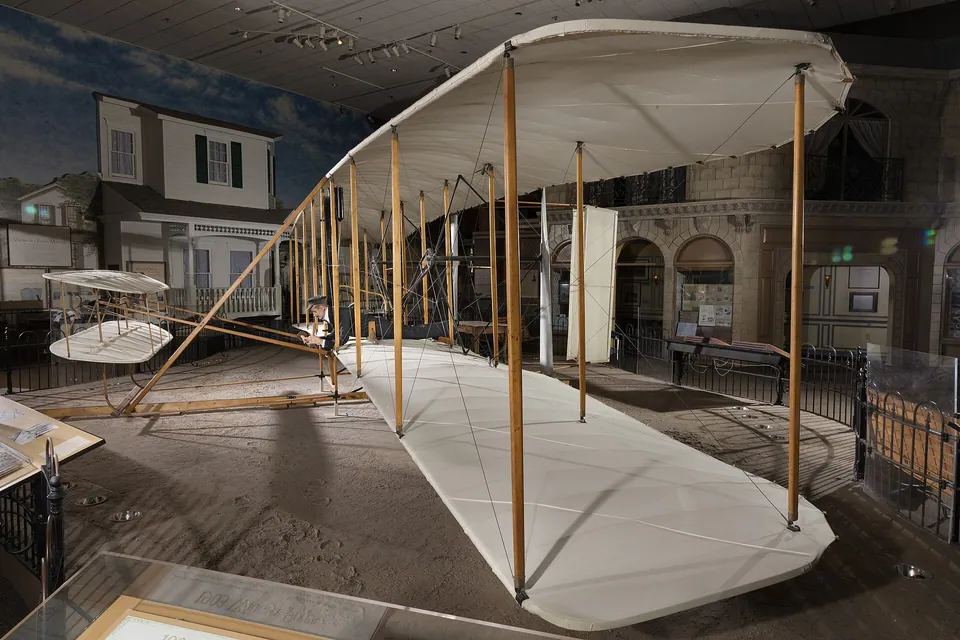
Nº 0166 · Aeroplane
Wright Flyer
Twelve seconds, 120 feet, on 17 December 1903.
Why it matters
The Wrights flew it four times on 17 December 1903 at Kill Devil Hills, near Kitty Hawk, with an engine and propellers of their own design. The National Air and Space Museum calls their propellers, conceived as rotating wings, one of the most original and creative aspects of their work.
The brothers built it in Dayton, Ohio, in the spring and summer of 1903, with a 12 horsepower engine made with their bicycle shop mechanic, Charlie Taylor. Orville flew first, at 10:35 a.m., for 12 seconds and 36 m; Wilbur’s fourth flight covered 255.6 m in 59 seconds, and a gust then overturned the machine, which never flew again. Crated in Dayton, it lay in water and mud for eleven days in the 1913 flood, and it was lent to the Science Museum in London from 1928 to 1948. It was formally given to the Smithsonian on 17 December 1948, 45 years after the flights.
What to notice
- The surface in frontA small double surface out ahead of the wings: the Flyer is a canard biplane.
- The pilot’s placeA figure lies where the pilot did, flat on the lower wing.
- A propellerOne of two propellers behind the wings, turned by chains from the engine.
3 min read
The full story
Kites, gliders, a wind tunnel
The Wrights took up the problem of flight in 1896, the year the German glider pioneer Otto Lilienthal died in a crash. On 30 May 1899 Wilbur wrote to the Smithsonian Institution asking for whatever it had published on aeronautics. That summer the brothers built a kite with a five-foot span to test an idea for control: twisting the wing tips in opposite directions, which they called wing warping.
In this story
- Kites, gliders, a wind tunnel
- Spruce, muslin, aluminium
- A morning on the dunes
- Quarrel with the Smithsonian

The story continues in the app
- Materials
- Wood, muslin covering, aluminium crankcase
- Dimensions
- Span 12.3 m, length 6.4 m, empty weight 274 kg
- Engine
- 12 hp, four cylinders, two chain-driven pusher propellers
- In collection
- National Air and Space Museum, Washington (A19610048000)
- Status
- Real · flew only on 17 December 1903
Connections
- Wilbur Wright
- Orville Wright
- Charlie Taylor
- Age of Industry
- Industrial design
- Wood
- Textile
- Dayton, Ohio
- Kill Devil Hills, North Carolina
Nearby in the archive
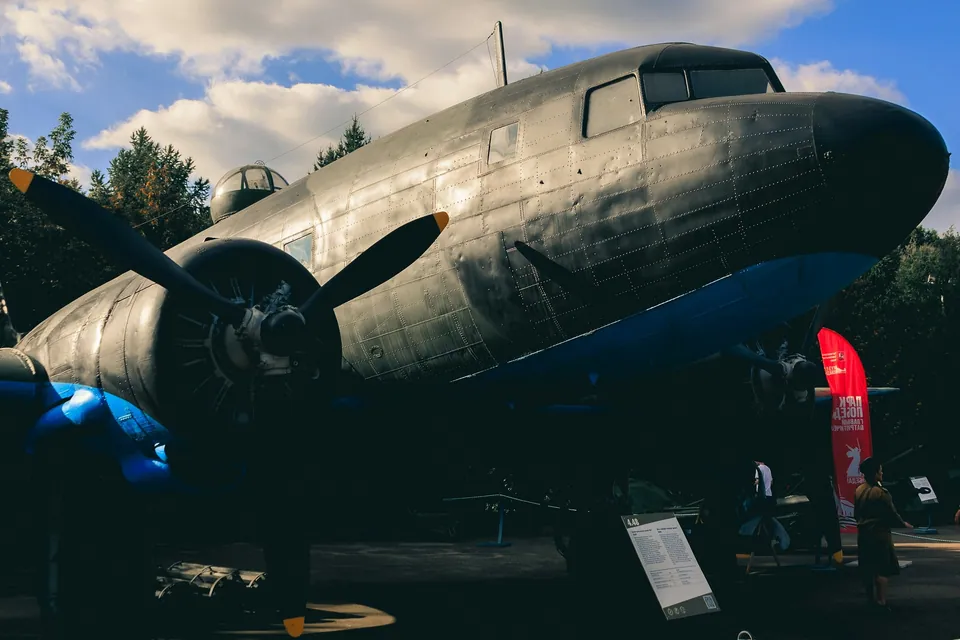 Douglas DC-3Douglas · 1935 · first flew 32 years to the day later
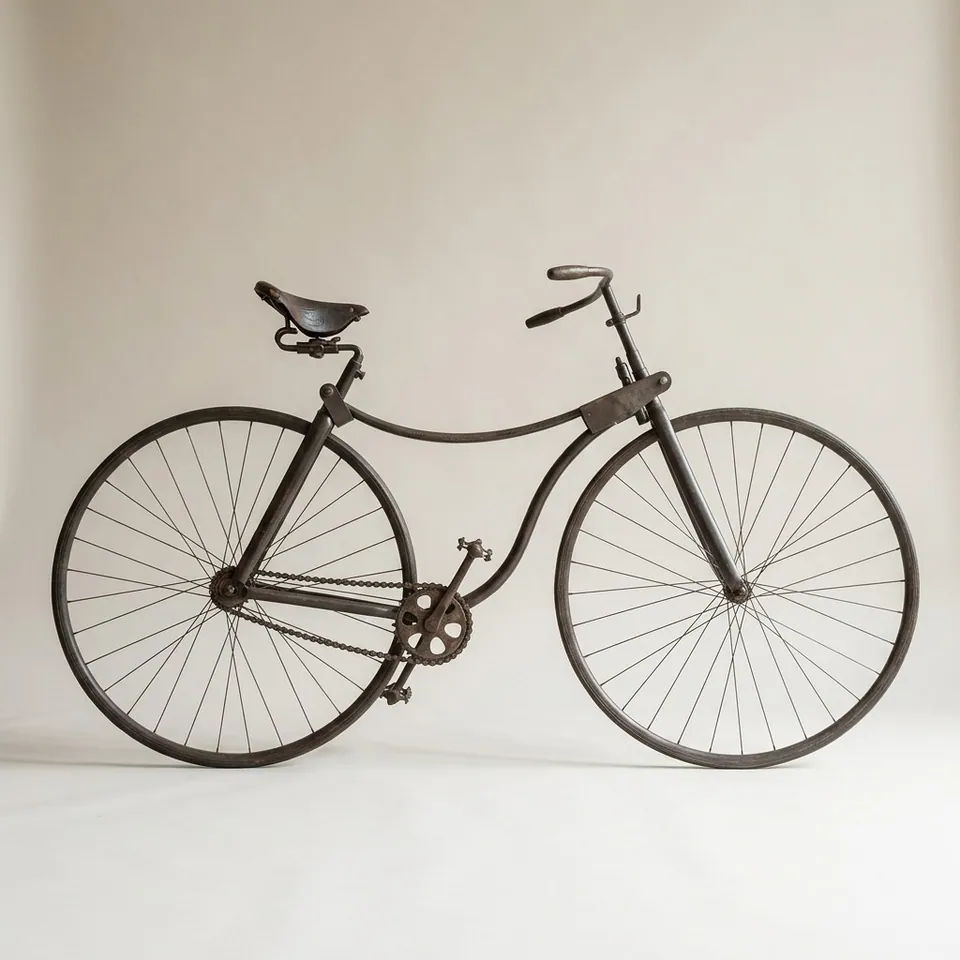 Rover safety bicycleStarley · 1885 · the Wrights were bicycle makers first
In collections
Go further
- The Bishop's Boys: A Life of Wilbur and Orville Wright, Tom D. Crouch (1989)A full biography of the brothers and their family by a Smithsonian aeronautics curator.
- The Wright Brothers, David McCullough (2015)A narrative account of the brothers’ work from the bicycle shop to their public flights.
- 1903 Wright Flyer, object A19610048000, National Air and Space MuseumThe museum record, with a long history of the aeroplane, its dimensions and open access photographs.
- What Happened to the Original Wright Flyer?, National Air and Space Museum (2022)Traces the aeroplane from its crates in Dayton through the Smithsonian dispute and the London loan to 1948.
- 1903-The First Flight, National Park Service, Wright Brothers National MemorialAn account of the morning of 17 December 1903 from the memorial that stands on the site.
Sources
- 1903 Wright Flyer, A19610048000, National Air and Space Museum
- How the Wright Flyer got to the Smithsonian, National Air and Space Museum
- Wikipedia (English), Wikimedia Foundation