A thread in a glass bulb
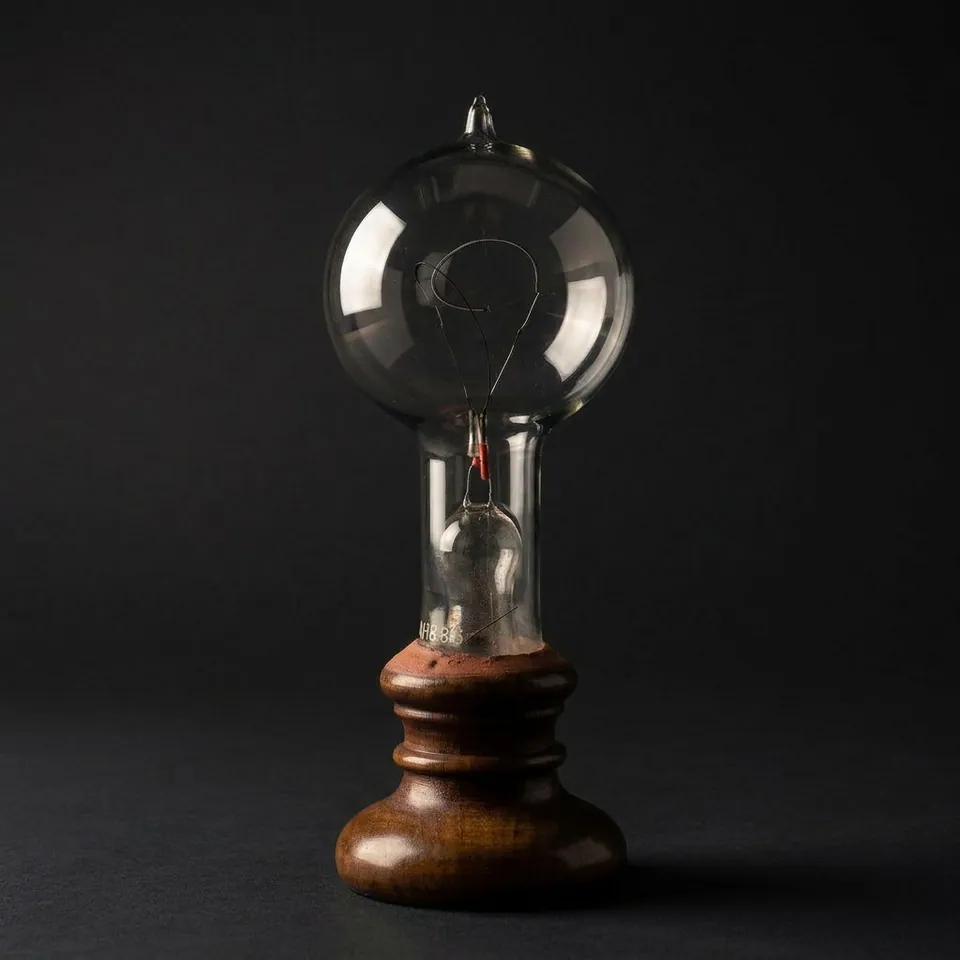
In experiments on 21 and 22 October 1879, at Thomas Edison’s laboratory in Menlo Park, New Jersey, a filament of ordinary cotton thread was carbonised and connected to a circuit. It glowed from half past one in the morning until three in the afternoon, about thirteen and a half hours. Charles Batchelor, one of Edison’s researchers, recorded the cotton thread experiments in his notebook on 22 October. Edison had already filed for a patent on 4 November, for a lamp with a carbon filament joined to platinum contact wires, when the laboratory lit more than 50 bulbs for a public demonstration on 31 December. The patent was granted on 27 January 1880.
In this story
- A thread in a glass bulb
- Coloured glass over the flame
- Opal glass and mulberry paper
- Henningsen and the problem of glare
- Springs and a block of marble
- Wax, halogen and aluminium

The essay continues in the app