Nº 0169 · Palace courtyard
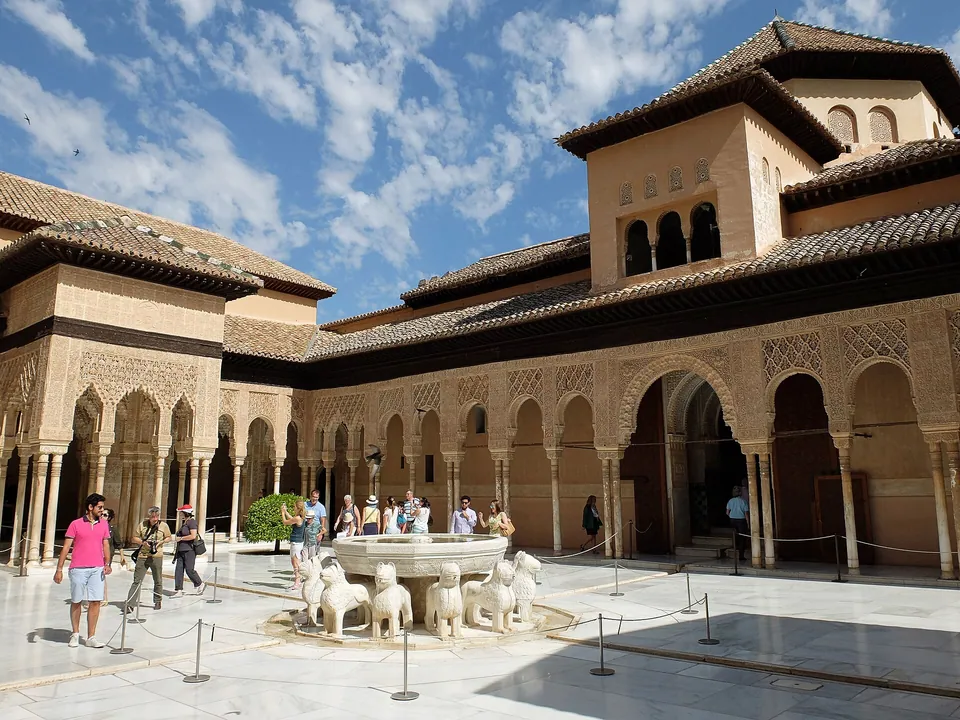
Court of the Lions, Alhambra
Twelve marble lions carry a basin inscribed with poetry.
Why it matters
The court sets a fountain where four water channels meet inside a colonnaded court, and carves a poem into the basin itself, so water, sculpture and writing form one object. It was built for Muhammad V of Granada in the period the Patronato de la Alhambra describes as the peak of Nasrid rule.
Muhammad V built the palace and its courtyard during his second reign, between 1362 and 1391; the names of its architects and carvers are not recorded. The court, about 29 by 16 m, is ringed by a gallery on 124 white marble columns, single or in groups of two and three, with a pavilion projecting at each short end. The twelve-sided basin at the centre is a single block of Macael marble resting on twelve marble lions, and verses by the court poet Ibn Zamrak run around it. The lions were taken away for restoration in stages from 2002 and returned in December 2011, when the courtyard floor was relaid in Macael marble.
What to notice
- The lionsTwelve lions stand in a ring under the basin, facing outwards.
- The pavilionA pavilion on clustered columns projects into the court at the short end.
- The plasterworkAbove the arches, carved plaster panels of net-like pattern and bands of inscription.
3 min read
The full story
A sultan back from Fez
Muhammad V became sultan of Granada in 1354, lost the throne in 1359 and went into exile in Fez. He regained Granada in 1362 and ruled until 1391, and the palace around the Court of the Lions belongs to this second reign. Building is thought to have begun in 1362 with the Hall of the Two Sisters, and most of the rest followed between 1377 and 1390.
In this story
- A sultan back from Fez
- A gallery on four sides
- Royal apartments, then engravings
- Marble underfoot again

The story continues in the app
- Materials
- Macael marble basin and lions; marble columns; carved plaster
- Dimensions
- Courtyard about 29 × 16 m
- Columns
- 124, in white marble
- Inscription
- Verses by Ibn Zamrak around the basin
- Status
- Real · the Alhambra, UNESCO World Heritage, 1984
Connections
- Middle Ages
- Architecture
- Marble
- Stone
- Granada
Nearby in the archive
In collections
Go further
- The Alhambra, Robert Irwin (2004)A short history of the palace and of how later centuries altered and imagined it.
- Al-Andalus: The Art of Islamic Spain, Jerrilynn D. Dodds (ed.), The Metropolitan Museum of Art (1992)The museum’s exhibition catalogue, with essays on the Alhambra among the monuments of Islamic Spain.
- The Court of the Lions, Patronato de la Alhambra y GeneralifeThe managing body’s own account of the palace, its plan and the workings of the fountain.
- Fountain of the Lions. Methodology of a Restoration, Patronato de la Alhambra y GeneralifeSets out how the lions and basin were removed, cleaned and returned between 2002 and 2012.
- The Fountain of the Lions, European Heritage Awards / Europa Nostra Awards (2013)The award entry for the restoration, with the jury’s reasons.
Sources
- The court of the lions, Patronato de la Alhambra y Generalife
- Fountain of the Lions. Methodology of a Restoration, Patronato de la Alhambra y Generalife
- The restoration of the Fountain of the Lions reconciles tradition and innovation, Patronato de la Alhambra y Generalife
- Patio of the Lions, alhambradegranada.org
- Wikipedia (English), Wikimedia Foundation

