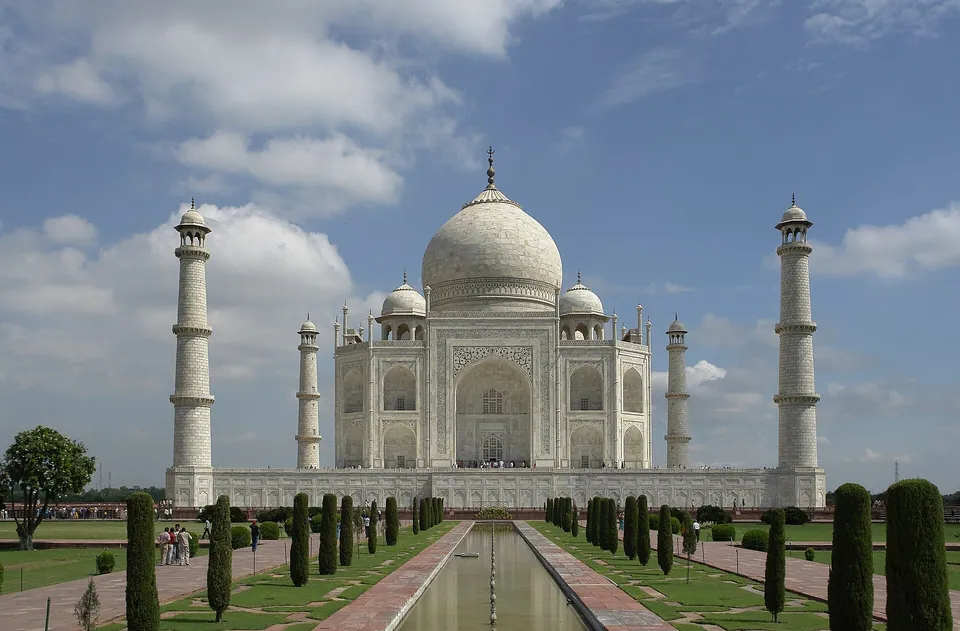
Nº 0168 · Mausoleum
Taj Mahal
Its cenotaphs are empty; the graves lie below.
Why it matters
The Taj Mahal joins a domed tomb, four minarets, a raised plinth and a walled garden into one symmetrical plan on the bank of the Yamuna. Its white marble is set with inlaid flowers and Quranic inscriptions in coloured stone, and the minarets are thought to have been built leaning slightly outwards, so that a fall would carry them away from the tomb.
Shah Jahan commissioned the tomb after his wife Mumtaz Mahal died in childbirth on 17 June 1631; building began in 1632, the mausoleum was finished in 1648 and the whole complex in 1653. Ustad Ahmad Lahori is traditionally credited as chief architect, and an estimated 20,000 workers and artisans worked on it. The mausoleum is white marble from Makrana in Rajasthan, inlaid with 28 kinds of precious and semi-precious stone, and the buildings around it are red sandstone. The two cenotaphs in the main chamber are not the graves: Mumtaz Mahal and Shah Jahan are buried in the crypt below.
What to notice
- The great archA tall pointed arch fills each face, framed by a band of inscription.
- A minaretFour minarets stand at the corners of the plinth, detached from the tomb.
- The water channelA long water channel runs on the garden axis, between paths of red sandstone.
2 min read
The full story
A grave moved to Agra
Mumtaz Mahal died on 17 June 1631 at Burhanpur, after the birth of her fourteenth child. She was buried there in a garden called Zainabad. About six months later her body was carried to Agra, where Shah Jahan had taken the throne in 1628.
In this story
- A grave moved to Agra
- Marble over brick
- Leaks and a second burial
- Lawns and mud packs

The story continues in the app
- Materials
- White Makrana marble; red sandstone; inlay in 28 kinds of stone
- Dimensions
- About 73 m high overall; plinth about 95 m square
- Minarets
- Four, each more than 40 m tall
- Calligraphy
- Quranic inscriptions set out and signed by Amanat Khan Shirazi
- Status
- Real · UNESCO World Heritage, 1983
Connections
Nearby in the archive
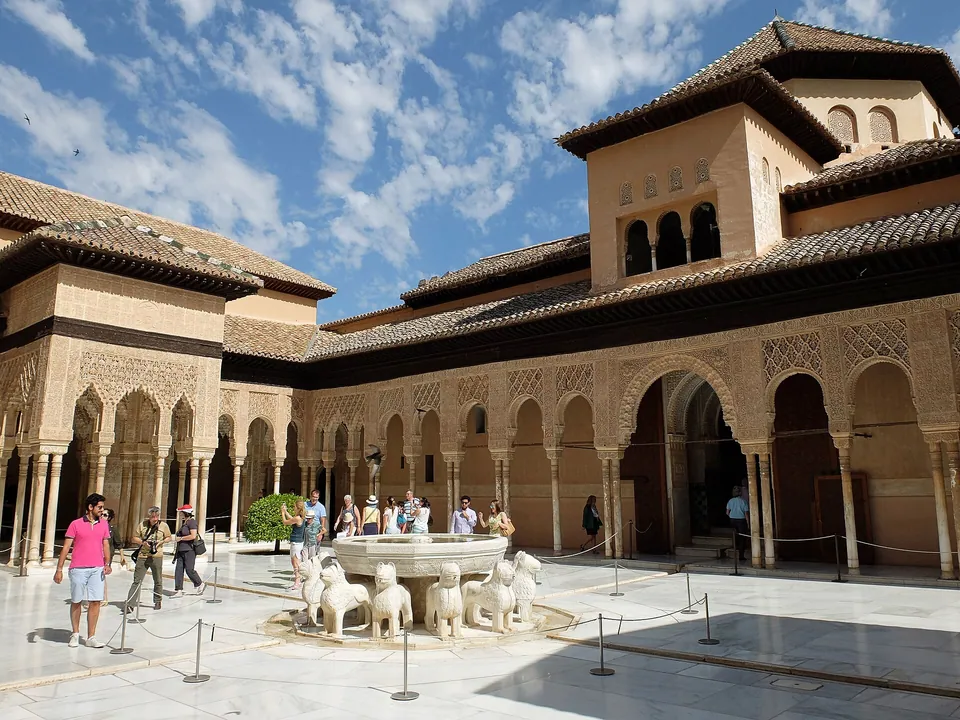 Court of the Lions, AlhambraNasrid court · c. 1362 · water channels on a cross in an Islamic court
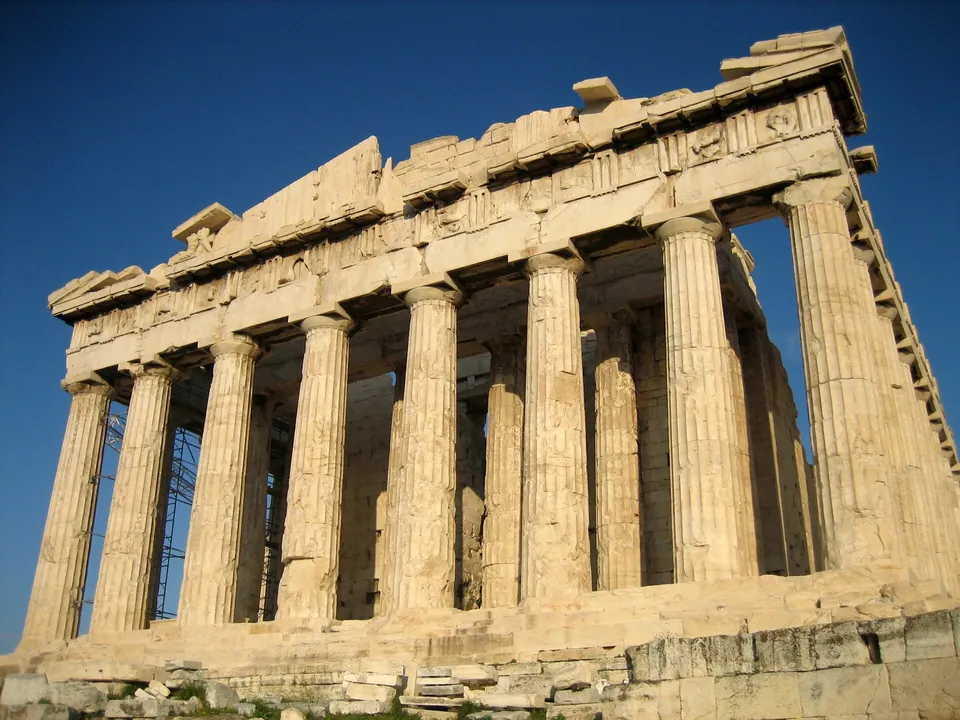 ParthenonIktinos and Kallikrates · 447 BC · another monument built wholly in white marble
In collections
Go further
- The Complete Taj Mahal and the Riverfront Gardens of Agra, Ebba Koch (2006)The standard scholarly study, with measured drawings of the whole complex and of the other Mughal gardens along the Yamuna.
- Taj Mahal, World Heritage List no. 252, UNESCO World Heritage CentreThe official listing, with a close description of the plan and a statement of how the site is protected and managed.
- The Taj Mahal, Roshna Kapadia, SmarthistoryAn illustrated introduction that sets out the garden plan, the view from the Mahtab Bagh and the rival readings of what the tomb stands for.
- Tops of the cenotaphs of Shah Jahan and Mumtaz Mahal in the Taj Mahal, AL.9232O, Victoria and Albert MuseumA watercolour of about 1820 by an Indian artist, recording the inlay on the two cenotaphs for a European buyer.
Sources
- Tops of the cenotaphs of Shah Jahan and Mumtaz Mahal in the Taj Mahal, AL.9232O, Victoria and Albert Museum
- Wikipedia (English), Wikimedia Foundation