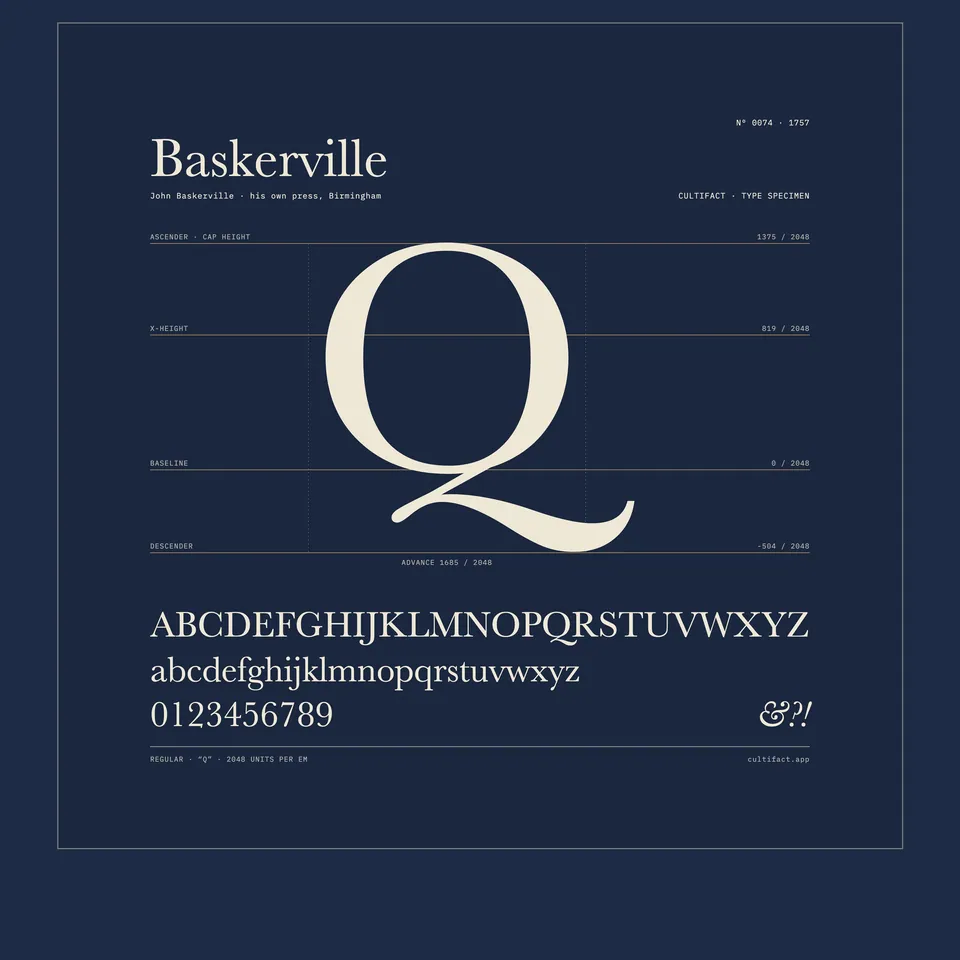
Nº 0074 · Typeface
Baskerville
A typeface with more than one original.
Why it matters
Baskerville sharpened the contrast between thick and thin strokes and set round letters more upright, and his type is described as the peak of the transitional style, between old style and modern faces. Cambridge University Library’s study of his punches shows a craftsman revising the design over years.
John Baskerville, a Birmingham japanner turned printer, opened his press in 1750 and printed his first book, a Virgil, in 1757 at his house at Easy Hill. The type was cut under his direction, with John Handy credited as the punchcutter. He became printer to Cambridge University in 1758, and the Cambridge Bible of 1763, shown here, is counted his masterpiece. More than 3,000 of his steel punches reached Cambridge in 1953 from the Paris foundry Deberny and Peignot.
What to notice
- Spaced capitalsWide-set capitals, with sharp contrast between thick and thin strokes.
- The italicTHE NEW in Baskerville’s italic capitals.
- The ornament rulesRows of small printed ornaments rule off the line Appointed to be read in churches.
3 min read
The full story
A japanner’s late start
John Baskerville came to printing late and already rich. He had taught handwriting and cut gravestones in Birmingham, then made a considerable fortune from japanning, the trade in lacquered goods. In 1750, in his forties, he set up a printing workshop. Seven years passed before it produced a book.
In this story
- A japanner’s late start
- Type, paper, ink and press
- Admired abroad, doubted at home
- Back from Paris

The story continues in the app
- Class
- Transitional serif
- First book
- Virgil, Birmingham, 1757
- Punches
- More than 3,000, steel, Cambridge University Library
- Revival
- Monotype, 1923
- Status
- Real · original punches survive
Connections
Nearby in the archive
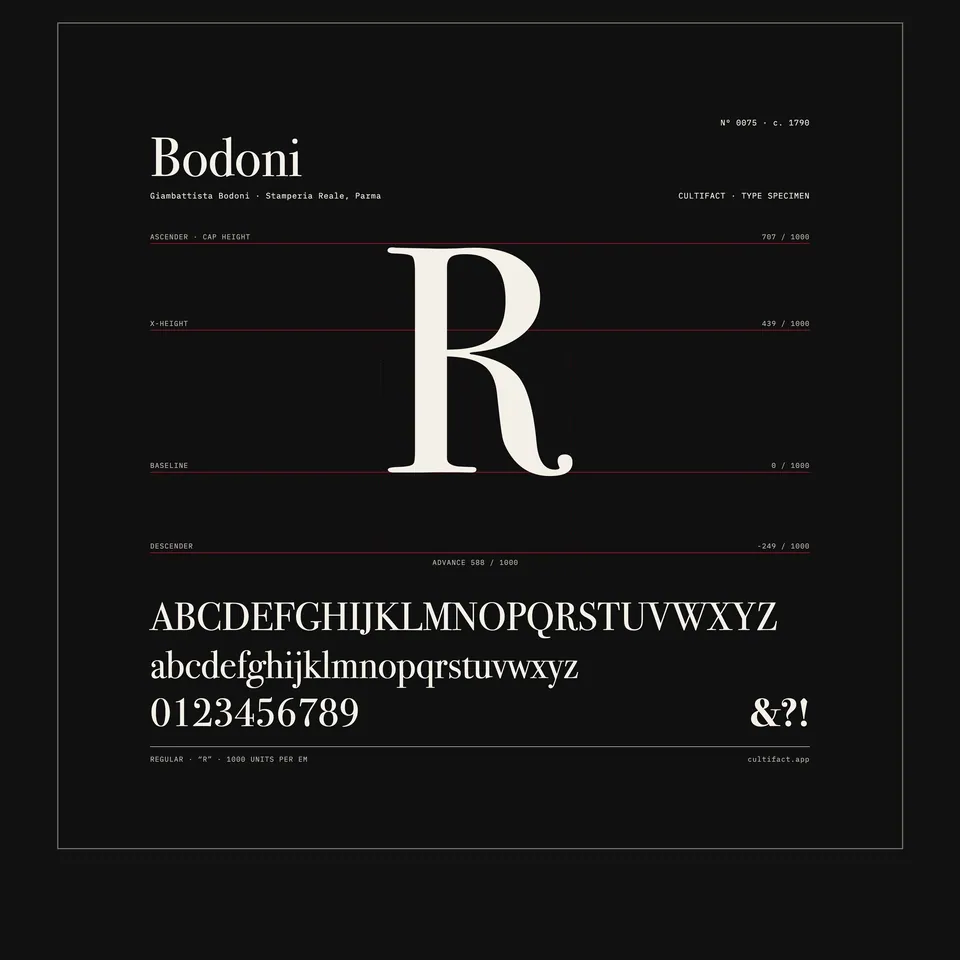 BodoniBodoni · c. 1790 · the contrast pushed further
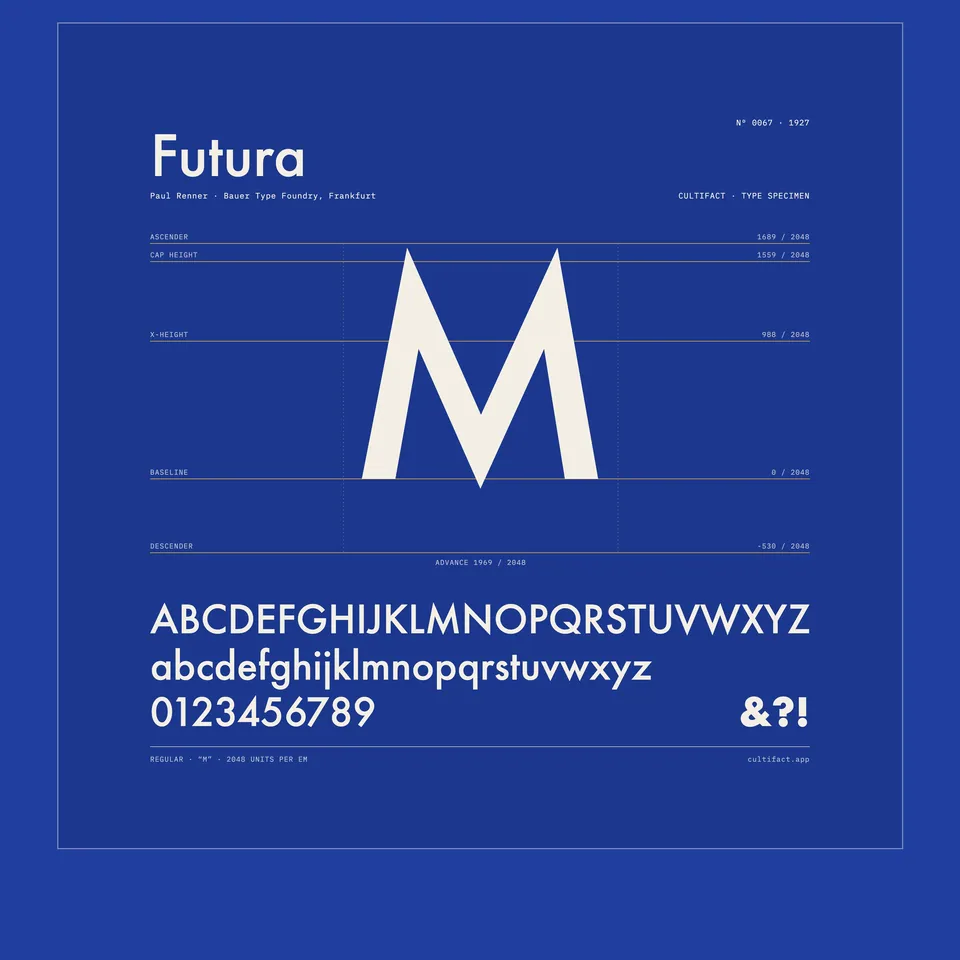 FuturaRenner · 1927 · two centuries on, the contrast removed
In collections
Go further
- John Baskerville: Art and Industry of the Enlightenment, Caroline Archer-Parré and Malcolm Dick (eds), Liverpool University Press (2017)A collection of essays on Baskerville as printer, japanner and industrialist, including his papers, his type and his afterlife in Birmingham.
- Preserving the Craft: Baskerville’s typographic legacy lives on as punches go online for first time, Cambridge University Library (2026)The library’s account of imaging more than 3,000 punches and what the images show about how the letters were revised.
- Publii Virgilii Maronis Bucolica, Georgica et Aeneis (Birmingham, 1757), Boston Public Library, via the Internet ArchiveA full scan of a copy of Baskerville’s first book, page by page.
- John Baskerville: The Anatomy of a Type, Part II, Alexander S. Lawson (1968)A printing historian traces the punches from Birmingham to Kehl and Paris and lists the twentieth-century revivals.
- Baskerville, Cadbury Research Library, University of BirminghamA short guide to the Baskerville books held in Birmingham, among them the Virgil and the Cambridge Bible.
Sources
- Preserving the Craft: Baskerville's typographic legacy lives on as punches go online for first time, Cambridge University Library
- Baskerville, Cadbury Research Library, University of Birmingham
- Wikipedia (English), Wikimedia Foundation
- Baskerville, Wikipedia

