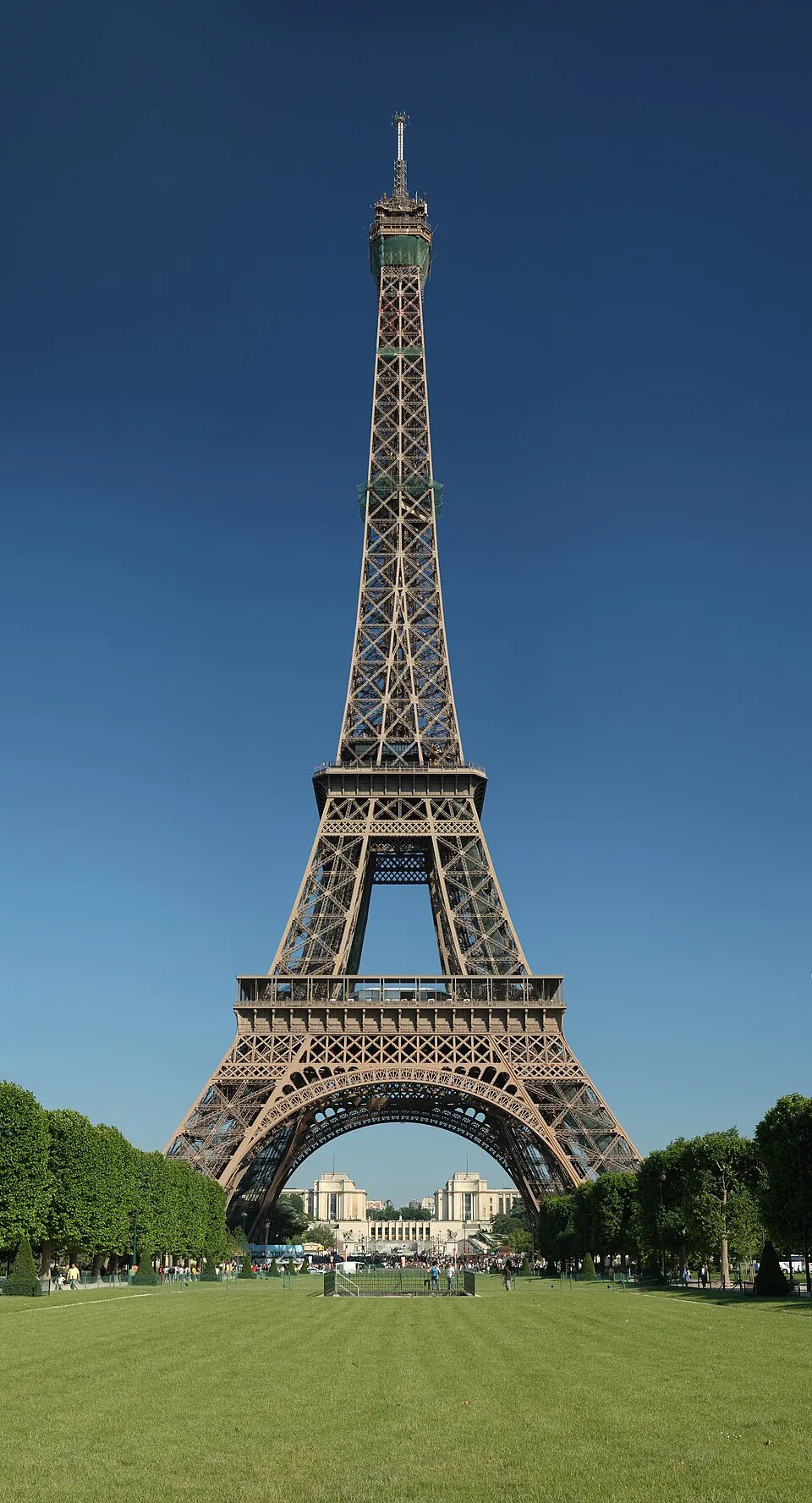
Nº 0106 · Tower
Eiffel Tower
18,038 iron parts, joined by 2.5 million rivets.
Why it matters
Two engineers in Gustave Eiffel’s company, Maurice Koechlin and Emile Nouguier, conceived a 300 m lattice tower, and the architect Stephen Sauvestre gave it its base, arches and top. It remained the tallest structure in the world until the Chrysler Building of 1930.
It was built for the Exposition Universelle of 1889, the centenary of the French Revolution, and chosen from 107 projects. Construction began in January 1887 and was complete on 31 March 1889. The structure is puddled, or wrought, iron, about 7,300 tonnes of it, and the great arches between the legs carry no load. It was 300 m high at completion and is 330 m today, with the aerial added in 1957.
What to notice
- The great archSauvestre’s arch between the legs is decoration; it carries no load.
- The latticeOpen iron lattice, growing finer as the tower narrows.
- The upper shaftAbove the second platform the four legs join into one tapering shaft.
3 min read
The full story
A pylon drawn in 1884
In June 1884 Maurice Koechlin and Emile Nouguier, the two chief engineers of Gustave Eiffel’s company, had the idea of a very tall tower. They drew it as a great pylon: four columns of lattice girders standing apart at the base, meeting at the top. The height of 300 m stood for the round figure of 1,000 feet. On 18 September 1884 Eiffel registered a patent for a way of building metal supports and pylons beyond that height.
In this story
- A pylon drawn in 1884
- Made in Levallois-Perret
- A protest, then two million
- Kept for its aerial

The story continues in the app
- Materials
- Puddled (wrought) iron, about 7,300 tonnes
- Height
- 300 m in 1889; 330 m today
- Parts
- 18,038 parts, 2.5 million rivets
- Maker
- Compagnie des Etablissements Eiffel
- Status
- Real · standing
Connections
- Maurice Koechlin
- Emile Nouguier
- Stephen Sauvestre
- Gustave Eiffel
- Compagnie des Etablissements Eiffel
- Age of Industry
- Architecture
- Iron
- Paris
Nearby in the archive
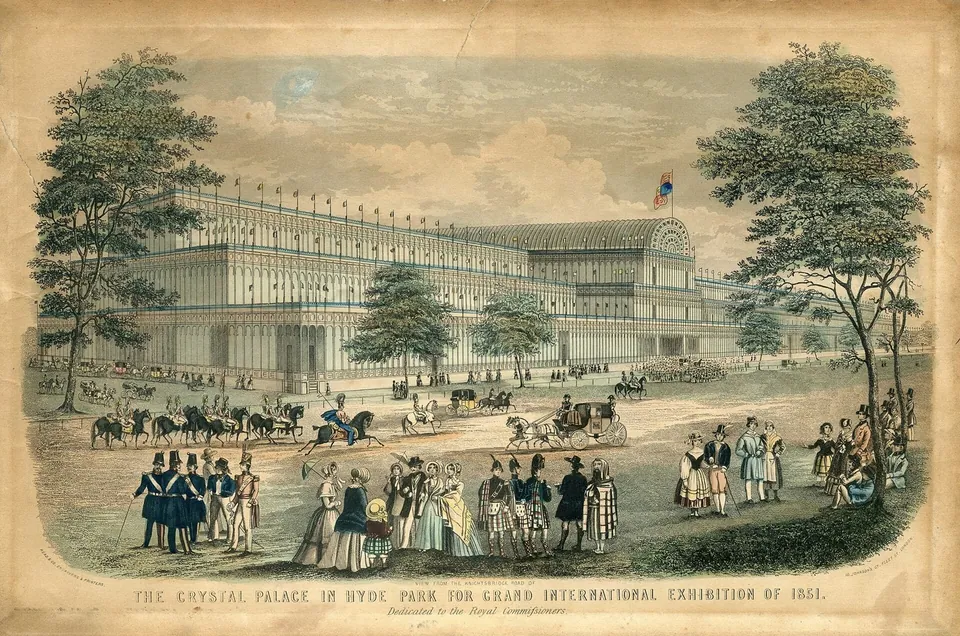 Crystal PalacePaxton · 1851 · iron and glass for an earlier exhibition
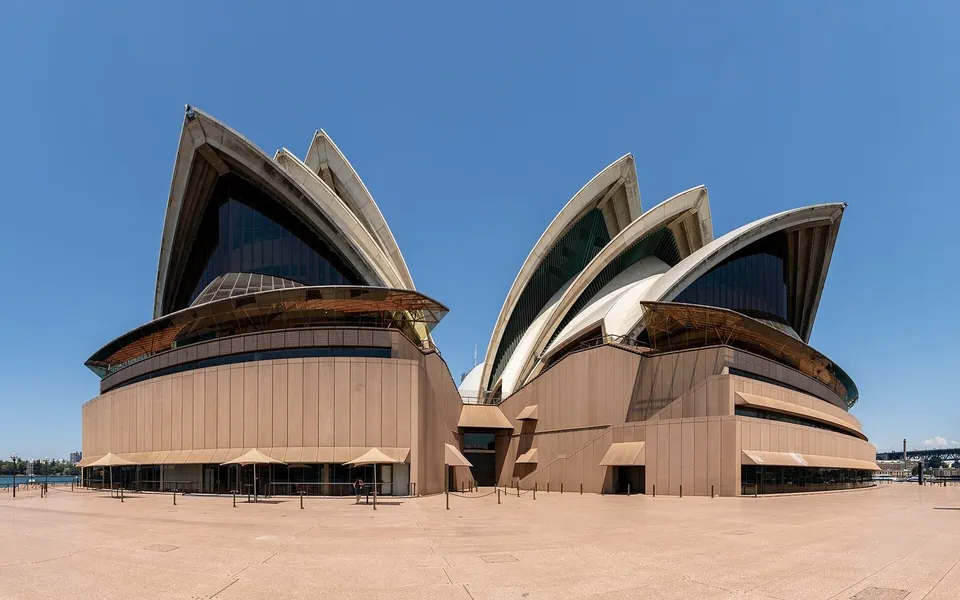 Sydney Opera HouseUtzon · 1957 · another structure read as the sign of its city
In collections
Go further
- Eiffel’s Tower and the World’s Fair Where Buffalo Bill Beguiled Paris, the Artists Quarreled, and Thomas Edison Became a Count, Jill Jonnes (2009)A narrative history of the tower and of the 1889 exhibition it was built for.
- La tour de trois cents mètres, Gustave Eiffel (1900)Eiffel’s own book on the tower, published in Paris eleven years after it opened.
- Origins and Construction of the Eiffel Tower, Société d’Exploitation de la Tour EiffelThe operator’s account of the design, the building schedule and the 1887 protest, with Eiffel’s reply.
- The Eiffel Tower and science, Société d’Exploitation de la Tour EiffelHow laboratory work and wireless telegraphy kept the tower standing, and the 72 scientists’ names on its sides.
- Paris, Banks of the Seine, UNESCO World Heritage CentreThe World Heritage record for the stretch of riverside Paris that includes the tower, inscribed in 1991.
Sources
- Eiffel Tower (historic civil engineering landmark), American Society of Civil Engineers
- The birth of the Eiffel Tower, Société d’Exploitation de la Tour Eiffel
- Wikipedia (English), Wikimedia Foundation

