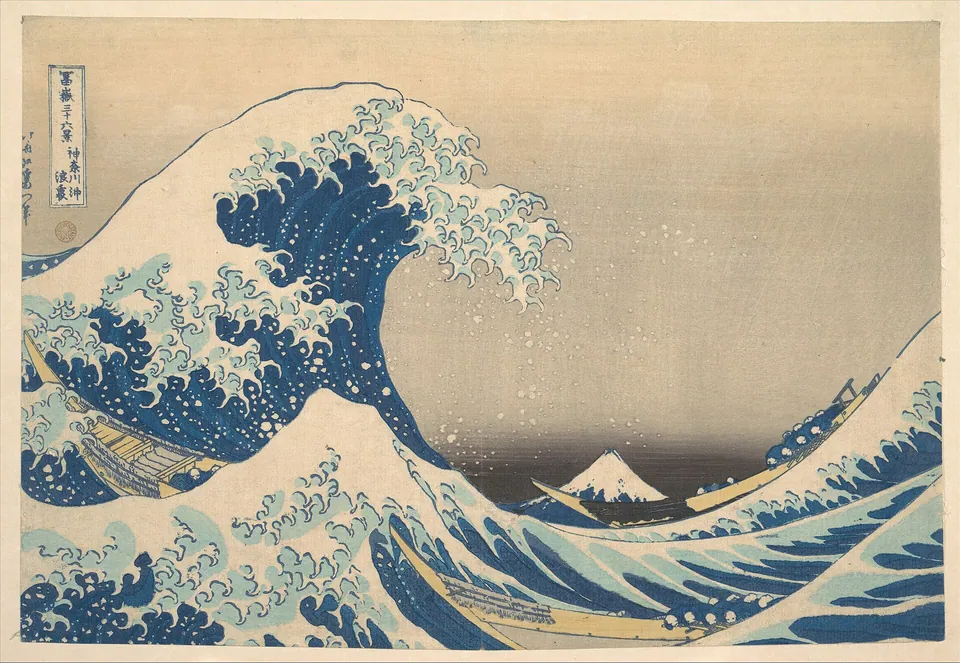
Nº 0133 · Woodblock print
The Great Wave off Kanagawa
Three fish boats under one breaking wave.
Why it matters
Hokusai set Mount Fuji, the subject of the whole series, small and far off in the trough of a wave, and let the sea fill the sheet. The print used Prussian blue, a synthetic pigment then newly available in Japan, and it was printed in so many impressions that museums on several continents each hold their own.
Eijudo published it in Edo, now Tokyo, about 1831, as one sheet of the series Thirty-six Views of Mount Fuji. The boats are oshiokuri-bune, fast boats that carried fresh fish to the Edo markets. The series title and the signature, Hokusai aratame Iitsu hitsu (Hokusai, now called Iitsu, brush), are printed at top left, and later impressions were taken from re-cut blocks. The impression in this photograph is in the Metropolitan Museum of Art, New York (JP10).
What to notice
- The crest of the waveThe crest breaks into claw-like fingers of foam above the boats.
- Mount FujiMount Fuji, snow-capped and small, sits in the trough of the wave.
- Rowers in a boatRowers crouch in a row along a narrow boat beneath the wave.
3 min read
The full story
A wave rehearsed for decades
Hokusai had drawn great waves long before this one. Timothy Clark, the British Museum curator who has written most closely on the print, notes that he rehearsed the motif several times in his thirties and forties, while he was absorbing deep perspective from the European prints that Dutch traders brought in and that passed among a few collectors and artists. The design itself may already have been drawn in the early 1820s.
In this story
- A wave rehearsed for decades
- Two blues, printed twice
- The price of noodles
- Hundreds of sheets, none definitive

The story continues in the app
- Materials
- Woodblock print, ink and colour on paper
- Dimensions
- About 25 × 38 cm, varies by impression
- Publisher
- Eijudo (Nishimuraya Yohachi), Edo
- In collection
- The Met · Art Institute of Chicago · V&A · NGV · LACMA
- Status
- Real · many impressions, no single original
Connections
Nearby in the archive
In collections
Go further
- Hokusai's Great Wave, Timothy Clark, British Museum Press (2011)A short, illustrated study of the print by the British Museum's curator of Japanese art, from its sources to its later reuse.
- Hokusai's Great Wave: Biography of a Global Icon, Christine M. E. Guth, University of Hawai'i Press (2015)Follows the image from Edo in 1831 through its reception abroad to its use in advertising and everyday goods.
- The Great Wave: Anatomy of an Icon, Marco Leona, The Metropolitan Museum of Art (2020)The Met's head of scientific research explains how the printers layered Prussian blue and indigo, with microscope images.
- The Great Wave: spot the difference, Capucine Korenberg, British Museum (2020)Shows how block wear and replacement blocks separate early impressions from late ones, with side-by-side details.
- A History of the World in 100 Objects: Hokusai's The Great Wave, Neil MacGregor, BBC Radio 4 (2010)A radio episode that sets the print against Japan's closed borders and the trade that brought in its blue.
Sources
- Under the Wave off Kanagawa (Kanagawa oki nami ura), also known as The Great Wave, JP1847, The Metropolitan Museum of Art
- Under the Wave off Kanagawa, E.210-1915, Victoria and Albert Museum
- The great wave off Kanagawa, 426-2, National Gallery of Victoria
- Under the Wave off Kanagawa (Kanagawa oki nami ura), 1925.3245, Art Institute of Chicago
- The Great Wave off Kanagawa, M.81.91.2, Los Angeles County Museum of Art

