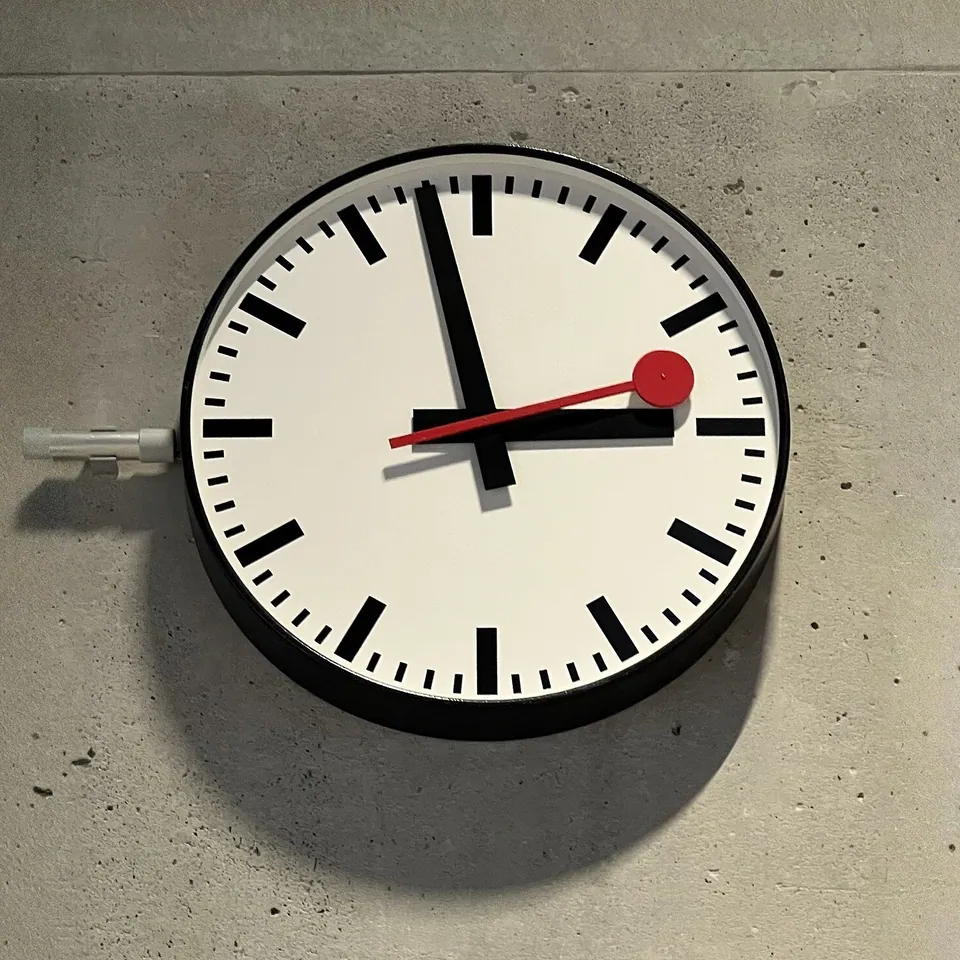
Nº 0212 · Station clock
Swiss railway clock
A red second hand that waits for the minute.
Why it matters
Hilfiker gave the Swiss railways one clock face for every station, with bars in place of numerals so the time reads from far down a platform. The face, with its red second hand shaped like a dispatcher’s baton, has been licensed for Mondaine wristwatches since 1986.
Hans Hilfiker, an electrical engineer at SBB, designed the clock in 1944 with the Sumiswald clock maker Moser-Baer, and production began in 1947. The red second hand was added in the early 1950s. Each station clock takes one electrical pulse a minute from a master clock: the second hand goes round in a little under 59 seconds, stops for about a second and a half, and moves on when the pulse comes and the minute hand jumps. The clocks in these photographs hang at Grindelwald Terminal station.
What to notice
- The red discThe second hand ends in a red disc, after the dispatcher’s signalling baton.
- Bars, no numeralsThick bars mark the hours and thin ones the minutes; there are no numerals.
- The bracketOn platforms the clock hangs from a bracket, with a face on each side.
3 min read
The full story
One time for every station
Until the 1940s Swiss stations hung clocks of many makes, and they did not all show the same time. The Swiss Federal Railways, SBB, gave the problem to Hans Hilfiker. Born in Zurich in 1901, he had trained as a precision mechanic and studied electrical and telecommunications engineering at ETH. He then spent several years in Argentina for a Siemens affiliate, working on army signals and telephone lines, and joined the SBB construction division in 1932.
In this story
- One time for every station
- A motor set to run fast
- From platform to wrist
- The pause that stayed

The story continues in the app
- Materials
- Metal and glass
- Dimensions
- Made in several sizes
- Maker
- Moser-Baer, Sumiswald, from 1947
- In collection
- Verkehrshaus der Schweiz, Lucerne (VHS-9971)
- Status
- Real · still in service at Swiss stations
Connections
- Hans Hilfiker
- Swiss Federal Railways (SBB)
- Moser-Baer
- Era of the World Wars
- Industrial design
- Zürich
- Sumiswald
Nearby in the archive
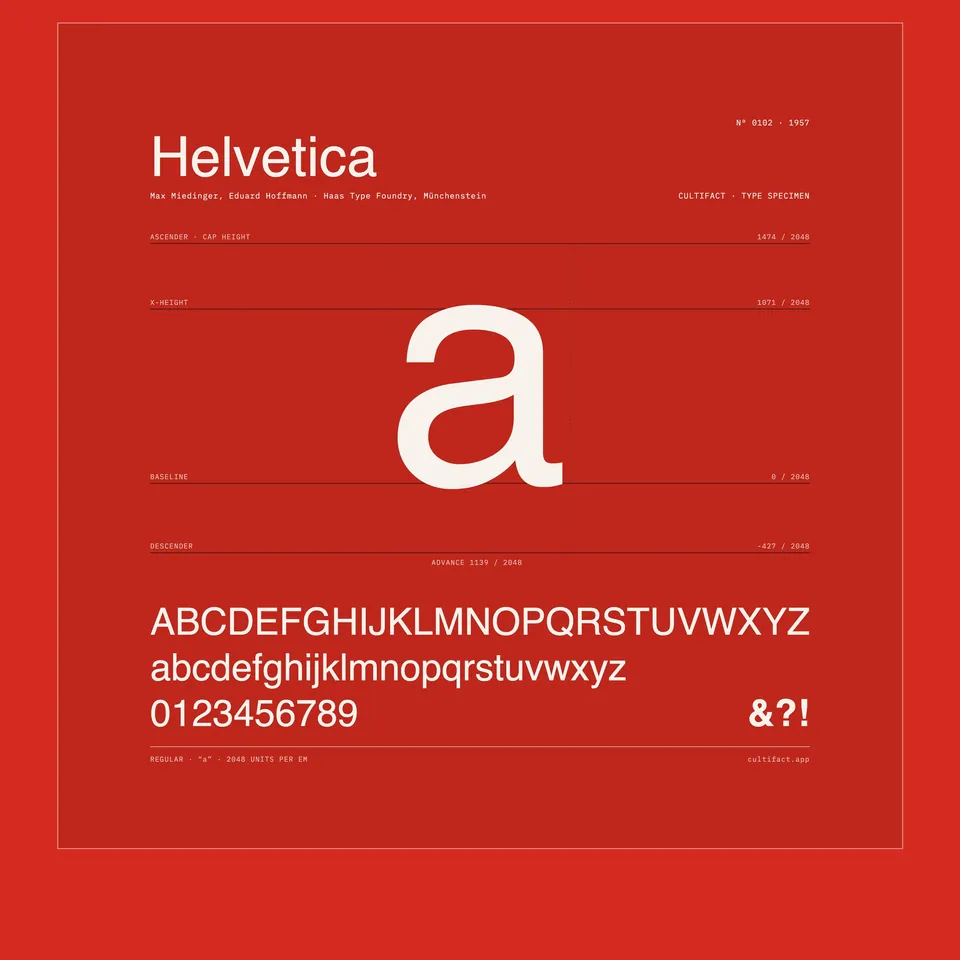 HelveticaMiedinger · 1957 · Swiss, drawn to read at a glance
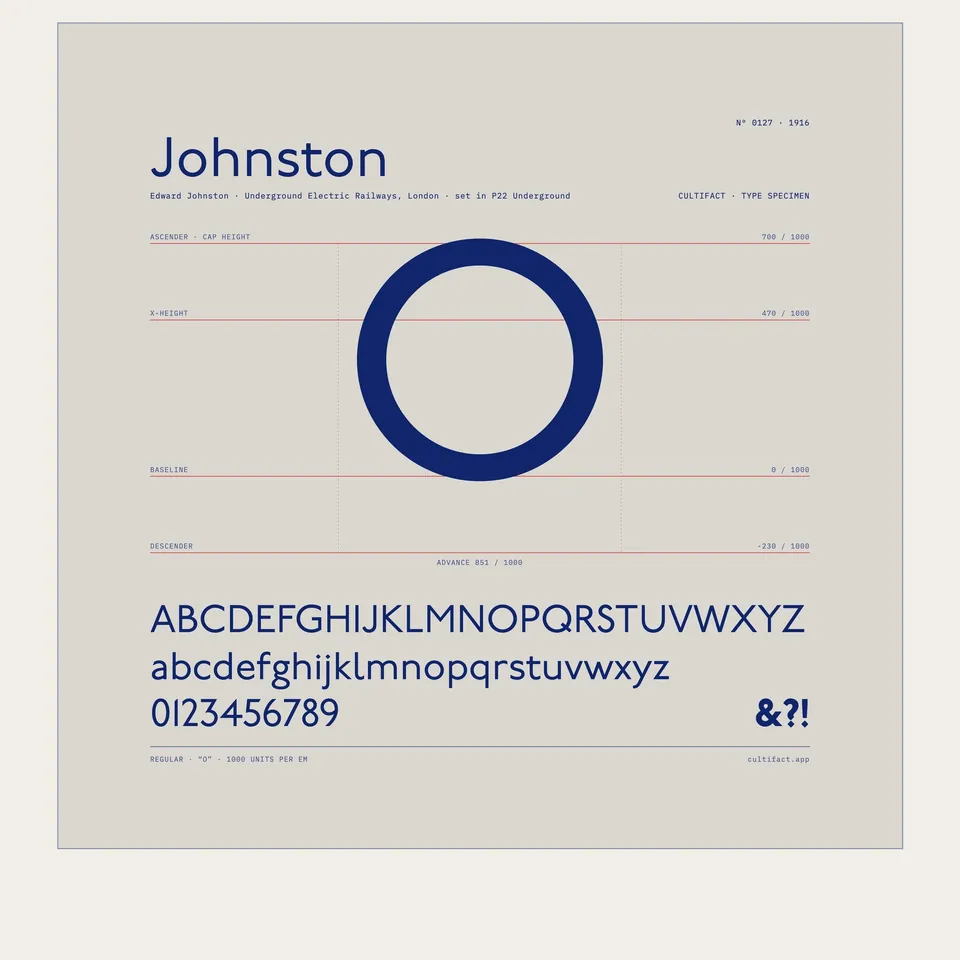 JohnstonJohnston · 1916 · another railway design for reading on the move
In collections
Go further
- Hans Hilfiker, Ingenieur und Gestalter, Kunstgewerbemuseum Zürich (1984)The exhibition catalogue on Hilfiker’s work as engineer and designer, in German.
- The iconic Swiss station clock, Thomas Weibel, Swiss National Museum (2022)A short history from Hilfiker’s years in Argentina to the dispute with Apple, with the numbers of clocks in use.
- Schweizer Bahnhofsuhr: Die SBB-Uhr gibt seit 80 Jahren den Takt an, auch beim Design, SRF Kultur (2024)The Swiss broadcaster’s piece for the clock’s eightieth year, in German, explaining master clocks and the minute jump.
- Bahnhof-Wanduhr mit rotem Punkt-Sekundenzeiger, VHS-9971, Verkehrshaus der SchweizThe museum record for a station wall clock of the 1947 type, with photographs, measurements and materials.
Sources
- Bahnhof-Wanduhr mit rotem Punkt-Sekundenzeiger, VHS-9971, Verkehrshaus der Schweiz, Lucerne
- The iconic Swiss station clock, Swiss National Museum blog
- Schweizer Bahnhofsuhr: Die SBB-Uhr gibt seit 80 Jahren den Takt an, auch beim Design, SRF Kultur
- Swiss railway clock: running on time, Prodir
- Wikipedia (English), Wikimedia Foundation

