Nº 0253 · Volumes of engraved plates
Encyclopédie, plate volumes
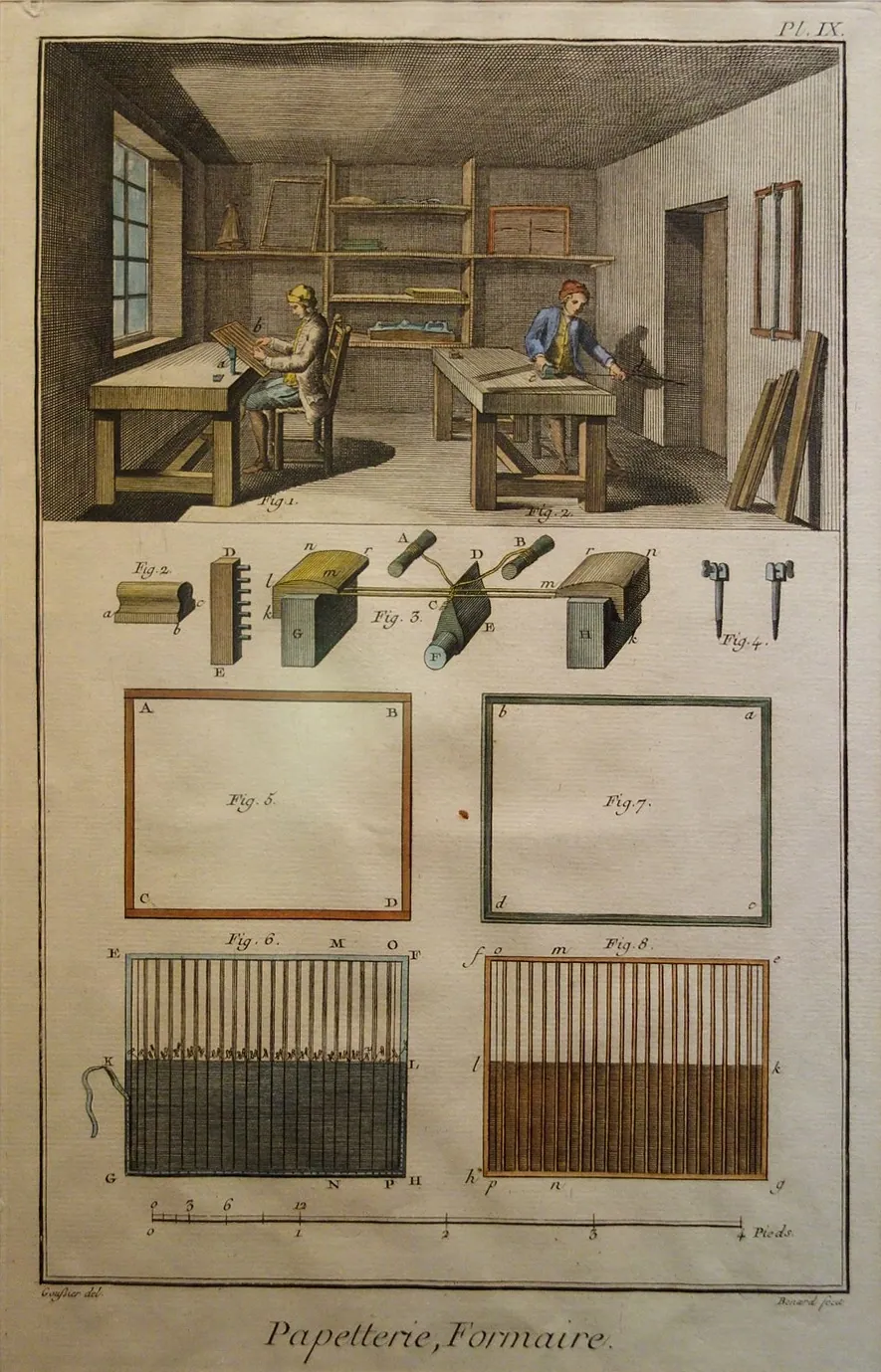
A workshop above, its tools below, every part lettered.
Why it matters
The eleven plate volumes put the mechanical arts beside the sciences and the liberal arts, as their title states, and showed each trade in a fixed arrangement: a scene of work above, the tools drawn apart below, each part lettered for the written explanation. They belong to the Encyclopédie of Diderot and d’Alembert, one of the founding works of the Enlightenment.
The seventeen text volumes of the Encyclopédie appeared from 1751 to 1765, and the plates followed in eleven volumes from 1762 to 1772, about 2,800 plates in all. When the royal privilege for the text was revoked in 1759, the plate volumes were still allowed to go ahead. Louis-Jacques Goussier directed the drawings, and Diderot credited him with all the good plates; Jacques Renaud Benard engraved at least 1,800. The plate shown, on the paper-mould maker’s trade, carries both names at its foot.
What to notice
- The workshopTwo men at benches in a mould maker’s room, with frames on the shelves and a window at the left.
- The toolsTools drawn apart from the scene, each part marked with a letter for the explanation.
- The scaleA scale in French feet, pieds, so the moulds above it can be measured.
- The credit lineGoussier del., drawn by Goussier; at the other corner, Benard fecit, engraved by Benard.
2 min read
The full story
Pictures for a translation
The Encyclopédie began in 1745 as a French version of Ephraim Chambers’s Cyclopaedia, published in two volumes in London in 1728. Under Denis Diderot it grew far beyond that. In his article on the word Encyclopédie, Diderot asked that the government let people into factories to watch the work, question the workmen and draw the machines and even the premises.
In this story
- Pictures for a translation
- Scene above, parts below
- Clean workshops, lettered tools
- From copper to screen

The story continues in the app
- Materials
- Etching and engraving on paper
- Dimensions
- Volumes about 40 cm high (Met vol. 11: 40.5 × 26.8 × 5.2 cm)
- Plates
- About 2,800, in eleven volumes
- Chief engraver
- Jacques Renaud Benard
- In collection
- The Met, New York (33.23) · Robert C. Williams Paper Museum, Atlanta
Connections
- Denis Diderot
- Jean le Rond d’Alembert
- Louis-Jacques Goussier
- Jacques Renaud Benard
- Enlightenment
- Industrial Revolution
- Information design
- Paper
- Paris
In collections
Go further
- A Diderot Pictorial Encyclopedia of Trades and Industry, Charles Coulston Gillispie (ed.) (1959)A large selection of the trade plates, with an introduction and notes by the editor.
- Blueprint: A Study of Diderot and the Encyclopédie Plates, Stephen Werner (1993)A short scholarly study of the plates and Diderot’s part in them.
- ARTFL Encyclopédie, University of ChicagoThe full text with the legends of all eleven plate volumes and high-resolution images of the plates, searchable.
- ENCCRE: Édition numérique collaborative et critique de l’Encyclopédie, Académie des sciences (2017)A critical digital edition of the original edition, with articles and plates linked and annotated by researchers.
- Engraving the plates, MIT LibrariesAn exhibition page that sets a copperplate made for the Académie des sciences beside a similar Encyclopédie plate and explains intaglio printing.
Sources
- Recueil de planches, sur les sciences, les arts libéraux, et les arts méchaniques, 1762 to 72, 11 volumes, The Metropolitan Museum of Art
- Recueil de Planches, Onzieme et Dernier Volume, 1772, 33.23(11), The Metropolitan Museum of Art
- Fourbisseur (Swordmaking), plate VII, 33.23.4(144), The Metropolitan Museum of Art
- Wikipedia (English), Wikimedia Foundation