Nº 0235 · Monumental inscription
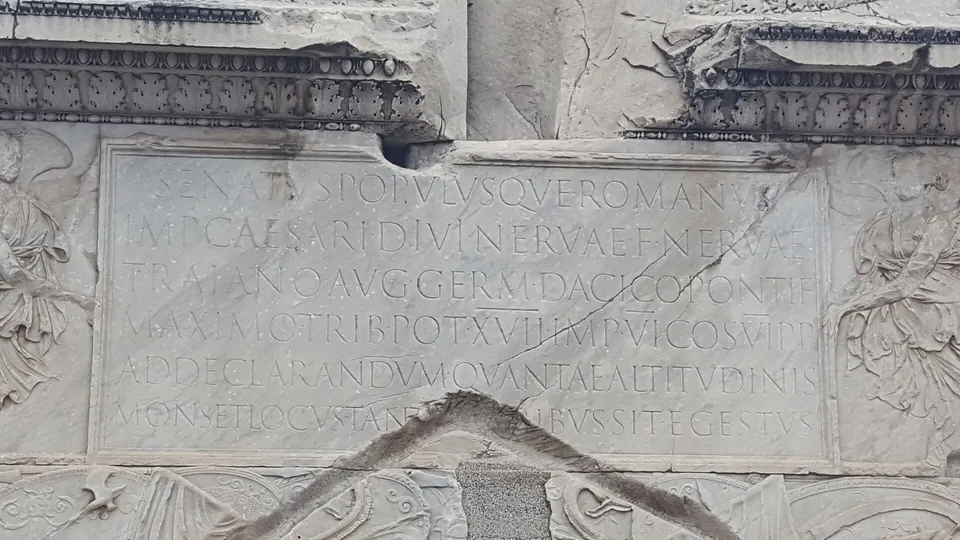
Trajan's Column inscription
Six lines of Roman capitals cut in marble.
Why it matters
The pedestal carries one of the most studied sets of Roman capitals, and later typefaces named Trajan, among them Carol Twombly’s Adobe Trajan of 1989, are drawn from it. The lettering scholar Edward Catich argued that the letters were first painted with a flat brush and then cut, so that their serifs keep the mark of the brush.
The Senate and People of Rome dedicated the column in 113 AD in the Forum of Trajan, and a spiral frieze of about 155 scenes and more than 2,500 figures winds up its shaft. Its architect is thought to have been Apollodorus of Damascus. The inscription on the pedestal runs to six lines of capitals, and the last two say that the column shows how high a hill and how much ground were cut away for these works. The V&A’s plaster cast of the column, bought in 1864, was made from copper electrotypes of moulds taken for Napoleon III, and the museum calls it a copy of a copy.
What to notice
- Points between wordsSmall points cut at mid-height separate the abbreviated words IMP, CAESARI and DIVI.
- A barred numeralA short bar is cut above the numeral XVII in the fourth line.
- Thick and thinIn ALTITVDINIS the upright strokes are heavy and the cross strokes light, each ending in a small serif.
3 min read
The full story
A title in the seventeenth year
The column went up at the northern end of Trajan's new forum, a monument to his wars in Dacia. It was dedicated in May 113, more than sixteen months after the forum itself. The date is written into the text: the fourth line counts Trajan's seventeenth year of tribunician power, a title he took on 10 December 112 and held for twelve months.
In this story
- A title in the seventeenth year
- Drawn for eyes below
- A plaster copy in London
- Rubbings, brushes and type

The story continues in the app
- Materials
- Marble, the letters cut with a V-shaped section
- Dimensions
- Column about 35 m high with its pedestal; inscription field about 4.5 by 10 ft (Penelope)
- Letters
- Roman square capitals, with thick verticals and thin horizontals
- In collection
- In place, Forum of Trajan, Rome · plaster cast at the V&A, REPRO.1864-128
- Status
- Real · in place since 113 AD
Connections
- Apollodorus of Damascus
- Antiquity
- Lettering and inscription
- Marble
- Stone
- Rome
Nearby in the archive
In collections
Go further
- The Eternal Letter: Two Millennia of the Classical Roman Capital, Paul Shaw (editor) (2015)Essays by letter carvers and type designers on the Trajan capitals and the many letters drawn from them.
- The Origin of the Serif: Brush Writing and Roman Letters, Edward M. Catich (1968)Catich's full case that the Roman capitals were painted with a flat brush before they were cut, with his brush-written letters as evidence.
- Trajan's Column, Victoria and Albert MuseumHow the V&A's cast was made from electrotypes of Napoleon III's moulds, and how its copy of the lettering reached art schools.
- The Column of Trajan, James Grout, Encyclopaedia RomanaA close reading of the column, its frieze and the pedestal text, with measurements of the inscription panel and its letters.
- This just in: Trajan rubbing and recutting, Stephen Coles, Letterform Archive (2022)One of Catich's full-size rubbings of the inscription, made in 1970, alongside a half-scale recutting in slate by his protégé Paul Herrera.
Sources
- The Column of Trajan, Encyclopaedia Romana, University of Chicago (Penelope)
- Trajan's Column, cast, REPRO.1864-128, Victoria and Albert Museum
- Trajan's Column, Victoria and Albert Museum
- Wikipedia (English), Wikimedia Foundation