Nº 0251 · Printed book
Hypnerotomachia Poliphili
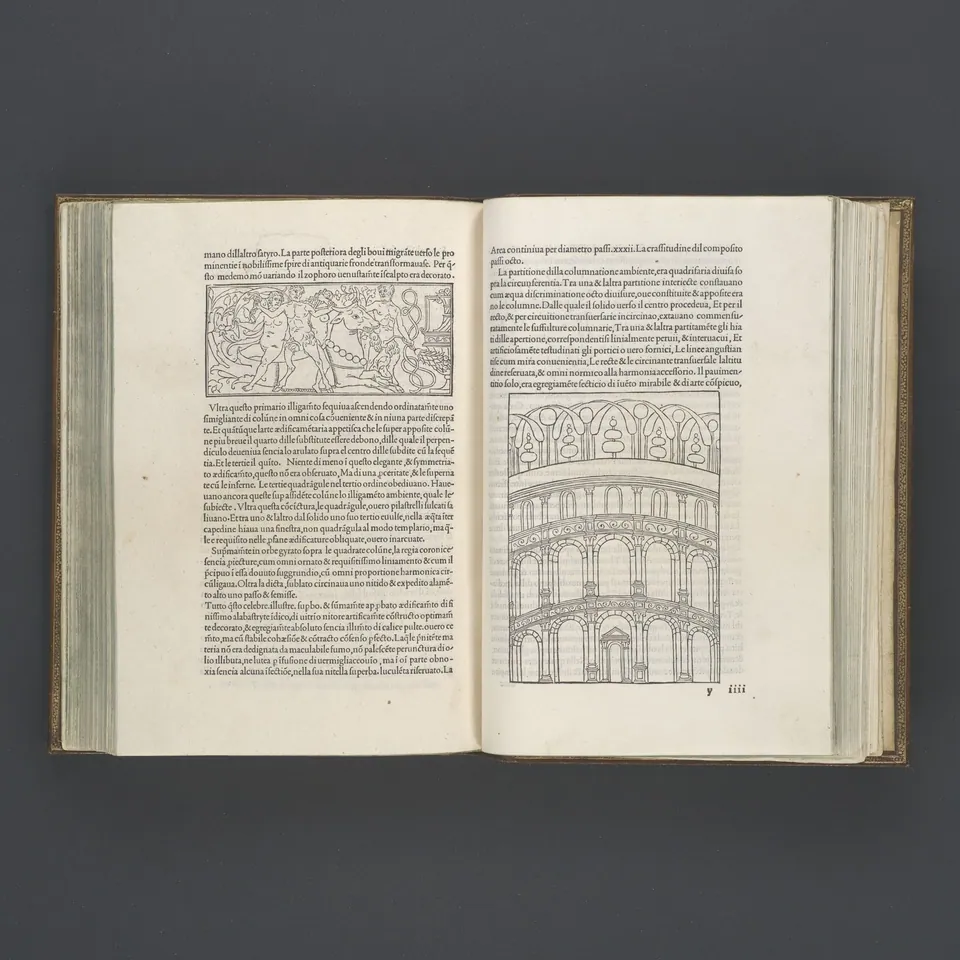
Roman type and woodcuts planned as one page.
Why it matters
Aldus Manutius printed it in Venice with a roman type cut by Francesco Griffo and woodcuts set into the text block, so that letters and pictures were composed together on the page. The University of Glasgow Library calls this integration of text and image unparalleled among fifteenth century books, and Monotype revived Griffo’s roman in the 1920s as Poliphilus and Bembo.
The book tells the dream of Poliphilo and his love for Polia, in an Italian mixed with Latin and Greek words. It was printed at the Aldine Press in December 1499 and paid for by Leonardo Crasso, a jurist of Verona. The initials of its chapters spell POLIAM FRATER FRANCISCVS COLVMNA PERAMAVIT, “Brother Francesco Colonna has dearly loved Polia”, which is why the text is attributed to a Francesco Colonna. Who designed its roughly 170 woodcuts is not known.
What to notice
- The woodcutA satyr and a sleeping nymph under a pedimented frame, cut in plain outline with little shading.
- The Greek captionGreek capitals under the picture, set from type like the rest of the page.
- The narrowing textThe last lines of the left page narrow step by step to a point, ending in three Greek words.
3 min read
The full story
A manuscript for Aldus
Aldus Manutius settled in Venice in 1490 and built his press on scholarly editions of Greek and Latin authors. The first volume of his Aristotle appeared on 1 November 1495. The Hypnerotomachia did not fit that list. It was a new romance in the vernacular, and it was printed on commission. Leonardo Crasso, a jurist of Verona, had obtained the manuscript, and in a prefatory letter to the Duke of Urbino he says that the book was printed at his own expense.
In this story
- A manuscript for Aldus
- Griffo’s roman, recut
- Slow sales, inked satyrs
- From Poliphilus to Bembo

The story continues in the app
- Materials
- Paper, letterpress and woodcut
- Dimensions
- About 30 × 22 cm (Met copy 29.5 × 22 × 4 cm)
- Type
- Roman cut by Francesco Griffo
- Woodcuts
- About 170, designer unknown
- In collection
- The Met, New York (23.73.1) · Morgan Library · Herzog August Bibliothek
Connections
- Francesco Colonna
- Aldus Manutius
- Francesco Griffo
- Aldine Press
- Early modern period
- Book design
- Paper
- Venice
Nearby in the archive
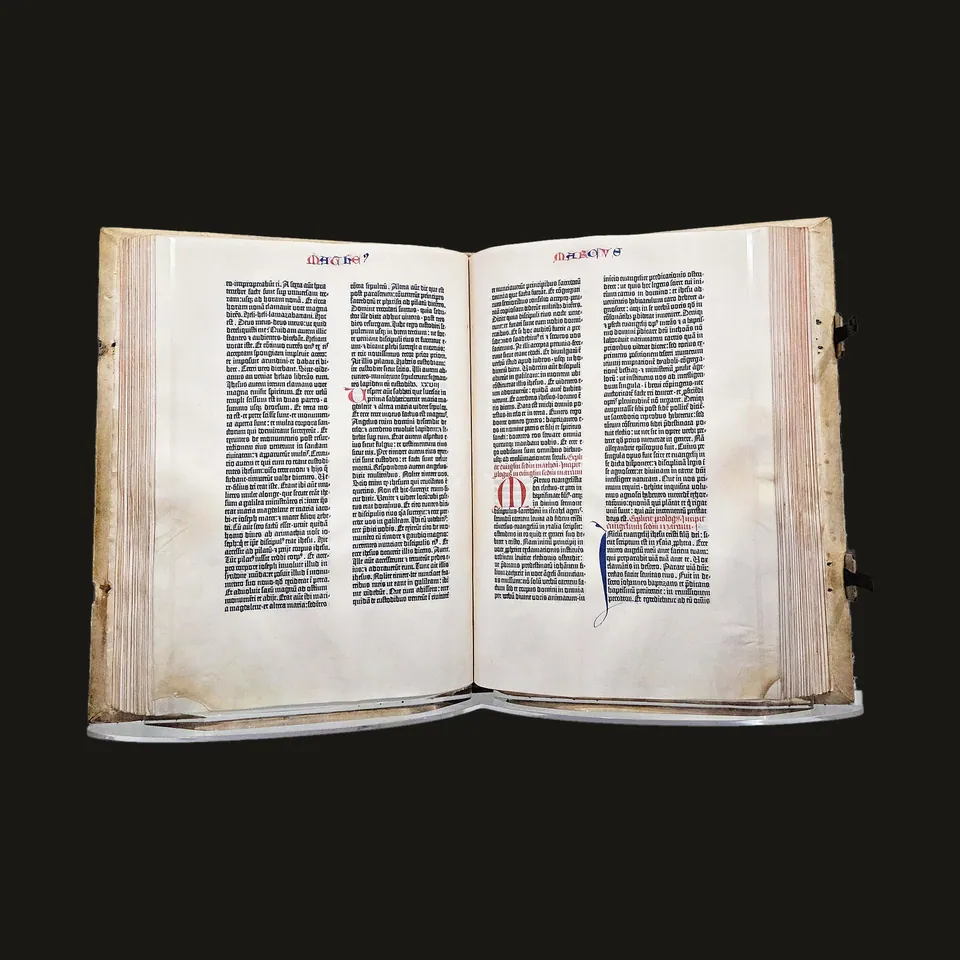 Gutenberg BibleGutenberg · c. 1455 · a Gothic-letter book printed without pictures
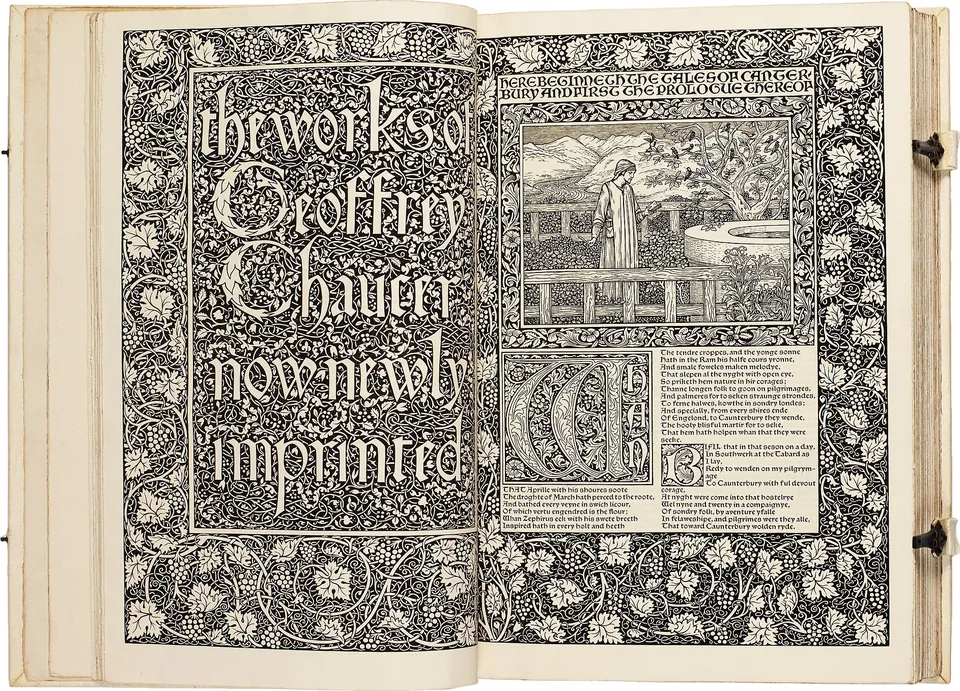 Kelmscott ChaucerMorris · 1896 · type and woodcut again planned as one page
In collections
Go further
- Hypnerotomachia Poliphili: The Strife of Love in a Dream, Francesco Colonna, translated by Joscelyn Godwin (1999)The first complete English translation, set in Poliphilus with the woodcuts placed as in the 1499 pages.
- Hypnerotomachia Poliphili and the Architecture of Dreams, Demetra Vogiatzaki, The Public Domain Review (2022)An architectural historian reads the imagined buildings of the dream, with many of the woodcuts reproduced large.
- Book of the Month, February 2004: Hypnerotomachia Poliphili, Julie Gardham, University of Glasgow Library (2004)A special collections essay on the Hunterian copy, covering the plot, the type, the hand correction and the acrostic.
- Hypnerotomachia Poliphili, 23.73.1, The Metropolitan Museum of ArtThe museum’s catalogue record for the copy given by J. Pierpont Morgan in 1923.
- Hypnerotomachia Poliphili, Boston Public Library copy, Internet ArchiveA complete page-by-page scan of a 1499 copy that can be read online or downloaded.
Sources
- Hypnerotomachia Poliphili, 23.73.1, Gift of J. Pierpont Morgan, 1923, The Metropolitan Museum of Art
- Book of the Month, February 2004: Hypnerotomachia Poliphili, University of Glasgow Library, Special Collections
- Hypnerotomachia Poliphili and the Architecture of Dreams (2022), The Public Domain Review
- Hypnerotomachia Poliphili, Parenthesis, Fine Press Book Association
- Wikipedia (English), Wikimedia Foundation

