Nº 0177 · Inscribed stela
Rosetta Stone
One decree, cut in three scripts, 196 BC.
Why it matters
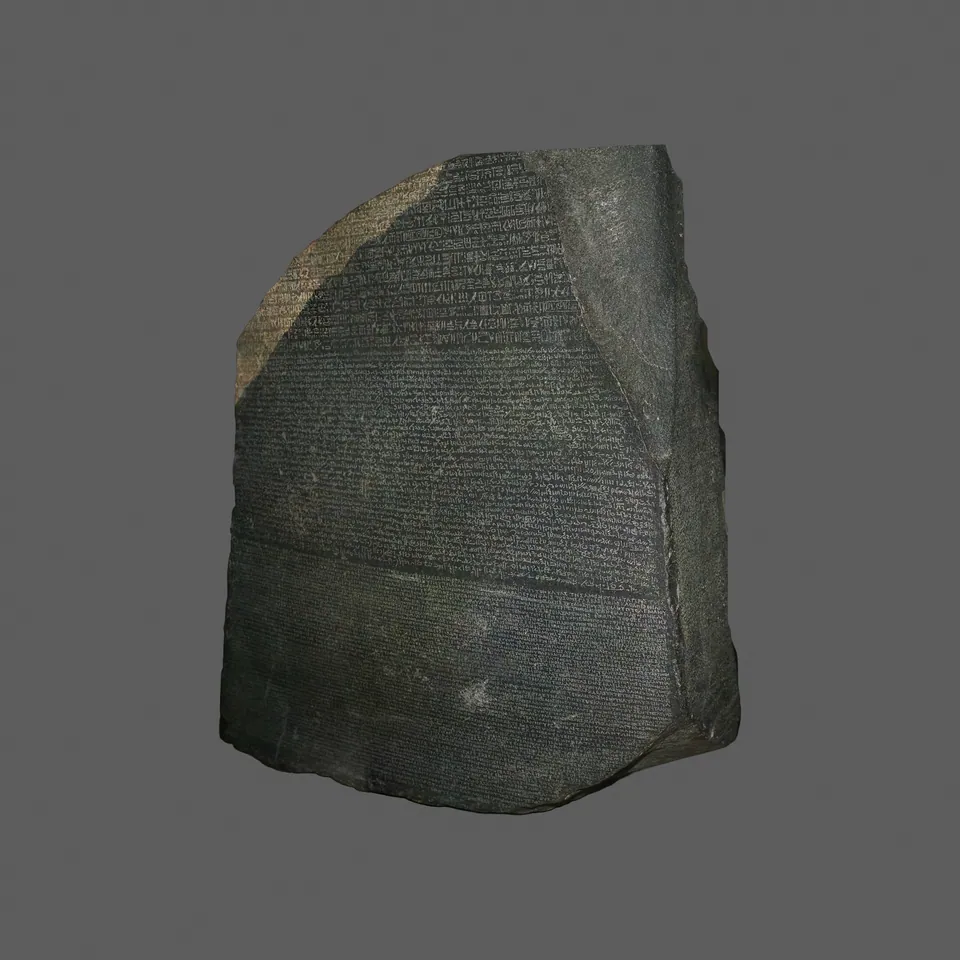
The same decree is written three times, in hieroglyphs, Demotic and Greek, and because the Greek could be read, scholars could compare it with the two Egyptian versions. That comparison led to the decipherment of hieroglyphs, announced by Champollion in his Lettre à M. Dacier of 1822.
It is a broken part of a stela of grey and pink granodiorite, carrying a decree issued by a council of priests at Memphis on 27 March 196 BC, in the reign of Ptolemy V. The text runs in three blocks: 14 damaged lines of hieroglyphs at the top, 32 lines of Demotic and 54 lines of Greek. Pierre-François Bouchard, a French officer, found it at Fort Julien near Rashid (Rosetta) on 15 July 1799, during Napoleon’s campaign in Egypt. It passed to the British after the capitulation of Alexandria in 1801 and has been on show at the British Museum since 1802.
What to notice
- The hieroglyphsThe top band: hieroglyphs, the most damaged of the three texts.
- The Greek textThe bottom band: Greek, the version scholars could already read.
- The broken edgeThe stone breaks off here; the top of the stela is lost.
3 min read
The full story
A boy king’s bargain
Ptolemy V came to the throne of Egypt as a child of five or six. His family was Greek, descended from one of Alexander the Great’s generals, and ruled from Alexandria. Revolts in the Delta and the south delayed his Egyptian coronation for years. When it came, the priests crowned him at Memphis, the old capital, and about a year later they met there again and issued a decree in his honour.
In this story
- A boy king’s bargain
- Three scripts, one slab
- Prints, casts and rivals
- In a case since 2004

The story continues in the app
- Materials
- Grey and pink granodiorite
- Dimensions
- 112.3 cm high, 75.7 cm wide, 28.4 cm thick; about 760 kg
- Text
- Hieroglyphic, Demotic and Greek; 14, 32 and 54 lines
- In collection
- British Museum, London (EA 24)
- Status
- Real · a fragment; the top corners and the lower right corner are lost
Connections
- Antiquity
- Lettering and inscription
- Stone
- Rashid (Rosetta)
- London
Nearby in the archive
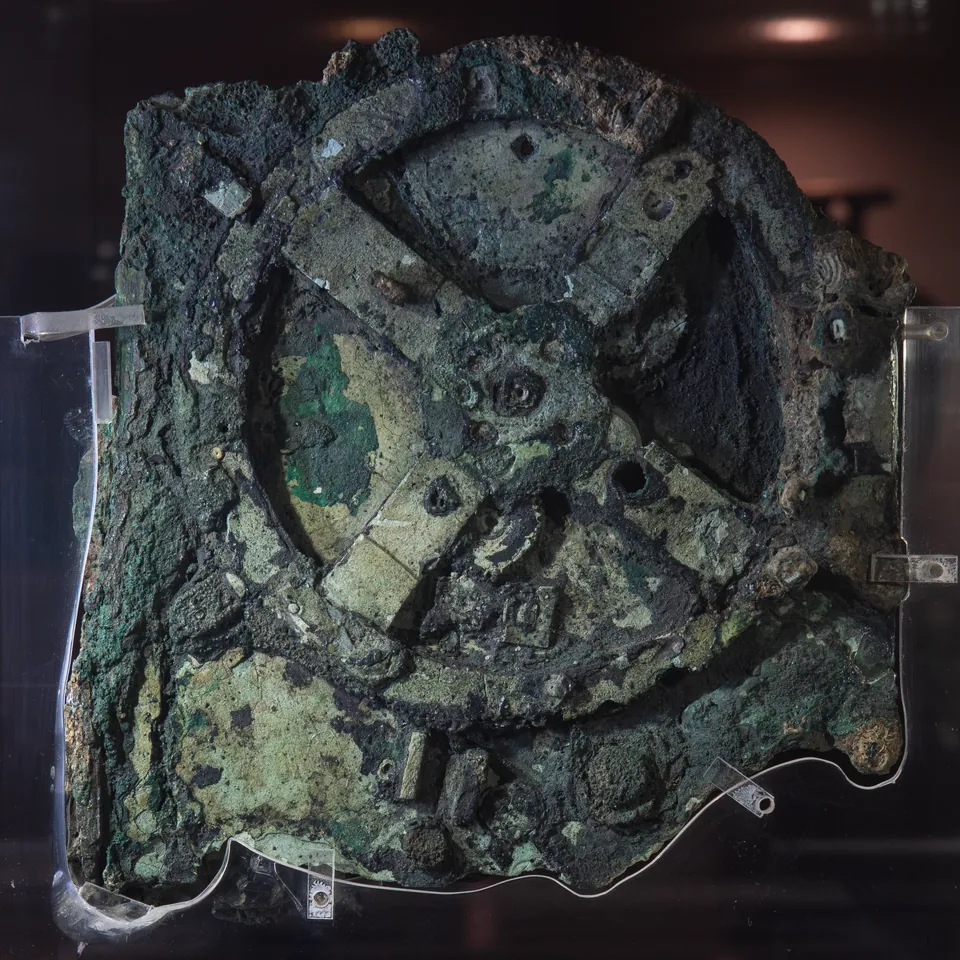 Antikythera mechanismMaker unknown · 2nd or 1st century BC · Greek letters cut small on another Hellenistic object
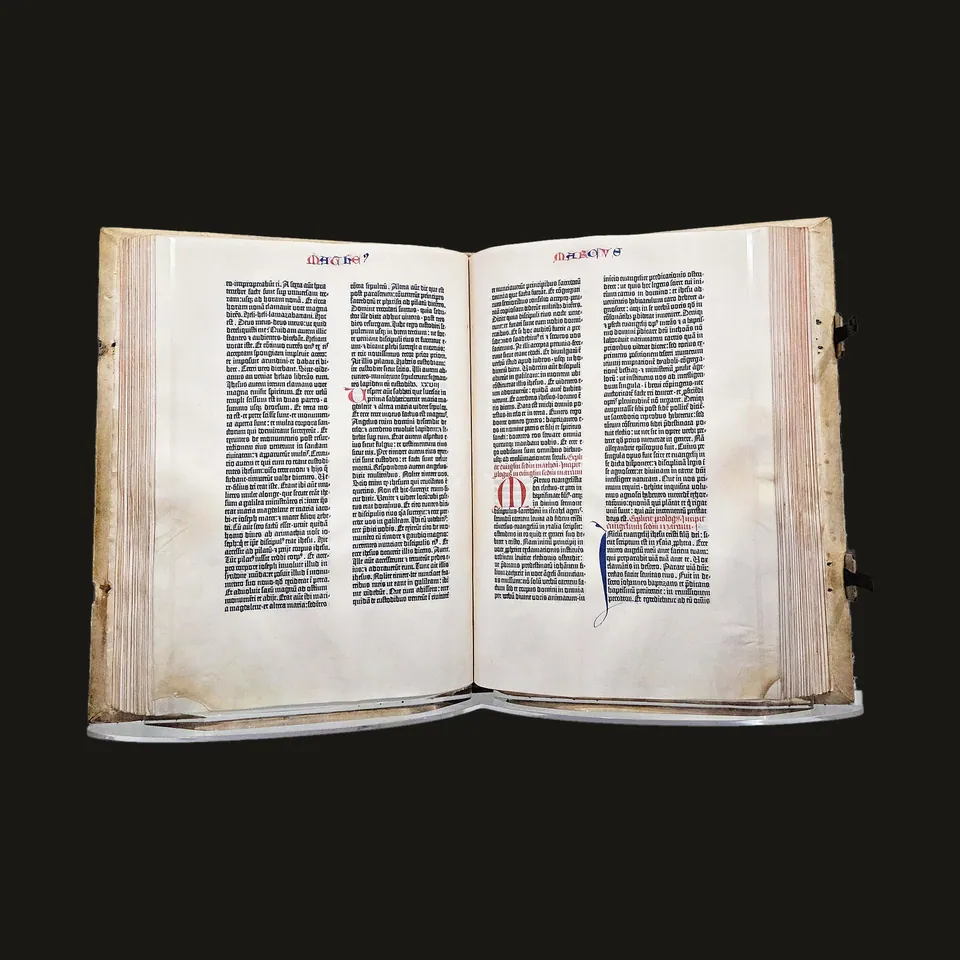 Gutenberg BibleGutenberg · c. 1455 · one text made to exist in many copies
In collections
Go further
- Cracking Codes: The Rosetta Stone and Decipherment, Richard Parkinson (1999)The British Museum’s own study of the stone and of how Egyptian scripts were read, written by one of its curators for the 1999 exhibition.
- The Rosetta Stone and the Rebirth of Ancient Egypt, John Ray (2007)A short account by a Cambridge Egyptologist of the decree, the rivalry between Young and Champollion, and the argument over where the stone belongs.
- The Rosetta Stone, object EA24, British MuseumThe museum’s collection record, with measurements, photographs, curator’s comments and a bibliography.
- A History of the World in 100 Objects, Episode 33: Rosetta Stone, Neil MacGregor, BBC Radio 4 and the British Museum (2010)The transcript of a fifteen-minute radio essay that reads the stone as a political bargain, with Dorothy Thompson and Ahdaf Soueif.
- The Rosetta Stone, 3D model, The British Museum on SketchfabA scan of the stone that can be turned and enlarged to see the cut signs, the broken edges and the rough back.
Sources
- Stela (Rosetta Stone), EA24, British Museum
- Rosetta Stone, WikiJournal of Humanities
- Rosetta Stone, World History Encyclopedia
- Rosetta Stone, Wikipedia

